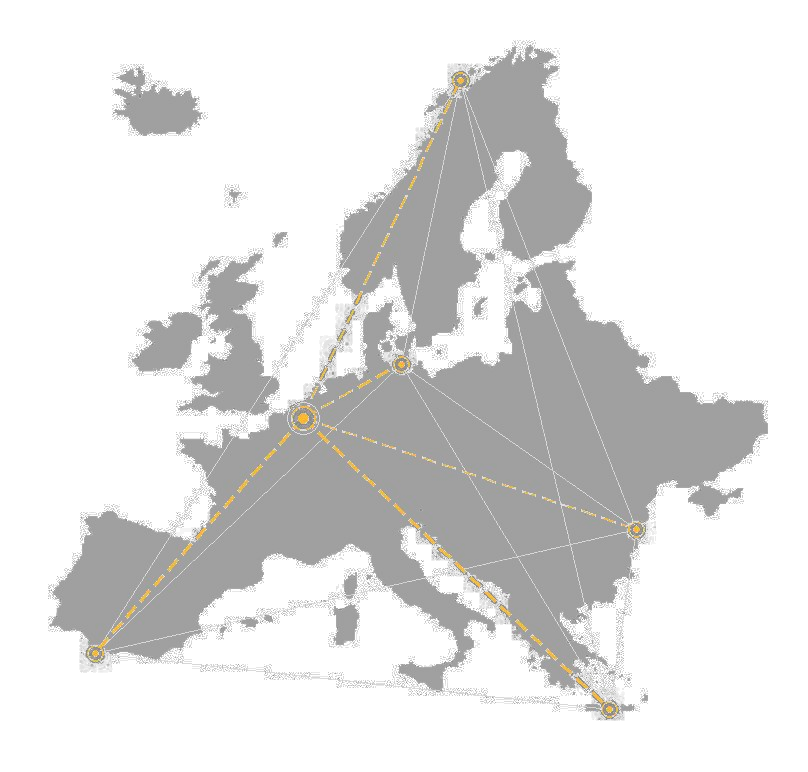
Scenario B: Same ESDA structure as Scenario A; higher GDP percentage per country to reach the same absolute amount. The ambition is therefore unchanged in Scenario B. Core group of 15 countries, combined GDP approximately €22,000bn/year (expected 2030). Figures are indicative orders of magnitude at full force target (Phase 3) and the operating level in the operating phase.
The report is written so that it can both be read in its entirety and used as a reference work. Many readers will not read everything from start to finish, but will focus on specific questions. Below, some typical entry points are outlined:
The report is intended as a first attempt at a coherent architecture. It invites discussion and adjustment — of both ambition level, pace and specific solutions — but aims to make the debate on European defence more concrete, evidence-based and manageable.
Chapter 2 explains why ESDA is necessary and what it fundamentally needs to be capable of. The diagnosis of Europe's current defence architecture is presented first, then ESDA is outlined as the solution: a new treaty-based alliance with its own forces, a clear division of labour with NATO and the EU, and a realistic level of ambition and funding.
Without US support, European states would struggle to move and sustain larger forces over distance, maintain a continuous common operational picture in space, air and cyber, or conduct coherent high-intensity operations over time — including in Europe's own neighbourhood.
The US's permanent stationing of approximately 100,000 troops creates a structurally unsustainable dependency and thereby weakens Europe's independent capacity to act.
That joint European logistics cooperation (EATC, MMF, SALIS) already exists on a smaller scale demonstrates that ESCL is not a conceptual novelty, but a scaling of a model that already works.
Initiatives such as PESCO and the EU's defence agency have created projects and cooperation on individual capabilities, but do not deliver a common standing military force, a supranational command structure with genuine decision-making power, or common binding standardisation across the entire force structure. The EU's institutional frameworks are moreover bound to unanimity and national veto rights, making rapid, risk-accepting defence decisions difficult.
Since 2024, the EU has gained a range of new financial instruments — the SAFE loan facility (€150bn), EDIP, and the broader ReArm Europe/Readiness 2030 framework — that genuinely address part of the underinvestment that was previously the EU's weakest point. This does not, however, change the structural limitation that is ESDA's real point: the EU can finance defence industry and national procurement, but the EU treaties do not allow the Union to establish standing joint forces, a unified operational command structure, or decision-making capacity without unanimity in security and defence matters. In other words, the EU has increasingly solved the financing question — but not the question of forces, command and decision-making power, which can only be established outside the framework of the EU treaties, as ESDA proposes.
European countries operate with many different platforms, parallel logistics systems and standards, short production runs with high unit costs, and limited shared ammunition stockpiles and supply chains. The result is that large defence budgets are not translated into collective, usable capability — and therefore do not produce the deterrence effect they should.
Europe does not have a common standing military force that can be rapidly and independently deployed in and around Europe's coastlines and neighbourhood. National forces are designed for national defence and operate in separate command structures. Even when political will is present, Europe lacks the ability to respond quickly with collective combat power — without waiting for NATO mobilisation or US leadership.
Without a common, standing and capable force, Europe will — even where the will exists — most often hesitate, because individual countries will often be wary of standing alone. A common, solidarity-based force would create the capacity to act that Europe needs.
This means that in the first critical 60–90 days of a major conflict, Europe is effectively dependent on the United States choosing to engage.
ESDA is established through the European Defence Ecosystem Treaty (EDE), which lies outside the EU's existing treaties, and membership is open to all European democracies — including countries outside the EU.
This enables faster progress without requiring EU unanimity for defence decisions, allows full participation of non-EU countries, and provides flexibility to adapt the agreement to defence realities rather than EU institutional logic.
To ensure that the treaty is designed on the basis of shared security effectiveness and resilience — and not as a compromise between national special interests and industrial policy considerations — the report proposes that the EDE be drafted by a small, independent treaty-drafting panel with a clear mandate to that effect.
The main legal and political principles of the EDE Treaty are described in more detail in chapter 3.
ESDA has directly recruited forces and capabilities with its own command structure, while national armies are preserved unchanged. ESDA constitutes a supreme shared capability layer that no national army can or should bear alone.
ESDA's forces are designed to deter attacks on European states and critical infrastructure, defend member states and shared interests in and around Europe, stabilise crises in the neighbourhood, ensure options and operational continuity in the first 60–90 days until national forces and possibly NATO can be fully mobilised, and to support national and NATO-led operations with shared European capabilities.
As a general rule, the ESDA Council makes decisions on the deployment of shared capabilities, cyber operations, budgets within the agreed GDP frameworks and major programmes by a two-thirds majority — no single state has a veto right in daily operational decision-making.
The choice of two-thirds rather than a simple majority or three-quarters is deliberate. A simple majority would allow a slim majority to drag a hesitant minority group into operations against their will — that is politically unsustainable in an alliance built on voluntary participation. A three-quarters requirement would give too much blocking power to a small group of countries and risk recreating the EU's unanimity problem in another guise. Two-thirds is the threshold at which ESDA can act — and not be paralysed.
This combines rapid collective agency with respect for national constitutions and political realities (see chapters 3.4–3.5 for a more detailed description).
Situational awareness is created through EIA's space, ISR and cyber capabilities with its own satellite layer, AEW&C, HALE drones, Cyber Command and AI Fusion Hub. Mobility and resilience are created through ESCL's strategic air and sealift, aerial refuelling, strategic supply stockpiles and logistics integration. Rapid visible military effect is delivered by ERF as an independent, mobile and maritime/littoral response force capable of acting independently in the first 60–90 days of a major conflict. Industrial resilience and wartime economic capacity are ensured through EDPA's standardisation, joint procurement, supply chain management and planned wartime economic scale-up — including designation and possible co-funding of selected cold standby capabilities. The maritime and littoral focus was chosen precisely because that is where Europe's strategic dependence is greatest and national capabilities thinnest — and because it complements rather than duplicates what national armies and NATO already deliver. For the same reason, ESDA does not build a joint combat air fleet: Europe already has national F-35, Eurofighter, Rafale and Gripen fleets — the missing link is the specialist capability that binds them together as one coordinated European air force. EIA's common air picture, ESCL's aerial refuelling and EDPA's standards deliver precisely this specialist capability, thereby making Europe's existing combat aircraft far more effective without ESDA needing to acquire a single combat aircraft itself.
Modern high-intensity warfare is increasingly characterised by drones, sensors, precision artillery, long-range missiles and electronic warfare — and to a lesser degree by classic, large armoured battles. ESDA is designed with this in mind: a light-to-medium-weight maritime and littoral force with strong sensors, stand-off capabilities, layered air defence and robust supply stockpiles. In larger conflicts, the concept assumes that air superiority and heavy combat air support are delivered by member states' own air forces, coordinated through ESDA's joint intelligence and command structure.
A core of 70–80,000 active military troops in the first 5–7 years — of which approximately 500 special operators — gradually expanded to approximately 100,000 military troops at full force target, supplemented by a supranational reserve. ERF must be capable of conducting independent operations in and around Europe's coastlines, including protection of critical infrastructure, mine countermeasures and deployment of ground forces from the sea. The land component is light to medium-weight and strongly drone- and sensor-supported, with coastal missiles, artillery, engineering capabilities and layered air defence — suited to rapidly stiffening exposed flanks, protecting key nodes and securing supply lines.
Own LEO constellation (Argus), AEW&C aircraft and HALE drones, Cyber Command and AI Fusion Hub — developed in cooperation with ESA. EIA should provide the ability to identify, track and analyse hostile forces, including air defences, logistics and command structures, in real time and independent of US infrastructure.
Approximately 200 transport aircraft, 40 MRTT and 10–12 Ro-Ro vessels for heavy transport, combined with joint strategic supply stockpiles of ammunition, fuel and spare parts at the five strategic hubs. ESCL should give Europe the ability to move and sustain forces rapidly across the continent and into operational areas — and ensure that national forces can be integrated into ESDA's network without delay.
ESDA Defence Standard Catalog, joint procurement and certification, strategic raw material and component reserves as well as industrial readiness: ongoing planning for how European defence production — particularly ammunition, missiles and critical components — can be significantly scaled up on short notice in a large-scale conflict, including through designation and limited co-funding of selected cold standby capabilities.
A cross-cutting objective is to build a credible European air and missile defence layer (area air & missile defence). This layer is primarily anchored in ERF's layered air defence around the MSRs and hubs, but is closely dependent on EIA's sensors, ESCL's hubs and EDPA's standards and procurements. It should protect ERF's assembly areas and operational zones as well as host nations' critical hubs and bases at a level comparable to the best allied systems — without duplicating them one to one. EIA's ISR layer and ESDA's stand-off capabilities (AMP, Strategic Strike Wing and national combat aircraft) should together support classic SEAD/DEAD functions, enabling hostile air defences to be located and suppressed where it is a prerequisite for effective operations.
A genuine defence against medium- and long-range ballistic missiles requires a broader, continentally anchored architecture extending beyond ESDA's maritime and littoral hubs — typically based on sensor and radar chains in Northern, Central and South-Eastern Europe, heavy interceptor units integrated in national systems and NATO's overall missile defence, as well as close coupling with EIA's space and airborne sensors. The five ERF hubs are users of such a broader system, not its primary anchoring points. In the longer term, ESDA can contribute to developing this layer in close cooperation with NATO and national governments. However, this report focuses on the theatre- and hub-proximate layer that ESDA can and should realistically deliver within the described framework.
Chapter 3 describes the legal and political foundation for ESDA through the EDE Treaty. Here the fundamental principles are established (never against member states, the two-thirds model, 5% funding), the relationship with the EU and NATO, the ESDA Council's decision-making rules, national framework laws and the Tier A/B/C model for military operations.
The European Defence Ecosystem Treaty (EDE) is the legal foundation for ESDA. The treaty must ensure that ESDA becomes an effective, supranational defence body — not merely another forum where national special interests block common solutions, and not a competitor to either the EU or NATO.
ESDA's purpose is clearly defined: protection, deterrence and building shared capabilities that deliver more effect and less waste for the resources member states invest. ESDA must act on the basis of this common purpose — not on the basis of individual countries' short-term national agendas. EDE establishes ESDA as a supranational body where the shared forces and capabilities belong to the alliance as a whole and decisions are made in common bodies according to common rules.
The ESDA Council is the supreme political body and as a general rule takes decisions by a two-thirds majority on the deployment and use of shared capabilities, budgets within the established GDP frameworks, major capability programmes and priorities, and the admission of new members.
The EDE Treaty operates with only one form of membership: full ESDA membership with commitment to all four pillars and the Tier A/B/C model. To avoid diluting the alliance's military and political cohesion, no "light" or observer memberships are established within ESDA.
At the same time, however, the treaty opens for selected European non-member states to enter into EDPA partnerships. An EDPA partnership provides the opportunity to participate in selected parts of Pillar 4 (EDPA), including:
EDPA partners are not members of ESDA, are not part of the force structure, are not covered by the Tier A/B/C model and have no treaty-based obligations to participate in military operations under ESDA command. All military contributions from such states — including any use of shared capabilities — are based on separate, ad hoc agreements outside the EDE Treaty.
In this way, ESDA can maintain a clear and unambiguous membership structure, while European neighbours and neutral states can be linked to the capability and industrial part of the ecosystem where it strengthens Europe's overall defence capability.
ESDA's obligations apply exclusively between member states. Countries outside the EDE Treaty have no rights to military assistance from ESDA and can only benefit indirectly from the general stabilising effect of a stronger European defence.
EDE is an independent treaty outside EU institutional frameworks, open to all European democracies that meet common political, legal and military criteria. Its location outside the EU provides flexibility and momentum: no requirement for EU unanimity, full participation for non-EU countries such as Norway and the UK, and the ability to tailor the agreement's content to defence realities rather than institutional logic. The treaty defines the alliance's purpose, tasks and institutions, decision-making rules, legal status of forces and personnel, and the funding mechanism as a percentage of GDP.
Europe has two models to learn from — both are unworkable for ESDA. The US President can order military operations within hours with minimal congressional approval. This provides agency, but concentrates power in one person and is politically and constitutionally inconceivable in a European alliance of equal states. The EU Council requires unanimity in security and defence matters. This protects sovereignty, but allows a single country to paralyse the entire continent's defence — not for days, but for months, while the threat grows. ESDA chooses a third way: two-thirds majority as the operational default rule. This means that at least two-thirds of member states must stand behind a decision — a substantial majority ensuring legitimacy — but no single state can block. A country that consistently votes against the majority loses influence, but not its membership. A country wishing to block cannot.
The ESDA Council consists of the defence ministers of the member states, with the possibility of involving foreign ministers in special situations. Each country has one vote — regardless of size, population or GDP. This is a deliberate choice: ESDA is an alliance between equal states, not a body dominated by the largest contributors.
In this way, the need for decision-making power without veto rights in daily operations is balanced with strong protections around the most far-reaching decisions (exclusion and treaty amendments).
Each member state adopts a national ESDA framework law upon ratification of the EDE, which:
Encompasses capabilities necessary for ESDA to see, move and protect at all — typically without direct use of lethal force. Tier A includes intelligence, surveillance and reconnaissance via satellites, AEW&C aircraft, HALE drones, maritime patrol aircraft and sensor chains, aerial refuelling and strategic transport via transport aircraft, MRTT and Ro-Ro vessels, logistics and strategic supply stockpiles, and cyber defence of ESDA's networks and critical infrastructure.
Tier A capabilities are pre-authorised through the national framework laws and the EDE Treaty. In normal operations, the use of these capabilities requires neither a separate decision by the ESDA Council nor national parliamentary approval on a case-by-case basis. Only when there are material changes in the scope or nature of operations — approaching Tier B — is the matter referred to the ESDA Council.
Tier A can be activated by the ESDA Council's two-thirds decision once a country has ratified the EDE and adopted its national framework law. Tier A does not require additional national parliamentary approval on a case-by-case basis.
Encompasses operations in which force may be used, but with a clearly defined purpose, duration and controlled (low to moderate) risk of escalation and casualties, for example:
Tier B operations are adopted by a two-thirds majority in the ESDA Council. The starting point is that Tier B operations are pre-authorised via national framework laws, as long as they remain within established criteria for purpose, duration, scope and risk profile. Member states may in their framework laws introduce a sub-category (e.g. B1/B2) where certain high-risk Tier B missions require separate parliamentary notification or approval.
Tier C encompasses long high-intensity combat operations with significant risk of casualties and escalation, and clear potential for counter-strikes against member states' territory. Offensive cyber operations reach Tier C level when they strike targets of strategic significance for a state's national functioning — including critical civilian infrastructure, national command and control systems or intelligence infrastructure — with an escalation profile comparable to kinetic combat operations.
Tier C operations are adopted in the ESDA Council by a two-thirds majority (overall mandate: purpose, geography, duration, risk frameworks). Each member state must follow its own constitutional procedures to confirm whether the country will participate militarily, and a country that does not approve participation does not as a starting point make its national forces or nationals available for the combat element of the operation in question.
Tier C operations are planned on the basis of an expected group of countries that have politically and militarily indicated their willingness to participate. A Tier C decision is only considered activated when an agreed minimum force package — i.e. the forces and capabilities minimally required for the operation to be militarily meaningful — has been confirmed through national decisions in the participating countries.
In accordance with the treaty's fundamental principles, it is a shared long-term goal that ESDA's agency on Tier C is strengthened over time. After 10 years, a joint evaluation is conducted in which each member state accounts for how its national rules on Tier C commitments relate to the treaty's goal of faster and more collective action.
Table 3.2 — Operation levels (Tier A–C): content, examples and national mandate role
| Tier |
What does it cover? |
Examples |
Decision / national role |
| A |
Core capabilities and support |
ISR, aerial refuelling, transport, logistics, cyber defence |
ESDA Council 2/3 + framework laws. Pre-authorised; no individual case-by-case approval. |
| B |
Limited, clearly defined combat operations |
Infrastructure protection, counter-piracy, limited precision strikes, coastal/naval missions |
ESDA Council 2/3. Normally pre-authorised; some high-risk missions may require additional national process. |
| C |
Large-scale combat operations ("war participation") |
Prolonged, high-intensity operations with escalation/casualty risk |
ESDA Council 2/3 (overall mandate) + separate national participation decision in each country (if required). |
3.5 The drafting of the EDE Treaty
The EDE Treaty is drafted by a small, independent treaty-drafting panel of 3–5 people, appointed by the founding group with a clearly defined and bound mandate. The panel produces the initial treaty draft, which is then negotiated and adopted by the participating states' governments in accordance with normal treaty practice. The model has historical parallels: the Spinelli Draft for a European Union treaty, prepared by a defined group within the European Parliament in 1984, and the convention model later used in drafting the proposed EU Constitutional Treaty. The purpose of this approach is twofold: to ensure that the initial draft is not shaped by the special interests of any single government or institution, while at the same time maintaining a clear democratic legitimation process in which it is the elected governments and parliaments that negotiate and ratify the final treaty. It is worth stressing that no draft is binding in itself — it is the states that, through negotiation and ratification, determine the treaty's final content.
3.6 The relationship with Türkiye
Türkiye is not part of ESDA's membership because ESDA is a European alliance. As with Canada — likewise a close NATO ally located outside Europe — ESDA membership is reserved for European states. Türkiye is, however, NATO's second-largest army, gatekeeper of the Bosphorus and Dardanelles straits under the Montreux Convention, and a significant defence-industrial actor, particularly in unmanned systems. ESDA therefore does not presuppose Turkish membership, but envisages an active partnership: Türkiye can be offered participation in EDPA on the same basis as other non-member states, and continued NATO cooperation ensures operational coordination independent of the ESDA framework. The same logic applies to other close partners outside Europe — cooperation takes place through EDPA and NATO, not through membership.
Chapter 4 translates the treaty into practical governance: how ESDA is actually led and commanded in peace, crisis and war. This covers the ESDA Council's role, the Triumvirate as daily leadership, The Citadel as joint headquarters, and the fundamental chains of command, oversight and audit mechanisms.
ESDA's governance structure
Supreme political body
ESDA Council
Defence ministers from all member states · two-thirds majority as the main rule
Daily operational leadership — the Triumvirate
Civil Director
Political-strategic leadership
CHOD
Military supreme command
High Representative
External representation
Military professional leadership council
Board of Department Chiefs
ERF Chief
EIA Chief
ESCL Chief
EDPA Chief
ESOF Chief
Joint headquarters · Brussels
The Citadel
OHQ · FHQ · JOC · JPD · AI Fusion Hub · JLSC · approx. 7,000 military and civilian personnel
4.1 The ESDA Council — practical role and interaction
The ESDA Council is described legally and in treaty terms in chapters 3.2–3.3 (mandate, the two-thirds rule, three-quarters requirement for exclusion, unanimity for treaty amendments and major budget increases). Here the focus is on the Council's practical role in the governance and command structure.
Composition and meeting format
- The Council is ESDA's governing board and consists of the defence ministers of all member states (in special situations with the participation of foreign ministers). Each member state has one vote in the ESDA Council; votes are not weighted by size, population or GDP.
- The Council meets regularly several times a year for planned meetings, as well as on an emergency basis — in person or virtually — during major crises.
The Council's practical function
The Council sets the overall strategic direction for ESDA — priorities between pillars, long-term capability targets and implementation pace — and takes specific deployment decisions: which Tier an operation falls under, which capabilities are activated, and the overall mandate for purpose, geography, duration and risk frameworks.
Interaction with the Triumvirate and The Citadel
The Triumvirate prepares decision briefs for the ESDA Council in the form of scenarios, risk assessments and options, and implements the Council's decisions through The Citadel and the five hubs. The Citadel translates the Council's decisions into concrete plans and orders through the Joint Operations Center and Joint Logistics Support Command, and reports continuously back to the Triumvirate, which briefs the ESDA Council according to established practice — particularly during longer-running operations.
Relationship with oversight bodies
The ESDA Council receives annual reports from the independent audit and oversight authority as well as opinions and recommendations from the parliamentary oversight body. On this basis, the Council can adjust practice for procurement, industrial readiness and use of shared capabilities, and initiate internal investigations and rule changes if problems are identified.
4.2 The Triumvirate
ESDA's supreme daily leadership consists of a Triumvirate:
-
Civil Director
The Civil Director is responsible for strategy development and long-term planning, budget and financial management, and membership relations and expansion strategy.
The Civil Director handles the overarching civil and political dimension of ESDA's daily operations and maintains close contact with national governments, the EU and NATO at the political-strategic level.
-
Chief of Defence (CHOD)
Four-star officer with overall military responsibility for the planning and conduct of all ESDA operations and command of the four pillars.
-
High Representative
The High Representative is responsible for the foreign, security and communications dimension, and coordination with national foreign ministries, the EU, NATO and other international actors, ensuring that ESDA's military actions are anchored in a clear political and communications strategy.
Internal relationship
The Triumvirate functions as ESDA's daily strategic and operational leadership body: it prepares decisions for the ESDA Council, implements the Council's decisions and manages crises within the politically established frameworks. Appointments follow the principles established in chapter 3.1.
4.3 Board of the Department Chiefs (military professional leadership council)
Under the Chief of Defence, a combined military professional leadership council (Board of the Department Chiefs) is established, led by the CHOD and consisting of five department chiefs — one for each of the four pillars and one for the European Special Operations Force (ESOF).
Role and responsibilities
Each department chief is a senior officer (typically three- or four-star) with overall responsibility for planning, building up and daily military leadership within their area. ESOF is organisationally part of ERF (Pillar 1), but its chief sits independently in the Board of Department Chiefs. This reflects that special operations forces in any alliance require direct access to the supreme military leadership — not because ESOF is a fifth pillar, but because its tasks are often time-critical, politically sensitive and cross-cutting across the pillars.
- ERF (pillar 1) — Maritime & Littoral Component (maritime/littoral response force)
- EIA (pillar 2) — European Intelligence Agency (space, ISR, cyber and AI fusion)
- ESCL (pillar 3) — European Strategic Command & Logistics (strategic transport and logistics)
- EDPA (pillar 4) — European Defence Procurement Authority (military requirements and prioritisation, standards and joint procurement)
- ESOF — European Special Operations Force (special operations force organically anchored in ERF, but with independent representation in the Board due to the force type's special character and operational autonomy)
The Board of the Department Chiefs functions as the CHOD's primary military professional advisory council and is responsible for translating the ESDA Council's and Triumvirate's decisions into concrete plans and force targets across the pillars.
Relationship with the Triumvirate
The Chief of Defence leads and coordinates the Board of the Department Chiefs and represents it in the Triumvirate. Department Chiefs participate as needed in Triumvirate meetings when topics directly concern their pillars or ESOF, but are not themselves part of the Triumvirate.
4.4 The Citadel — Headquarters and command centre
Location and function
The Citadel is initially located in Brussels (Phase 0–1) and established permanently from Phase 3 at a location determined during the treaty negotiations. The Citadel contains the strategic and operational headquarters — in NATO terminology both OHQ and FHQ — consolidated in one location with a 24/7 Joint Operations Center, AI fusion and data centre, and logistics and resource coordination centre.
Structure
As a combined OHQ/FHQ, The Citadel houses the core functions normally found in an operational headquarters and a force headquarters: planning, command, logistics, medical coordination and cyber/EW, consolidated in the following elements:
Joint Operations Center (JOC)
The JOC monitors the global and regional situation in real time and receives and fuses data from EIA's satellites, AEW&C aircraft, drones and cyber, national sources as agreed, and open sources and commercial services. The JOC directs the operational deployment of ESDA forces including ERF and ESCL capabilities.
Joint Planning Directorate (JPD)
The JPD develops operations plans and contingency plans, links ESDA's planning to NATO and the EU where agreed in accordance with the EDE Treaty's principles of complementarity, and ensures coherence between the four pillars.
Joint Logistics Support Command (JLSC)
The JLSC plans and manages logistics flows of fuel, ammunition, spare parts and transport by air, sea and land. The JLSC coordinates the use of the five strategic hubs, the Ro-Ro fleet and the airlift and tanker fleets, and integrates ESDA's logistics capabilities with national logistics systems where relevant.
Joint Medical Coordination Cell (JMCC)
Plans and leads medical chains across pillars and hubs, and supports physical security, access control and protection of key personnel and facilities in cooperation with the host nation.
Military Police & Security Office
Handles military police functions in The Citadel: disciplinary cases, investigations and detention.
Cyber/EW & AI Fusion Center
Cyber Command and EW functions are consolidated in one centre with AI-driven analyses under human control and approval. The centre supports the Triumvirate and JOC with ongoing risk assessments and recommendations.
Personnel
The Citadel is manned with approximately 5,000 staff shared across all of ESDA: 2,000 military staff officers, planners, operations officers, and logistics, cyber and intelligence personnel, and 3,000 civilian analysts, engineers, lawyers, economists, and IT and cyber personnel.
4.5 Chain of command in crisis and conflict
Incremental chain of command
Chain of command in crisis and conflict
Step 1
Warning and assessment
EIA identifies the crisis · JOC and Triumvirate assess threat level and options
Step 2
Political decision
Triumvirate presents · ESDA Council decides Tier, capabilities and overall mandate by two-thirds majority
Step 3
Military order
CHOD translates into operational orders · The Citadel dispatches to hubs and component commands
Step 4
Execution
JOC monitors and reports · escalation referred to Council · adjustments within mandate handled by the Triumvirate
-
Warning and assessment
EIA identifies a crisis via ISR, cyber indicators or allied reports. JOC and the Triumvirate assess the situation including threat level, possible options, and consequences and risks.
-
Political decision
The Triumvirate presents recommendations to the ESDA Council, which takes a decision under the two-thirds model on which pillars are activated, which Tier is relevant, and the overall mandate for purpose, geography, duration and risk frameworks.
-
Military order
The Chief of Defence translates the Council's decision into concrete operational orders and resource allocation from the pillars. Orders are dispatched via The Citadel to the five strategic hubs and relevant component commands.
-
Execution and ongoing adjustment
JOC monitors the course of events and reports continuously to the Triumvirate. When the situation changes, the Triumvirate can adjust operational matters within the politically given mandate, while major changes such as escalation or de-escalation are referred to the ESDA Council for a new decision.
4.6 Democratic control, oversight and audit
To ensure democratic legitimacy and responsible management of ESDA's resources and capabilities, the governance structure is built up with three complementary layers of control:
- National parliaments (via framework laws and ongoing briefings)
- A joint parliamentary oversight body
- An independent audit and oversight authority
National parliaments
National parliaments approve the EDE Treaty and the national ESDA framework laws that establish which types of operations are pre-authorised, when national parliamentary approval is required, and the funding framework for national contributions.
Parliaments receive ongoing briefings from governments on ESDA's activities, major operations and budgets, as well as the results of the joint parliamentary oversight and independent audit.
Parliamentary oversight body
- Composed of members from the national parliaments of ESDA's member states (appointed according to national procedures).
- The oversight body receives regular briefings from the Triumvirate and The Citadel on plans, operations and major programmes, is presented with annual reports on economics, effectiveness, risk management and industrial readiness, and issues non-binding but politically significant opinions and recommendations to the ESDA Council.
- Works in a classified setting where necessary, but with a fundamental commitment to strengthening transparency towards national parliaments.
Composition
- The oversight body itself consists primarily of parliamentarians from member states.
- In addition, a permanent secretariat of approximately 20–30 full-time lawyers, economists, analysts and administrative staff is required to prepare meetings and hearings, process and structure reports from ESDA and the audit authority, and support the preparation of the oversight body's own reports and recommendations.
Independent audit and oversight authority
- Is a permanent, professional body under ESDA with a clearly separate mandate from the operational and procuring units.
- The authority audits ESDA's overall finances including major procurement programmes and framework agreements, particularly under EDPA, reviews the use of funds for industrial readiness and cold standby agreements to ensure they follow established criteria and do not develop into hidden industrial subsidies, and investigates major discrepancies and suspicions of corruption, conflicts of interest or breaches of ESDA's internal rules.
- The authority reports annually to the ESDA Council with recommendations for changes in practice and policy, and to the parliamentary oversight body with particular focus on transparency and responsible use of funds.
Composition
- The authority is staffed with approximately 80–120 full-time specialists including auditors and financial analysts, procurement and contract lawyers, experts in defence logistics and procurement, and data analysts and IT and cyber auditors.
- The scale is deliberately modest relative to ESDA's overall size but sufficient to conduct annual audits of major programmes, maintain ongoing oversight of EDPA's standardisation and industrial readiness functions, and handle cases of discrepancies, suspicions and special investigations.
If the independent audit and oversight authority identifies serious breaches of ESDA's own rules (for example, systematic irregularities in major procurements or misuse of industrial readiness agreements), the ESDA Council is obliged within six months to present an action plan to address the problems and to consider temporarily suspending new contract awards in the relevant area until corrective measures have been implemented.
Together, these three layers of control should ensure that ESDA can act quickly and effectively in crises — without losing the democratic anchoring and economic accountability that are the prerequisite for sustained political support in member states.
ESDA is more than structures and materiel — the alliance also requires a shared professional culture and attractive conditions for personnel. Chapter 5 describes how ESDA builds this human dimension through ESDA Defence Academy, multinational composition of units (the 20% rule), European Merit Status, and common frameworks for jurisdiction, family and veteran support.
5.1 ESDA Defence Academy and educational philosophy
ESDA Defence Academy has three purposes:
- to create a shared professional culture,
- to ensure common doctrine and understanding of international law, ROE, data ethics and technology,
- and to train leaders and specialists for all four pillars.
ESDA Defence Academy is not a replacement for national officer schools, but an advanced layer and shared melting pot. Here, personnel from all member states gain a common framework understanding of ESDA, the Tier model and governance, shared tools for operational planning and common operational thinking, and personal networks across countries and service branches.
5.1.1 Joint advanced officer programme (12 months)
An approximately 12-month advanced programme for officers who have already completed national officer education covers the following topics: ESDA's strategic framework (the EDE Treaty, the ESDA Council, the Tier model), operational planning and joint doctrine, international law and ethics (ROE, jurisdiction, cyber/AI), technology and domain understanding (space, ISR, cyber, mobility, industrial readiness), and multinational leadership and cultural understanding.
5.1.2 Other training tracks
Beyond the advanced officer programme, NCO and specialist courses are established within cyber, logistics, ISR, MCM, boarding, CBRN, base protection and air defence; staff and senior command courses for officers heading to positions at The Citadel, at the five hubs and in central staffs; and a civilian track targeted at lawyers, economists, engineers, procurement specialists and data and supply chain experts for EIA, ESCL, EDPA and The Citadel.
The Academy is organised with one main campus and satellite centres at selected hubs and major military training facilities.
5.2 Recruitment and the 20% rule
5.2.1 Recruitment
ESDA recruits personnel through three channels: direct recruitment in member states, lateral entry from national forces, and civilian recruitment — particularly for cyber, AI, logistics, procurement, law, engineering and economics.
5.2.2 The 20% rule — multinational composition
To prevent ESDA units from in practice becoming national contingents, a strict 20% rule is introduced: no operational ESDA unit at company level or above — and no centrally located staff — may consist of more than 20% personnel from the same member state. In practice, this means that an ERF company, an ESCL logistics unit or a staff in The Citadel will typically include personnel from at least five different countries.
The purpose is threefold: to create genuine shared identity and cohesion, to reduce the risk of national political agendas in tactical and operational units, and to make it natural to think in terms of an ESDA "we" rather than national categories. The rule is implemented incrementally — first in staffs and key units, then in all operational units as recruitment and training make it possible.
The 20% rule — multinational composition of an ESDA unit
100 personnel · schematic example
Max. 20% from the same member state
Country A — 20 personnel (20%)
Country B — 20 personnel (20%)
Country C — 20 personnel (20%)
Country D — 20 personnel (20%)
Country E — 20 personnel (20%)
No single nationality may constitute more than 20% of the personnel in operational units at company level or above — or in central staffs. A typical company will include personnel from at least five countries.
5.3 European Merit Status and career paths
European Merit Status is a special status awarded to personnel who have rendered sustained and qualified service in ESDA.
5.3.1 Criteria
The status is indicatively awarded on the basis of approximately 10 years of total service in ESDA structures, documented strong performance evaluations and completion of centrally defined key training programmes.
5.3.2 Rights and benefits
Personnel with European Merit Status gain a joint ESDA pension scheme that supplements national schemes, as well as access to continuing education and support for career transitions to the civilian sector through transition programmes. In addition, priority is given for positions in ESDA institutions and multinational staffs, as well as easier access to jobs in national defence ministries, EU institutions and international organisations.
European Merit Status should be a visible quality mark that makes service in ESDA a natural career choice for talented military and civilian profiles.
5.4 Jurisdiction, family and veteran support
5.4.1 Jurisdiction and discipline
Jurisdiction over ESDA personnel is described fundamentally in chapter 3. Here the personnel-related aspects are specified.
ESDA introduces a common military criminal code for service matters within ESDA. This is supplemented by home countries' residual jurisdiction over particularly grave crimes. Member states may in their national ESDA framework law define additional particularly sensitive offence categories (e.g. sexual offences) where the home country retains primary jurisdiction, subject to close coordination with ESDA's military legal authority.
All serving personnel are clearly informed of their rights and duties and have access to legal assistance and complaint mechanisms within the ESDA system.
This creates predictability and legal certainty for personnel serving under a common flag, often far from their home country's systems, while member states retain residual jurisdiction in the most sensitive areas.
5.4.2 Families and mobility
ESDA personnel will often serve in multinational units and have multiple postings at hubs, The Citadel, the Academy or in missions. Therefore, Family Support Offices are established at all five hubs and at The Citadel, helping with housing, schooling, language and integration for families, and coordinating with national authorities on social benefits, health and education. This is supplemented by common minimum standards for access to healthcare, recognition of school programmes across countries, and travel arrangements for families.
The goal is to make multinational service family-compatible, so that it is not only young and unattached individuals who can realistically pursue a career in ESDA.
5.4.3 Veteran support
ESDA personnel who have been deployed in live operations or have sustained physical or psychological injuries must have clear access to veteran support coordinated with national veteran services and subject to a common ESDA minimum standard. This includes psychosocial support, PTSD treatment and rehabilitation, transparent compensation and insurance schemes, and the possibility of redeployment to appropriate functions and support for civilian transition.
Common standards should prevent the level of support from depending too heavily on which country one comes from, when one has served under the same shared structure.
5.5 Joint training, test and depot centres
In addition to the hubs and ESDA Defence Academy, a small number of joint training, test and depot centres are established to support training, certification and logistics across the pillars — with a primary focus on ERF's needs.
The centres have three main functions:
- Training and exercises: advanced facilities for joint training of MSR units, air defence, artillery and MCM, as well as EW and cyber exercises in which EIA, ERF and national units can participate.
- Testing and certification: practical test ranges for the Certification & Compliance Center, including live-fire exercises, interoperability tests and EW/cyber tests, with the possibility of testing new systems before they are rolled out at scale.
- Depots: central stockpiles for selected materiel and spare parts categories, closely linked to EDPA's standards and ESCL's logistics chains.
The concept is 1–2 larger centres in Europe — one in Northern/Central Europe and one in Southern Europe — located at existing military training areas and logistics hubs. At full force target, the centres are collectively staffed with approximately 500 military and approximately 1,500 civilian full-time equivalents, plus rotating military units from member states during major exercises and tests.
The centres are not operational forces, but a shared backbone for testing, training and selected central storage that relieves the hubs and strengthens ERF's ability to develop, test and maintain its capabilities across member states.
Chapter 6 describes Pillar 1: ERF — the maritimely/littorally oriented response force that is ESDA's military core. The chapter covers how ERF is organised around five hubs, which ships, drones, ground forces and support capabilities the force consists of, how the three layers of air defence are built up, and how ERF is to be used in practice to deter, respond and support national and NATO-led operations.
6.1 Overview and purpose
Pillar 1 — European Response Force (ERF) — is ESDA's standing, independent and mobile maritime/littoral response force. ERF should deliver Europe's rapid, technologically advanced first response from the sea and in the littoral zone, and must be capable of conducting independent, high-intensity operations in and around the coastal zone for 60–90 days without substantial support from national forces.
Tasks and profile
ERF's tasks include maritime crisis management and stabilisation operations, protection of trade routes and energy and cable infrastructure, coastal control including mine countermeasures, precision strikes against maritime and land targets, and rapid deployment ashore at ports, beaches and coastal urban areas to secure key terrain, support own and allied ground forces and establish supply corridors from sea to land. The force is characterised by speed and precision, unmanned systems in air, on the surface and underwater, mine countermeasures and coastal control, and close integration between sea, land, air and cyber.
Scope limitations
ERF does not encompass nuclear attack submarines or strategic submarines — these functions remain national and can be politically coordinated with ESDA as desired. ERF also does not build its own combat air fleets, heavy rocket artillery or heavy tank formations; air superiority, deep air strikes and heavy armour continue to be delivered by national armies, air forces and NATO. ERF instead focuses on light-to-medium wheeled ground forces, maritime and littoral capabilities, ship-based and hub-based drones, missiles, mine countermeasures, logistics and layered air defence as a supplement and reinforcement to national forces in Europe's neighbourhood.
ERF is inspired by lessons from the US Marine Corps but is not a mirror of the American model — the emphasis is on layered air defence, mine countermeasures, coastal control and large pre-positioned stockpiles rather than global intervention and own combat aircraft, targeted precisely where Europe's current dependence on the United States is greatest.
Why maritime and littoral?
The choice of a maritime and littoral profile is not coincidental — it follows directly from Europe's geography, the existing gaps in European defence capability, and the type of conflicts Europe must realistically prepare for.
Europe is geographically a peninsula surrounded by sea. The Baltic Sea, the Black Sea, the Mediterranean and the Atlantic are all potential conflict theatres, and the majority of critical infrastructure — submarine cables, energy pipelines, LNG terminals, trade routes — is maritime. A force that cannot operate from and at sea cannot protect these interests.
National armies already have infantry, artillery and armoured forces. NATO has a well-established command structure for heavy land operations on the central European front. The specific European gap lies in the maritime and littoral domain: the ability to rapidly deploy a combined European force from the sea, maintain coastal control, clear mines and deliver precision fire against maritime and land targets — without waiting for NATO mobilisation or US decision. A joint European air force with combat aircraft would require massive investment in aircraft, pilots, maintenance and airfields, and would largely duplicate capabilities that NATO and national air forces already possess. A joint armoured force would raise deep questions about sovereignty and territorial defence and would be tied to fixed fronts — not to the flexible, hub-based concept that gives ERF the ability to rapidly reposition between the Baltic Sea, the Black Sea and the Mediterranean as needed.
ERF is therefore designed as the precise answer to the precise gap: a light-to-medium-weight, mobile, maritime and littoral force capable of acting independently in Europe's neighbourhood — and that complements rather than duplicates what national armies and NATO already deliver.
Starting point and effect
European navies are today fragmented without a common chain of command, with limited 24/7 readiness and dependence on national decision-making processes and NATO frameworks for larger operations. ERF establishes one common command structure and political decision-making mechanism through ESDA, as well as a standing, independent and mobile readiness dimensioned for rapid response with a strong focus on precision capability, unmanned systems, mine countermeasures, coastal control and integrated air and missile defence in three tiers. ERF is built on joint ownership of platforms, weapons stockpiles and logistics and support capabilities — national forces are welcome reinforcements, but not a prerequisite for ERF to function.
6.2 MSR structure
At full force target, ERF comprises approximately 110,000 personnel split between 100,000 military and 10,000 civilian specialists at the five hubs. The civilian personnel handle logistics, maintenance, IT/CIS and administration — functions that are critical to keeping a standing maritime/littoral force in continuous operational readiness. The 100,000 military are organised in up to 25 Maritime Strike Regiments, which form ERF's operational backbone and are distributed across the five strategic hubs according to geography and task weighting.
6.2.1 Force target and incremental build-up
The 100,000 military constitute ERF's full force target (FOC) when the alliance is fully built up (after approximately 10–15 years). Of these, 25 Maritime Strike Regiments (MSR) of approximately 3,000–3,200 soldiers each form the operational units — approximately 75,000–80,000 military in total. The remaining approximately 15,000–20,000 military man support and specialist capabilities.
An operational minimum core of 12–15 MSRs (around 50–60,000 military) will already give ESDA the ability to conduct one major and one minor maritime/littoral operation in parallel (e.g. simultaneous crisis management in the Baltic Sea and the Black Sea). Additional MSRs are added gradually as the membership and funding allow.
The build-up is incremental:
- In Phase 2 (year 3–7) the aim is an operational active manning of approximately 70–80,000 military, organised in a core of Maritime Strike Regiments and support functions.
- In Phase 3 (year 8–15) the active manning is gradually increased towards full force target of approximately 100,000 military. During the same period, a proper reserve component is established with clear mobilisation plans that can further augment the force in major crises.
This phased build-up makes it possible to prioritise early investments in platforms, ammunition and logistics infrastructure, while simultaneously building up and training a core of standing forces.
6.2.2 Military structure
ERF's 100,000 military are organised in two layers. The first layer is the operational forces: 25 Maritime Strike Regiments (MSR) of approximately 3,000–3,200 military each form ERF's operational backbone with approximately 75,000–80,000 military at full force target. The second layer is support and enablers: approximately 15,000–20,000 military manning maritime components (EAC, AMP, MCM), air capabilities (helicopters, MPA, hub-based MALE drones, Strategic Strike Wing), ESOF, and hub staffs, C2 and joint support functions. It is this second layer that gives the MSRs combat power at sea, in the air and on land — and that distinguishes ERF from a traditional ground force.
Each MSR is designed as a highly integrated, modular task group with its own manoeuvre units, fire support, engineer, air defence and logistics capabilities, capable of participating directly in ERF's overall joint operations:
- Own logistics battalion (supply, transport, maintenance)
- Own integrated drone capability including both small reconnaissance drones and a significant number of simple FPV (First Person View) and kamikaze drones, used for reconnaissance and precise engagement of targets at close range.
- Own signals/CIS unit (C2/CIS, SATCOM, encryption)
- Own medical capability (Role 1 and parts of Role 2)
- Own engineer element to support littoral operations
- Integrated littoral land package with coastal missiles, layered air defence and artillery (see 6.3.7)
6.2.3 Civilian structure
Each hub is manned with approximately 2,000 civilian specialists — primarily within logistics, maintenance, IT/CIS and administration — giving a total of 10,000 civilians linked to ERF's hub activities. In addition, shared civilian resources at The Citadel, training/test/depot centres and oversight, described in chapters 4–5, are not included in Pillar 1's civilian target figures.
6.2.4 Geographic location (MSR hubs)
ERF is organised around five strategic hubs (Tromsø, Rostock, Crete, Rota and Constanța), each with a slightly different profile but built on the same fundamental principles for base structure, logistics and resilience. The concrete criteria for the selection of hubs and the detailed weighting of capabilities at each base are covered in section 6.4.
The five ERF hubs — geographic location
69°N 19°E
Arctic · GIUK · Energy security
54°N 12°E
Baltic Sea · Central Europe
36°N 6°V
Atlantic · Gibraltar · Transit routes
35°N 25°E
Eastern Mediterranean · Suez · Energy
44°N 28°E
Black Sea · Mine countermeasures · Coastal defence
North–south: Tromsø (69°N) → Rostock (54°N) → Constanța (44°N) → Rota/Crete (35–36°N). Details on profiles and capability distribution: section 6.4.
At full force target, ERF is organised in up to 25 Maritime Strike Regiments (MSR) with associated air, maritime and support capabilities, distributed across five strategic hubs. Rather than completely identical package solutions at each hub, a differentiated model is used where the overall force is maintained (25 MSR, 10 EAC, 20 AMP, 150 LSM) but distributed according to geography and task weighting.
Each hub also has ESOF units attached with approximately 500 operators and approximately 2,000 civilian specialists in support functions such as logistics, maintenance, IT/CIS and administration.
Headquarters (The Citadel)
The Citadel houses a dedicated ERF component as part of ESDA's overall HQ and contributes to the approximately 5,000 staff with functions covering planning, management and logistics for ERF and integration with EIA, ESCL and EDPA.
Training/test/depot centre
The training/test/depot centres are manned with approximately 500 military and 1,500 civilian specialists focusing on simulators and training facilities, depot and maintenance of joint materiel, joint testing of new systems, and concept development and experimentation.
Incremental manning
In Phases 1–2, approximately 70–80,000 active military are manned, distributed across a core of 12–15 MSRs and associated support functions at selected hubs. Remaining MSR and support capabilities are built up as framework structures that can be manned in Phase 3 or during serious crises. In Phase 3, active manning is gradually increased towards full force target of up to 25 MSRs and approximately 100,000 military, and a proper reserve component is established with clear mobilisation plans.
The differentiated hub model makes it possible to adapt the force profile to the geography and threat picture of each region, without increasing the overall force size.
6.2.5 MSR personnel
At full force target, ERF is manned by approximately 110,000 personnel. The overall structure is described in 6.2 — the table below shows the indicative distribution across functional categories.
Table 6.1 — ERF: personnel at full force target by functional category
| Functional category |
Personnel (≈) |
Operational forces
MSR units and land components (manoeuvre, artillery, engineer, logistics, FP/MP and staff) |
75,000–80,000 |
| Maritime components (EAC, AMP, MCM, support vessels) |
5,000–7,000 |
| Air component (helicopters, MPA, hub-based MALE drones, Strategic Strike Wing) |
3,000–5,000 |
| ESOF (operators, support personnel and planners) |
800–1,000 |
| Hub staffs, base management and joint support functions (C2, logistics, MRO, medical, infrastructure, administration) |
4,000–6,000 |
| Central structures (The Citadel ERF component, training/depot centres, rotation and training) |
2,000–4,000 |
| Total |
≈ 100,000 |
6.3 Capabilities and resource base
In the following sections 6.3.1 to 6.3.14, ERF's necessary and recommended capabilities are reviewed.
ERF Capability overview — 14 capabilities in four groups
⚓ Naval platforms
EACFloating drone base — ISR, attack and UxV at sea
AMPUnmanned missile vessels — forward firepower in high-risk areas
LSMLanding ships — brings MSR ground forces from sea to shore
MCMMine countermeasures — secures ports, straits and approaches
SealiftOrganic Ro-Ro fleet and support vessels for sustainment between hubs
🛡 Land component
MSR land packageCoastal missiles, artillery, engineer and three-tier air defence
Land capabilitiesLight/medium-weight infantry, armoured vehicles and logistics
ESOFSpecial operations force — reconnaissance, direct action, SOF
MedicalRole 1–3 chain from front to hub, incl. hospital ship
✈ Air & drones
Strike Wing"Arsenal aircraft" with palletised weapons for stand-off strikes
MALE dronesHub-based long-range strike drones with long endurance
ISR / MPAMaritime patrol aircraft, helicopters and drones for local reconnaissance
⚙ Support & specialist capabilities
C2 / CIS / EWCommand, communications, SATCOM and electronic warfare
National air supportCombat aircraft from member states — air superiority and CAS
6.3.1 Drone carriers (EAC — Expeditionary Aviation/Drone Carrier) — 10 units
EACs — Expeditionary Aviation/Drone Carriers — are ESDA's designation for a class of converted civilian vessels functioning as floating forward operating bases for drones and unmanned systems. Conceptually, an EAC is a light variant of what in NATO and USN terminology is known as an Afloat Forward Staging Base (AFSB) or Expeditionary Sea Base (ESB) — a floating base not designed for manned combat aircraft, but for projecting drones, sensors and unmanned systems forward into the operational area. The EAC differs from classic aircraft carriers by being smaller, cheaper and built on civilian hulls — but shares the fundamental principle of bringing air capability close to the operational area without dependence on fixed land bases. The concept is built on existing, proven technology and is one of the most realistically and rapidly achievable elements in ERF's capability build-up.
Purpose
EACs are mobile, floating bases for ISR drones, armed drones and unmanned surface and underwater vehicles (USV/UUV). They give ERF the ability to build close sensor coverage and conduct precision strikes in coastal areas and straits without depending on fixed land bases or large aircraft carriers.
Main characteristics
Platform and size: The EAC is built on converted civilian hulls, typically in the range of 120–180 metres in length and 8,000–20,000 tonnes displacement (for example smaller container, Ro-Ro or supply vessels). The vessel has a large, open deck area and/or a hangar deck fitted for launch, recovery, parking and maintenance of drones and unmanned vehicles.
Below deck, the vessel is fitted with rows of standard containers and modular spaces along the ship's sides and amidships, where workshops can be established for repair and preparation of drones and sensors, storage areas for spare parts, batteries, fuel and weapon loads, and operations and control rooms for managing drones and USV/UUV in real time. The composition of workshop, storage and control modules can be changed from mission to mission, so an EAC can for example be optimised for ISR-heavy operations, mine countermeasures or more weapon-intensive tasks. The vessel also has two helipads: one dimensioned for regular use by MEDEVAC, supply and liaison helicopters in connection with operations, and one reserved for unplanned visits from cooperating units, special forces or SAR. The EAC is not a helicopter carrier — the helicopters are guests, not organic units.
Capabilities: The EAC's capability is organised in three layers that complement each other and together give ERF an integrated, ship-based drone ecosystem.
First layer: Strike and precision fire. The EAC's primary strike capability in Phase 2 is delivered by medium-sized armed VTOL drones that can be launched, re-armed and maintained from the EAC's deck in continuous rotation. Heavy MALE drones of the MQ-9 Reaper class supplement this capability from the five strategic hubs, as existing MALE platforms require conventional runways that exceed the EAC's ship length. Together, the two capabilities give ERF a sustained strike capability in the operational area without dependence on fixed land bases. In Phase 3, transition to heavy VTOL-capable MALE drones capable of operating directly from the EAC's deck is pursued — subject to technological maturity. An EAC in the 120–180-metre class can typically house and maintain 12–20 medium-sized armed VTOL drones in the hangar and on deck — a number depending on drone size and what proportion of the ship's volume is configured for this layer versus ISR or USV/UUV. Of these, 6–10 can be kept in active rotation, with the rest under preparation, re-arming or maintenance. The rotation capacity, not the raw number, is the operationally decisive figure.
Second layer: ISR and targeting. Medium-sized VTOL ISR drones — for example the Schiebel Camcopter S-100 class already in operational use in several European NATO navies — conduct tactical surveillance, targeting and battle damage assessment in close association with the EAC and the task group's other units. These platforms are fully MOTS and can be deployed from the EAC's deck without special infrastructure requirements. They function as the eyes that find and confirm targets for the first layer's strike drones and for AMP's missile systems, and continuously feed data into EIA's AI Fusion Hub. EIA's HALE drones supplement this layer with strategic ISR at high altitude and long range beyond the EAC's organic capability. An EAC can typically house and operate 8–12 medium-sized VTOL ISR drones. Of these, 4–6 can be kept on continuous air missions with overlap, so at least two drones are on station over the operational area at all times while the rest are recovering, processing data or under maintenance.
Third layer: Underwater and surface control. The EAC operates and supports unmanned surface and underwater vehicles in coastal waters. USVs in the MCM role — for example the Thales rMCM/Pathmaster toolbox, deploying Exail K-STER expendable mine-neutralisation UUVs — are particularly relevant in the Baltic Sea and the Black Sea where the mine threat is high. UUVs for underwater surveillance and inspection of critical infrastructure in the Saab Sabertooth or Kongsberg HUGIN class supplement ERF's underwater picture in cooperation with maritime patrol aircraft. Both capability types are built on existing proven technology and can be integrated into the EAC from Phase 2.
Security and resilience: The EAC is equipped with reinforced communications and data link systems (LoS and SATCOM) and protection against cyberattacks and electronic warfare.
Maturity and timeline
Technology: High degree of COTS/MOTS (Military/Commercial Off The Shelf) — conversion of existing hulls and integration of known drone systems. The first EAC can be operational 18–30 months after contract. A full fleet of approximately 10 EACs can be built up over 3–5 years through continuous series conversion.
Integration in ERF/ESDA/Nations
The EAC cooperates closely with EIA via ISR data fed directly into the AI Fusion Hub, and participates with AMP and MSRs in maritime/littoral task groups. The vessels can be quickly redirected between the five hubs and particularly support Tromsø, Crete and Rota in large, open waters.
Heavy EAC
In the longer term, ESDA may choose to develop a heavier variant — Heavy EAC — as a limited number of larger mother ships with expanded helicopter and VTOL/STOVL drone capability. This concept is described in Annex 3.
6.3.2 Autonomous missile platforms (AMP — unmanned missile vessels) — 20 units
AMPs are unmanned surface vessels (USV; Unmanned Surface Vehicle) carrying containerised missiles and functioning as forward weapons platforms in high-risk areas.
Purpose
AMP is the technologically most ambitious and development-intensive element in ERF — and this is a deliberate decision. The report generally relies on mature, proven technology in Phase 2 and more advanced systems in Phase 3. AMP is an exception to this principle.
Unmanned surface vessels of the 40–70-metre class with full military C2 integration and containerised missile systems do not exist in operational service anywhere in the world today. The technological challenges are real: robust and secure autonomy in a complex maritime environment, fail-safe architecture meeting international law and ESDA's requirements for human authorisation, and full integration in ESDA's command chain under operational conditions. This is not merely engineering work waiting to be done — it is in part unsolved problems requiring targeted development effort over a number of years.
The US MASC programme (Modular Attack Surface Craft, 2025–) is pursuing exactly this concept with containerised weapons and aims for the first operational units from 2027. This confirms that the capability niche is real — but also that Europe risks falling behind if development is delayed.
Why is AMP still part of the ERF concept? Because the capability niche is real and important. Manned vessels cannot be deployed forward in high-risk areas characterised by mines, coastal missiles and dense drone and rocket threats without unacceptable crew casualties. Long-range aircraft and missiles can partially fill the role, but lack AMP's sustained forward presence and volume. ERF needs a platform capable of holding position in dangerous waters over time and delivering fire on order — and AMP is the most logical answer to that requirement if the technology succeeds.
AMP's ability to operate in dangerous waters depends on the approaches having been cleared — or being under clearance. The mine threat is not managed by AMP itself, but by ERF's dedicated MCM capability (section 6.3.6), which is typically deployed ahead of or in parallel with AMP deployments in waters with high mine threats, including the Baltic Sea, the Black Sea and parts of the eastern Mediterranean. AMP operates with MCM as a prerequisite, not with MCM as a backstop.
The submarine and torpedo threat is not something AMP is dimensioned to handle independently — nor is it intended to be. AMP is a surface combatant in the coastal and littoral domain, not an ASW platform. Protection against the submarine threat in the operational area rests on ERF's maritime patrol aircraft (MPA/MPRA) and the UUV capabilities operated from the EAC. This dependency is a deliberate capability limitation, not a design flaw.
Main characteristics
Platform and hull: AMPs are unmanned surface vessels (USV) in the range of approximately 40–70 metres in length and 500–1,500 tonnes displacement, depending on design. They can either be based on new, relatively simple hulls developed for the purpose (with a focus on stability, low signature and easy maintenance) or on converted smaller civilian hulls (e.g. supply/offshore vessels) converted for unmanned operation and missile carrying. The hulls are not intended to be heavy warships, but robust "workhorses" capable of sailing for extended periods with limited maintenance requirements.
Weapons profile (incremental build-up):
- In the first phase, containerised anti-ship missiles (e.g. systems of the NSM/RBS15/Exocet/MARTE class or equivalent European solutions) are used to engage hostile surface vessels and selected coastal targets. Depending on missile class and container configuration, a single AMP in this variant can carry 16–32 anti-ship missiles distributed across typically 4–8 standard containers. The lower number applies to larger systems such as NSM or RBS15 with their associated launch and cooling systems; the upper number is achievable with more compact missiles such as MARTE ER or equivalent. A group of 3–6 AMPs — the standard configuration in operational use — can thereby deliver a coordinated salvo of 48–192 anti-ship missiles.
- In the second phase, long-range cruise missiles (e.g. systems of the FMAN/FMC class or equivalent) are integrated when technology and politics allow, so that AMP can also deliver deep, precise strikes against selected land targets (e.g. command posts, ammunition depots and logistics hubs in coastal belts). This means AMP can to a large extent fill the role that mobile rocket artillery of the HIMARS class plays in pure ground forces, but in a sea-based, unmanned variant that can operate forward with a lower risk profile for manned units. In the phase 2 configuration, the missile inventory per AMP is reduced to typically 8–16 cruise missiles, as these are substantially larger and heavier than anti-ship missiles — a lower volume, but offset by markedly greater range and the ability to engage targets deep inland.
Security and safety: The platforms have physical protection against sabotage and unauthorised access. Weapons and launch systems are only activated via encrypted commands in ESDA's command chain with human authorisation. A built-in fail-safe mode and the possibility of controlled neutralisation are provided in case of loss of control or hijacking attempts. As an unmanned platform, AMP has no organic helicopter capability, but is equipped with one helipad for inspection, servicing and personnel transfer from support vessels or EAC — including technical teams boarding for maintenance or in connection with controlled neutralisation.
Air protection: AMP is not dimensioned to defend itself against all air threats — that responsibility rests primarily on escorting EAC-based drones, EIA's air picture and ERF's layered air defence in the operational area. It would be neither technically appropriate nor cost-effective to mount a heavy air defence system on a platform designed for simplicity, low signature and sustained forward presence. AMP is not a warship — it is a forward missile magazine.
Within these constraints, it is realistic to equip AMP with a limited soft-kill system: chaff rockets, IR decoys and a compact electronic jamming system directed against radar and heat-seeking incoming anti-ship missiles. These systems are lightweight, require minimal maintenance and can be integrated without compromising the hull's simplicity. They do not provide full protection, but significantly increase survivability against the most likely precision-guided threats. In Phase 3, supplementing with a lightweight hard-kill CIWS system — e.g. a system of the SeaRAM or AHEAD class — already mounted on vessels in the 50–80-metre class today can be considered. Such an upgrade should however be carefully weighed against the resulting increase in platform complexity and maintenance requirements.
Replenishment and logistical support: AMP is not replenished with missiles in an active operational area — containerised missile systems require calm conditions, sufficient space and technical personnel on board to be safely transferred, and cannot be changed under way in threatened or weather-exposed waters. When an AMP has expended its missiles, it withdraws to the nearest logistics support point for replenishment. ERF has three levels of logistical support for this purpose.
The first level is ERF's own logistics support vessels — 6–8 dedicated fuel and ammunition ships described in section 6.3.13 — which can conduct replenishment at sea (RAS) for fuel and selected supplies and in secured waters assist with container exchange. The second level is the EAC, which is the operative base of the AMP groups and natural intermediary: the EAC's modular spaces and helipad make it possible to conduct light maintenance, technical inspection and coordinated logistics in close proximity to the operational area, before AMP is sent for full replenishment. The third and primary level is the pre-positioned stockpiles (PPS) at the five hubs, holding missiles and spare parts dimensioned for at least 60–90 days of high-intensity operations. An AMP that has expended its missiles returns via support vessel or under its own way to the hub port, is replenished with new missile containers and returned to rotation.
This logic means that AMP's operational endurance in a forward area is limited by the missile inventory — typically one to three attack runs depending on missiles expended per sortie and the operational tempo — but that the rotation can be maintained continuously, so that AMP capability is always present in the operational area while other units are replenishing.
Maturity and timeline
Technological maturity — platform: Unmanned surface platforms of smaller sizes (10–20+ metres) are already demonstrated and partially in service in several countries. Vessels of the 40–70-metre class as fully unmanned platforms are not yet widespread in operational service, but can be developed on the basis of existing civilian hulls converted to USV and known autonomous navigation and control systems (a combination of COTS/MOTS and military hardening). The technology risk lies primarily in robust, secure autonomy (navigation, evasive manoeuvres, fail-safe) and full integration in military C2 systems — not in the hull itself.
Technological maturity — weapons:
- Phase 1 can be implemented with existing European anti-ship missiles and well-tested containerised launch modules.
- Phase 2 requires fully developed long-range cruise missiles and political acceptance of use against land targets.
Indicative timeline:
- For phase 1 (anti-ship missiles), 2–3 years are estimated for design and testing of the first AMP prototypes (converted hulls with integrated missile container systems) and 3–5 years to the first operational units, with gradual series deployment as hulls and missiles are delivered.
- Phase 2 (cruise missiles) depends on the development progress of FMAN/FMC or equivalent systems and is realistic during the 2030s. The AMP deployment is deliberately placed in late Phase 2 and Phase 3 (after approximately year 7/8), so that legal frameworks, technical safety and interoperability can be fully tested before large series are brought into service.
Integration in ERF/ESDA/Nations
AMPs are typically operated in groups of 3–6 vessels controlled from EAC, hubs or The Citadel via secure data links, and participate in maritime/littoral task groups together with manned vessels, MCM units, MSRs and air capabilities. Close cooperation with EIA ensures continuously updated target coordinates and threat pictures.
Alternatives to AMP (plan B)
Because AMP is a development programme rather than a procurement programme, it is analytically necessary to identify which capabilities can take over AMP's role — fully or partially — if development is delayed, exceeds the budget framework or does not achieve sufficient technical maturity before Gate 1.
Manned missile corvettes and frigates constitute the most immediately available solution. European platforms such as the FREMM class and equivalent corvettes are in production today, are fully NATO-interoperable and can be procured within known time and cost frameworks. The disadvantage is precisely what AMP is designed to resolve: manned vessels cannot be deployed forward in the high-risk areas where AMP's capability niche is greatest, and operating costs are considerably higher. Manned platforms are therefore a supplementary — not an equivalent — alternative to AMP.
Distributed armament on existing ERF platforms is a more direct plan B. The EACs and larger LSMs can be equipped with containerised missile systems — anti-ship missiles in the first phase, cruise missiles in the second — and deliver a significant portion of AMP's planned firepower without requiring development of a new unmanned vessel system. This solution is technologically mature, builds on platforms already in the ERF concept, and can be implemented in parallel with AMP development. The disadvantage is that firepower is concentrated on fewer and more expensive platforms, increasing the risk from losses.
Scaling of hub-based MALE drones constitutes ERF's primary plan B. MALE drones of the MQ-9 Reaper class are, as described in sections 6.3.1 and 6.3.14, already an integrated capability under ERF, operated from the five strategic hubs. If AMP is delayed or does not achieve sufficient operational maturity before Gate 1, the ESDA Council can decide to increase the number of hub-based MALE drones and if necessary expand the number of EACs accordingly.
This gives ERF a scalable, technologically mature strike capability that does not require development of new platform types — merely a quantitative and logistical scaling of a system already in service. The disadvantage compared to AMP is twofold. First, MALE drones are dependent on the EAC as a base and thus indirectly on the EAC's own vulnerability profile — they do not possess AMP's sustained forward presence in high-risk areas. Second, there is a significant qualitative and quantitative difference in firepower: a MALE drone typically carries 4–8 Hellfire-class missiles suitable for single-target engagement, while an AMP with containerised missile systems can realistically carry 16–48 anti-ship missiles or cruise missiles and fire them in salvoes. AMP is in reality a floating missile magazine with firepower and range that MALE drones cannot match. By comparison, a modern European frigate (e.g. the FREMM class) typically carries 8–16 anti-ship missiles plus a VLS system with typically 16–32 mixed missiles — but is simultaneously a manned vessel of 150–200 crew with corresponding operating costs and a vulnerability profile that in practice limits its use in forward high-risk areas. An LSM primarily carries troops and materiel and can with containerised systems mount 8–16 anti-ship missiles as a secondary capability, but is not designed for this role. AMP's niche is precisely the combination: forward missile capability in the heavy class, without crew and at a fraction of a frigate's acquisition and operating costs.
ERF's resilience against AMP delays is thus real: the combination of distributed armament on EAC/LSM and scaling of MALE drones ensures that ERF's offensive capability is not single-point-dependent on AMP's development success. If AMP succeeds — and the ambition level is that it should — it adds ERF a qualitatively superior forward capability that cannot be realised through other means.
6.3.3 Landing ships (LSM — Landing Ship Medium) — 150 units
LSM is ERF's primary means of bringing ground forces from sea to shore. Without LSM, ERF is a naval and missile force — with LSM, it is a genuine maritime/littoral expeditionary force capable of landing vehicles, artillery, engineering capabilities and logistics directly on beaches, in ports and at coastal infrastructure points.
Purpose
LSMs transport and deploy the MSRs' land components from sea to shore and function as the direct link between ERF's maritime component and land operations. They must be able to operate in shallow water and on open beaches without depending on deep-water ports, establish and supply beachheads in the first critical hours of an operation, and ensure continuous supply of forward positions until ESCL's heavy logistics can take over.
Main characteristics
LSMs are medium-sized landing ships in the range of 60–120 metres in length and 1,500–4,000 tonnes displacement, built or adapted for rapid loading and unloading of vehicles, containers and ammunition via bow or stern ramp. They must be able to operate in shallow water and on open beaches without quay facilities, and transport a fully equipped MSR unit — typically including armoured personnel carriers, trucks, artillery and engineering materiel. The vessels are based as far as possible on adapted civilian roll-on/roll-off hulls, militarily hardened with force protection, CIS and necessary medical capability. The 150 LSMs are distributed across the five hubs according to task weighting, with the greatest concentration at Rostock and Constanța and relatively fewer at Tromsø and Rota.
Load capacity and lift logic: An LSM in the 60–120-metre class and 1,500–4,000 tonnes displacement can typically transport 8–25 heavy vehicles — depending on vessel size, vehicle weight and load configuration. The lower number applies at full loading with heavy APC/IFV of the 8x8 class (25–35 tonnes per unit); the upper number is achieved with lighter vehicles, trucks and containers. A fully equipped MSR has 600–830 vehicles of all types (cf. section 6.3.8) and thus requires 25–100 LSM lift runs to move completely from sea to shore. This is not a problem — it is the concept's logic: LSMs operate in waves, not as a single combined lift. A first wave of 20–30 LSMs can land the MSRs' combat vehicles and infantry and establish a beachhead, while subsequent waves land artillery, logistics and engineering materiel as the landing area is secured. With 150 LSMs distributed across five hubs, ERF in Phase 2 can conduct simultaneous multi-strand landing operations at up to three hubs — a capability matching the requirement to deploy 8–10 operational MSRs.
Speed and range: LSMs in this class typically sail at 12–18 knots at normal operating speed and 15–20 knots at sprint speed in favourable weather. This gives a transit time of 3–8 hours for coastal operations at distances of 50–200 nautical miles — the typical operational radius from an ERF hub to a forward landing area. For longer deployments from hub to operational area — for example from Rostock to the eastern Baltic or from Crete to the northern coast of the Black Sea — transit time is 12–36 hours depending on route and weather. These transit times are operationally acceptable: LSMs are not expected to function as fast attack craft, but as robust, reliable transports that arrive at a landing window prepared by EAC, AMP and MCM.
Force protection: LSMs are not dimensioned as combat vessels and have no organic heavy armament. Force protection is based on three layers. The first is operational protection: LSMs are only deployed when EAC and AMP have established maritime superiority in the operational area, MCM has cleared the approaches, and ERF's air defence covers the landing zone — LSMs arrive at a prepared window, not an open engagement. The second is passive protection: hulls are hardened with armour at critical points (engine room, fuel storage, command spaces) and equipped with crew shelters, damage control equipment and emergency procedures for rapid unloading and evacuation. The third is organic close defence: LSMs are equipped with light autocannon and/or MANPADS for close defence against fast boats, FPV drones and low-flying threats — not to win a fight, but to survive long enough to unload and withdraw.
Maturity and timeline
European industry has relevant solutions in this class, and civilian roll-on/roll-off vessels can largely be adapted for military use without complete new construction. The technology risk is low compared to EAC and AMP. The first LSMs can be operational 2–3 years after contract, and series deliveries can build up the capability gradually over 5–8 years. In Phase 2, the aim is 60–80 operational LSMs; the full fleet of 150 units is achieved in Phase 3.
Integration in ERF/ESDA/Nations
The LSM is the operational link between ERF's maritime component and the MSRs' land component: EAC and AMP create the conditions at sea, MCM clears the approaches, and LSM delivers the force ashore. In larger operations, ERF's organic LSM capability is supplemented by ESCL's strategic Ro-Ro fleet, which lifts heavy cargo over longer distances, while LSMs handle the final stretch from assembly area to shore. National landing craft can be integrated as needed via EDPA standards and ESCL's integration officers.
6.3.4 Strategic Strike Wing — 30 "arsenal aircraft"
Strategic Strike Wing (working name for ESDA's "arsenal aircraft" capability) is a capability of transport aircraft converted to function as "arsenal aircraft" with palletised weapons modules for stand-off strikes and specialised payloads.
Purpose
Strategic Strike Wing should deliver stand-off precision weapons against selected land and maritime targets, release decoy drones and EW payloads that saturate or divert hostile air defences, and support operations in coastal and maritime areas where national combat aircraft are not always available in sufficient numbers.
Main characteristics
Platform: Medium transport aircraft (for example in the same size class as C-130/C-295), equipped with palletised launch modules that can be dispensed via the cargo ramp. No permanent, built-in weapons systems — the same aircraft is loaded with flexible mission kits according to task.
Weapons and payload: Stand-off precision weapons (for example air-to-ground cruise missiles, glide bombs or other guided munitions), decoy drones to saturate or divert hostile air defences, and EW/jamming transmitters and other specialised payloads. A single aircraft of the C-130/C-295 class in a fully armed configuration can typically load 8–20 stand-off precision weapons via palletised launch modules — 8–12 for heavy long-range cruise missiles, up to 16–20 for lighter glide bombs or compact stand-off weapons. Of the total inventory, all weapons are normally released on one sortie as the pallet is dispensed in its entirety from the cargo ramp. This means three to five coordinated aircraft deliver a salvo that in terms of capacity is comparable to an AMP group in phase 1 configuration — but from the air and with shorter reaction time.
Flexibility: The same aircraft can be used as pure transport aircraft when weapons modules are not loaded. Palletised solutions make it possible to change role in a short time.
Maturity and timeline
The concept of palletised weapons modules has already been demonstrated internationally; however, it requires certification and integration with specific European platform and weapon types. The first operational capability is estimated to be achievable 1–3 years after decision, depending on aircraft type and weapons integration. The biggest bottleneck is expected to be the availability of suitable stand-off weapons — not the platform itself.
Integration in ERF/ESDA/Nations
Strategic Strike Wing is directly attached to ERF as an organic capability that can be reinforced by national combat aircraft contributions. Planning and control take place through EIA's ISR data and The Citadel's Joint Operations Center, so that target designation, weapons selection and timing are coordinated with other means — AMP, coastal missiles and artillery. Logistically, the capability is integrated with ESCL and EDPA.
6.3.5 European Special Operations Force (ESOF)
The European Special Operations Force (ESOF) is ESDA's special operations force. It consists of specially selected and experienced operators, with common training, common standards and access to the most advanced means of deployment and sensors. ESOF is thus ESDA's most specialised and politically sensitive military capability.
Purpose
ESOF carries out tasks requiring special precision, discretion and political control — including maritime reconnaissance, target identification and preparatory actions ahead of larger ERF operations, protection of critical underwater and cable infrastructure, high-risk hostage rescue operations, and deep offensive actions inland when required. ESOF is only employed where political sensitivity, risk level and precision requirements are particularly high.
Main characteristics
Organisation: At full force target, ESOF consists of approximately 25 teams distributed and rotating between the five hubs, corresponding to approximately 500 operators. In addition, support personnel, technical specialists, planners and instructors bring the total ESOF force to approximately 800–1,000 military. This corresponds to approximately 150–200 military per hub on average, although actual presence varies with the rotation cycle and ongoing operations. All units work according to one common doctrine, training standard and equipment profile, so operators can rotate between hubs without losing interoperability.
Individual hubs can have special training and environmental focuses without locking units into one niche. Tromsø can for example have main facilities for cold-water and Arctic training and protection of energy and cable infrastructure in the north. Rostock and Constanța can have particularly good conditions for mine countermeasures, coastal defence, port operations and maritime routes in the Baltic Sea and the Black Sea, while Crete and Rota can offer optimal conditions for boarding, counter-piracy, coastal stabilisation operations and protection of critical infrastructure in the Mediterranean and the eastern Atlantic. The specialisation lies primarily in training facilities and experience-building at hubs — not in permanent, narrow role profiles for individual ESOF teams.
Means of deployment: ESOF has swimmer delivery vehicles (SDV) for discreet insertion and extraction of divers, low-signature fast boats for night operations and rapid transit, and UUVs for local surveillance, mine threat assessment and cable/pipeline inspection. Helicopters, lighter aircraft and land vehicles are used when the nature of the operation requires it.
Equipment and sensors: Equipment includes advanced night vision systems, thermal cameras and multi-sensor packages for reconnaissance and target identification, as well as communications equipment with high security, low electromagnetic signature and direct coupling to EIA's ISR and fusion systems.
Recruitment and standard: Operators are selected primarily from existing national special operations forces and undergo a common, demanding selection and training process. ESOF constitutes ESDA's highest joint special operations level and is only employed where political sensitivity, risk level and precision requirements are particularly high.
Maturity and timeline
Many key elements (SDV, fast boats, UUV, sensors) already exist as COTS/MOTS solutions or prototypes and can be adapted to ESDA's needs. The first procurements — SDV, boats, sensors and basic UUVs — as well as initial training capability can be in place within 12–24 months. More advanced systems such as heavier UUV platforms and special support and mobility means are phased in and tactically matured over 24–48 months.
Integration in ERF/ESDA/Nations
ESOF is operationally anchored in ERF (Pillar 1) and supports both maritime/littoral operations and broader ESDA missions, including deep reconnaissance and action tasks inland when required. Although ESOF formally falls under ERF, the ESOF chief has a permanent seat in the Board of the Department Chiefs.
Use of ESOF in the most politically sensitive mission types — e.g. high-risk hostage rescue operations, operations against high-priority individuals or deep offensive actions — requires explicit approval at the Triumvirate/ESDA Council level within the framework of the Tier model.
ESOF works closely with EIA on ISR and intelligence support and target designation, and coordinates with national special operations forces so that ESDA's and nations' capabilities complement rather than compete with each other. ESOF can be used to create local situational understanding and effect (reconnaissance, shaping, target designation, direct action) before larger units (MSR, AMP, LSM etc.) are deployed — or after larger operations, where selective, precise actions are needed to stabilise or secure critical points.
6.3.6 Mine countermeasures (MCM — Mine Counter Measures)
The MCM capabilities are ESDA's mine clearance and mine hunting means at sea, based on mother ships and unmanned systems.
Purpose
MCM ensures safe sea routes, port approaches, straits and coastal areas against naval mines and underwater threats, so that naval vessels, LSMs, Ro-Ro and supply vessels can sail safely, ports and critical maritime infrastructure are kept open in crisis and war, and the adversary cannot easily close key areas via mines. The focus is not on armament, but on sensors, control facilities and management of unmanned systems. MCM mother ships are not combat vessels and do not operate in direct fire contact. The mother ships' self-protection relies on low signature, operational distance from hostile activity and escort from ERF's other maritime and air capabilities. An MCM unit that detects a minefield under hostile fire ceases the operation and withdraws — mine clearance is a prerequisite for operations, not a part of them.
Main characteristics
The MCM capability is based on MCM mother ships (new or converted vessels) in the range of approximately 60–100 metres in length and 2,000–5,000 tonnes displacement, depending on design. The vessels can either be new, specially designed mine clearance vessels with low magnetic and acoustic signature or converted civilian hulls (e.g. smaller supply/offshore vessels) adapted with sonar, control spaces and davits/cranes for USV/UUV.
Fleet size and composition: ESDA has not fixed a final number of MCM motherships, and the report deliberately states a capability target rather than a locked fleet structure. The indicative need — based on five hubs with their associated access routes and ERF's overall areas of operation in the Baltic Sea, the Black Sea, the Mediterranean and the Atlantic — points to 10–20 MCM motherships at full operational capability (FOC), corresponding to 2–4 per hub with a reserve for rotation and maintenance. Each mothership typically serves 4–8 USVs and 2–4 UUVs, depending on task and area of operation — a mothership in the high-mine-density Baltic is typically configured heavily for USV/sonar capability, while a mothership in open water can operate with fewer but more advanced UUVs for deep-water tasks. The mine threat is asymmetrically distributed: Rostock and Constanța require the greatest MCM capability, Rota the least.
In addition, unmanned surface vehicles (USV) for mine clearance and mine hunting (towed sonars, minesweeping equipment, remotely controlled neutralisation units) and unmanned underwater vehicles (UUV) for detection, identification and neutralisation of mines are included. The MCM systems can be integrated with other units (EAC, larger support vessels) so that capabilities can operate flexibly in different theatres.
The MCM units can detect and classify mines via sonar and underwater sensors, neutralise identified mines with remote-controlled explosive charges and UUV, and map safe sea routes while continuously updating the mine picture in support of ERF, ESCL and national navies.
Maturity and timeline
European MCM solutions already exist as both classic MOTS mine clearance vessels and advanced USV/UUV-based systems, including new programme families where mother ship and unmanned systems are conceived as one combined solution. The first fully operational MCM units — mother ships with USV/UUV kits — can be ready 2–3 years after contract, based on existing designs or converted civilian hulls. Subsequently, continuous series deployment takes place at all five hubs as experience from the first units is incorporated.
Integration in ERF/ESDA/Nations
MCM is typically used before or in parallel with larger operations — AMP deployments, LSM landings and port security. Data from MCM operations is fed into EIA and shared with national navies and NATO as agreed. The MCM capability is particularly critical at Rostock, Crete and Constanța, where the mine threat in the Baltic Sea, the eastern Mediterranean and the Black Sea is greatest.
6.3.7 Littoral land package
The littoral land package is the land military component of each Maritime Strike Regiment (MSR), including coastal missiles, artillery, engineer units, logistics and a layered air defence in three tiers.
Purpose
The land package gives each MSR an independent, deployable land component that can control coastal areas with coastal missiles and artillery, establish and protect forward bases and landing areas, and protect itself and the host nation's critical points against air threats through a layered air defence in three tiers.
Coastal missiles
Each MSR has one coastal missile battery based on existing European anti-ship missile systems (for example the NSM/RBS15/Exocet/MARTE class or equivalent), typically consisting of 3–4 mobile launch units, radar/sensor units and command vehicles. The battery is wheeled and mobile so it can change position along the coast, be temporarily deployed in the rear area and quickly vacate a position after firing. The system can engage ships and in some cases selected coastal land targets.
Layered air defence in three tiers
- Short-range air defence (SHORAD)
Protects units close to the front against aircraft, helicopters, drones and low-flying cruise missiles. Examples of system types are short-range solutions of the CAMM/IRIS-T SLS/Mistral/Stinger class or equivalent European SHORAD systems, incl. dedicated C-UAS capabilities.
- Medium-range air defence
Covers larger operational areas and functions as the middle layer between SHORAD and the upper area layer. Examples of system types are medium-range solutions of the IRIS-T SLM/CAMM-ER class or equivalent European systems with ranges in the low-to-mid medium-range category.
- Long-range air and missile defence (area/theatre defence)
Upper layer around key areas and larger ERF deployments. Can protect hubs, assembly zones and larger bases against advanced air threats and selected ballistic missiles (TBM in the tactical/operational category). Examples of system types are European area air & missile defence systems of the SAMP/T class (Aster 30 family) or equivalent European solutions; specific choices are made through EDPA and member states.
Artillery and engineers
Each MSR has one artillery battery with approximately 18–24 155mm systems (e.g. wheeled systems of the CAESAR/ARCHER/RCH155 class or equivalent) for precise and mobile fire support, and one engineer company for land mine clearance, beach and port area clearance, rapid infrastructure repair and establishment of amphibious bridges/ferry solutions (e.g. M3 class or similar).
Small drones and FPV capabilities
The MSRs' land components also include a large number of smaller drones closely integrated into infantry, reconnaissance and fire support units:
- Small reconnaissance drones — commercially based quadcopters and other small UAS, used for reconnaissance of hostile positions, movement, mines and obstacles, giving units at platoon and company level a local, cheap and fast ISR layer.
- FPV and kamikaze drones — simple, cheap FPV drones and other improvised kamikaze systems with grenades or smaller explosive charges, as known from recent conflicts, used to engage vehicles, weapons positions and smaller units with high precision and low cost, and which can be mass-produced and procured in large numbers through EDPA with a focus on standard batteries, spare parts and training packages.
These drones are seen as an integrated part of the MSRs' short-range capability and fire support, not as something separate alongside it. They are closely linked to the MSRs' training programmes and logistics so that units can use and maintain them at scale without becoming dependent on improvised solutions in wartime.
Logistics
The land package includes a logistics element with forward fuel and ammunition depots, field workshops and support for helicopters and drones.
Maturity and timeline
All elements exist in European industry as existing or under development (air defence systems, artillery, engineering materiel). The first MSRs can be built up with short- and medium-range air defence and artillery and engineering capabilities within 3–5 years. The full long-range area layer is phased in gradually over 5–10 years depending on system choices, production pace and funding.
Integration in ERF/ESDA/Nations
- Each MSR's land package is designed to be landed via LSM and to operate closely integrated with the maritime component (EAC, AMP, MCM) and ESCL's logistics.
- The three air defence layers are closely integrated with EIA's sensors (ISR from satellites, AEW&C, HALE) and national air defence systems, achieving a coherent picture of the air threat and coordinated fire control.
- Around the five hubs, a reinforced layered air defence is built up with higher density and redundancy, based on the same principles and system classes as in the MSRs.
6.3.8 Land military capabilities in ERF
The land military capabilities in ERF are consolidated in the Maritime Strike Regiments' (MSRs') land components and give ERF a genuine land military weight that can be landed from the sea and operate on land for extended periods.
Purpose
ERF's land military capabilities ensure that the force is not only a naval and missile component, but can land significant ground forces, secure and hold key terrain and support national armies when they reach the operational area. The MSRs' land component is dimensioned as light-to-medium-weight brigade-like units in modular sub-units that can be rotated and combined as needed.
Manoeuvre units
Light and medium-weight infantry materiel (armoured personnel carriers, light armoured vehicles and trucks), designed to be landed via LSM and Ro-Ro and to operate in urban, coastal and other complex terrain.
Fire support
Towed and/or wheeled 155mm artillery for precise and mobile fire support, supplemented by mortars and shorter-range indirect fire systems integrated at battalion and company level.
Direct combat support
Engineering materiel for bridging, mine clearance, field fortification and rapid repair of roads, quay facilities and other infrastructure, as well as equipment for rapid establishment and defence of forward positions and bases.
Logistics and sustainment
Trucks, tankers and specialist vehicles transport fuel, ammunition and supplies from landing areas to units further inland. Field workshops and mobile workshop modules are used for repair and maintenance of vehicles, weapons and other materiel, and forward medical facilities (Role 1/Role 2) are an integrated part of the MSR structure.
MSR vehicle and artillery profile (example)
The MSRs' land components are dimensioned as light-to-medium-weight brigade-like units, based on wheeled platforms and modern 155mm artillery. The sketch below shows a typical vehicle and artillery profile for one MSR. The numbers are approximate and are given as capability classes, not specific makes.
Combat and escort vehicles: An MSR typically has 120–180 light-to-medium armoured vehicles (APC/IFV) of the 8x8 and 6x6 class, used as infantry carriers, command vehicles and fire support platforms, with a protection level adapted to high-intensity combat in coastal and urban environments.
Tactical trucks and logistics: Approximately 250–350 tactical trucks (4x4, 6x6, 8x8) are included for transport of supplies, ammunition and personnel, and for towing artillery pieces and trailers, 40–60 tankers (fuel) and water trucks, and 30–50 specialist trucks for refrigeration/freezing, sanitary purposes and special loads.
Specialist and support vehicles: The MSRs also have 40–60 engineering vehicles (bridge and field road systems, mine clearance vehicles, excavators, bulldozers), 20–40 maintenance and recovery vehicles, 30–50 command vehicles and signals/CIS vehicles with high requirements for power, antenna capacity and workspace layout, and 20–40 medical vehicles (ambulances and lighter medical trucks).
Artillery: An MSR typically has 18–24 155mm guns (equivalent to one artillery battery), primarily wheeled (for example systems of the CAESAR/ARCHER/RCH155 class or equivalent European solutions) for deep and flexible fire support, and 24–36 mortars (typically 81/120mm), distributed across manoeuvre and fire support units, with the possibility of integrating precision ammunition where available.
155mm artillery with modern ammunition provides effective fire support at short and medium-deep ranges — typically up to approximately 30–40km with standard ammunition and further with selected special types. For targets beyond artillery's practical range, MSR operations are envisaged to be supported by stand-off capabilities from the air (national combat aircraft and Strategic Strike Wing) and from the maritime side via AMP (autonomous missile platforms), where geography and mandate allow.
All wheeled platforms and artillery systems are standardised as much as possible across MSRs via the ESDA Defence Standard Catalog, so that training, spare parts, maintenance and logistics chains can be scaled, including when units rotate between hubs.
Maturity and timeline
All elements — light armoured vehicles, artillery, engineering capabilities and drones — exist in European industry and in member states' existing structures. The first MSR land components can be established by combining existing national materiel standardised via EDPA within 3–5 years. Over 10–15 years, an ever-larger proportion can be specifically ESDA-standardised and procured in joint series.
Integration in ERF/ESDA/Nations
The land component of each MSR is fully integrated with ERF's maritime component — it is transported via ESCL's Ro-Ro vessels and ERF's LSMs and can quickly be linked to national brigades and divisions via ESCL's integration officers. The drone capabilities are coordinated with EIA for data fusion and EDPA for standardisation and mass procurement. The land component is thus the link between ERF's maritime force and national armies — both operationally and logistically.
6.3.9 Air and maritime ISR and maritime patrol aircraft
ERF has its own air and maritime-based sensors in the form of maritime patrol aircraft, helicopters, ship-borne sensors and unmanned systems — supplementing EIA's space and airborne ISR. Where EIA (see chapter 7) primarily delivers the broad, strategic overview across regions, ERF's own sensors provide a close, local and continuously updated picture of ships, submarines, mines, coastal areas and critical infrastructure in the operational area itself. This makes it possible to plan and lead specific operations (e.g. mine clearance, LSM landings, AMP deployments and port security) on a more detailed and time-sensitive basis than with EIA capabilities alone.
Purpose
ERF must rapidly be able to build and maintain a precise picture of surface vessels, submarines and small craft in relevant sea areas, mine threats and obstacles in straits, ports and coastal zones, and activity in coastal land areas of direct relevance to maritime and littoral operations.
Maritime patrol aircraft (MPA/MPRA)
Platforms based on medium-sized aircraft (e.g. C295/ATR 72 class or equivalent) in patrol configuration, equipped with radar, electro-optical/IR sensors, sonobuoys and optionally a light weapon load (light ASW/ASuW capability). They can cover large sea areas, locate submarines, small craft and mine threats, and designate targets for other weapon systems (AMP, coastal missiles, etc.).
Maritime helicopters
Helicopters attached to ERF's vessels and bases with capacity for anti-submarine operations (dipping sonar, light torpedoes), boarding, sea rescue and MEDEVAC, as well as local ISR and target designation.
Unmanned systems (UAS, USV, UUV)
Drones for short- and medium-range surveillance of harbour approaches, straits, coastlines and critical points, as well as integrated USV/UUV for mine threat assessment, cable/pipeline inspection and close surveillance/reconnaissance.
Maturity and timeline
MPA/MPRA platforms already exist in European service and can be adapted to ESDA standards. Maritime helicopters and unmanned systems are largely MOTS or easily adaptable. The first ERF-integrated MPA/MPRA capabilities are estimated to be ready within 3–5 years. Unmanned systems can be phased in more quickly in pace with the EAC and MCM build-up — first wave within 2–4 years.
Integration in ERF/ESDA/Nations
Air and maritime reconnaissance is closely coupled to EIA — sensor output is fed into the AI Fusion Hub and combined with data from the Argus constellation, AEW&C aircraft and other ISR sources. MPA, helicopters and drones directly support AMP, MCM, the MSRs' land component and EAC during operations in and around the five hubs. National MPA and helicopter capabilities can be integrated as needed via EDPA standards and ESCL's integration officers.
6.3.10 Medical support
The medical support in ERF is an integral part of the force and follows units from ship to land. The structure is built up in levels (Role 1–3) so that casualties can be stabilised quickly and then treated at the appropriate level.
Purpose
The medical support must ensure that wounded soldiers and other personnel can quickly receive life-saving first aid and be stabilised close to the operational area, that sufficient capacity exists for surgery, intensive care and follow-on treatment during prolonged operations, and that MEDEVAC from the front to a higher treatment level can be conducted quickly and in a coordinated manner — both at sea and on land.
First-line support (Role 1)
Present with each major unit (e.g. in MSRs and on board larger vessels) with capacity for immediate first aid, stabilisation of casualties and preparation for evacuation to a higher treatment level.
Intermediate level (Role 2)
Smaller clinics or field hospitals at selected vessels, bases and forward positions with capacity for simpler operations, monitoring and treatment for shorter periods, as well as triage and determination of who should be evacuated home and who should proceed to more advanced treatment.
Advanced treatment (Role 3)
Larger, stable treatment facilities at or near each ERF hub, typically in the form of a military Role 3 hospital or a permanent military capability integrated into a nearby civilian hospital. As a supplement, it is an objective for ESDA to have at least one modern hospital ship at a high international standard that can move between regions and support larger operations, natural disasters, evacuations and periods of high casualty rates. The hospital ship functions as a flexible, moveable Role 3 capability that can relieve and reinforce the land-based solutions as needed. The Role 3 level has capacity for higher-level surgery, intensive care and extended nursing and follow-on treatment. Where possible and appropriate, ERF cooperates with host nations' health systems on Role 3 capability.
Medical evacuation (MEDEVAC)
Helicopters, vessels and aircraft are used for evacuation from near-front areas to Role 2/Role 3 facilities. The MEDEVAC chain is coupled to ESCL's medical coordination function, so that there are clear agreements on which facilities receive patients and how resources are prioritised in mass casualty scenarios.
Maturity and timeline
Medics, field hospitals, hospital ships and MEDEVAC procedures are well-known capabilities in both national and NATO frameworks. ESDA should primarily standardise and consolidate existing experience and solutions — not invent new concepts. Basic Role 1 and Role 2 capability is established in parallel with the first MSRs and vessels within 2–4 years. A fully integrated Role 3 setup is tested in larger exercises over 5–10 years.
Integration in ERF/ESDA/Nations
The medical chain is planned and coordinated with ESCL's logistics structure and host nations' health systems to avoid overload and ensure clear lines of accountability. Standards for treatment, equipment, documentation and veteran/family follow-up are developed in cooperation with EDPA and ESDA Defence Academy, so that personnel from different countries can work seamlessly in the same medical units. Medical data management is designed with high data security and interoperability, so that patients can be tracked safely across units, bases and host countries.
6.3.11 Air support from national air forces
ERF is deliberately not built as a fully independent air force with its own combat aircraft fleets, because it would be both economically and politically unrealistic to create a parallel European "mini air force" on top of national air forces and NATO. Instead, the concept builds on heavy air support, air superiority and offensive air operations continuing to be delivered by member states' own air forces.
ERF focuses on operationally binding the national air forces together so they can collectively function as a de facto European air force: through shared ISR and target data, shared strategic airlift and aerial refuelling, shared air defence and shared planning and command structures that make it possible to deploy national combat aircraft as one combined capability when politically decided.
In scenarios with strong hostile air defence, SEAD/DEAD tasks (Suppression/Destruction of Enemy Air Defences) will typically be resolved in conjunction between national combat aircraft, EIA's ISR capabilities and ESDA's stand-off means (AMP and Strategic Strike Wing), so that ERF can operate in coastal areas without unacceptable risk.
Purpose
ERF must be able to receive combat aircraft support from national air forces in larger scenarios, participate in operations where air superiority is created and maintained by member states' combat aircraft while ERF focuses on maritime and littoral operations, and be planned and led in close coordination with national air forces through shared ISR, C2 and aerial refuelling.
No own combat aircraft in ERF
ERF's organic air capabilities are primarily helicopters, maritime patrol aircraft, "arsenal aircraft" (Strategic Strike Wing), drones and layered air defence. Air superiority and heavy CAS/strike are delivered by national air forces (F-16, F-35, Rafale, Eurofighter, etc.) following national decisions.
Planning frameworks
For each major ERF operation, ESDA's military commander (Chief of Defence; CHOD) and EIA/ESCL set indicative frameworks for necessary combat aircraft support (e.g. number of aircraft, mission days, aerial refuelling). These frameworks are translated into concrete contributions from those member states that have relevant air forces and political willingness to make them available.
Maturity and timeline
No new combat aircraft platforms are required — it is primarily about structure and procedures: standardised data links and target designation, joint exercises where ERF and national air forces train integrated operations, and agreed command relationships and ROE frameworks for the use of national air support in ESDA operations.
- In the first 0–3 years, basic standards for data links, aerial refuelling and target designation are established, and ERF/ESDA is incorporated into existing national and NATO exercises.
- In years 3–7, larger joint exercises with integrated air support from several national air forces are conducted, and permanent procedures and SOPs are established.
- From year 7 onwards, the cooperation is fully embedded so that ERF can routinely receive coordinated air support from multiple countries as one combined capability when politically decided.
Integration in ERF/ESDA/Nations
EIA's AEW&C aircraft, HALE drones and Argus satellites provide the air picture that national air support must fly on. ESCL provides aerial refuelling and airlift so that combat aircraft can be deployed and supported across theatres. Air support is planned and directed through The Citadel in close coordination with national air operations centres, so that ERF's needs, national constraints and NATO plans are aligned.
6.3.12 Command, communications, SATCOM and EW (Electronic Warfare)
ERF's command, communications and information systems, as well as SATCOM and electronic warfare, are the backbone of the force's ability to be commanded securely and effectively — including in an environment characterised by electronic and digital warfare.
Purpose
ERF's command and communications systems must ensure that the force can be commanded coherently across sea, land and air, that communications and data networks are robust and function under pressure, and that own systems are protected against cyberattacks and electronic influence — and where the mandate allows, can affect the adversary in the electromagnetic and digital domain.
Command systems (C2)
Standardised command systems connecting MSRs, vessels, EAC, AMP, MCM, MPA, helicopters and other ERF elements. The C2 systems deliver a Common Operational Picture (COP) integrating data from EIA (satellites, AEW&C, HALE, SIGINT/OSINT) and local sensors, enabling both centralised and delegated command depending on the character of the operation.
Communications and information systems (CIS)
Secure radio chains, tactical data links and IP-based networks with robust encryption, designed to function under jamming, interference, outages and physical damage to individual nodes. Interfaces are standardised via EDPA so that national systems can be connected without expensive special adaptations.
Satellite communications (SATCOM)
An encrypted SATCOM layer connecting vessels, air capabilities (aircraft, helicopters, drones), land units and The Citadel and ERF hubs. Redundant satellite connections (own and commercial, where appropriate) are used for both voice, data and ISR feeds, with close coupling to EIA's space segment and data centres to ensure high availability and flexibility.
Cyber and electronic warfare (EW)
Built-in cyber protection functions (SOC/CERT capability) monitor ERF's own networks and weapons systems for attacks and irregularities, handle incidents (incident response) in real time and continuously test security through vulnerability scans, penetration tests and red teaming in close cooperation with EIA's Cyber Command. There is close professional and operational coupling to EIA's Cyber Command in Tallinn and EIA's EW specialists.
Maturity and timeline
C2, CIS and SATCOM systems, as well as cyber protection and EW capabilities, are well-known technologies in both national and NATO frameworks. ESDA should primarily standardise and integrate existing solutions — not develop entirely new concepts. The primary challenge is not technological maturity but interoperability: ensuring that systems from different national industries and suppliers can communicate seamlessly under pressure.
Basic C2 and CIS standards and initial SATCOM capability are established in parallel with the first MSRs and vessels within 2–4 years. Fully integrated cyber and EW capability with close coupling to EIA's Cyber Command and ongoing red teaming matures over 5–8 years as ERF's other capabilities are built up and exercised together.
Integration in ERF/ESDA/Nations
ERF's C2 and CIS systems are standardised via EDPA so that national units can be connected without expensive special adaptations. The SATCOM layer is closely coupled to EIA's space segment and data centres, so that ISR feeds, target data and situational pictures can be shared across pillars and hubs in real time. The cyber and EW capabilities are continuously coordinated with EIA's Cyber Command in Tallinn, so that ERF's defensive and offensive functions in the electromagnetic and digital domain are professionally and operationally anchored in ESDA's overall cyber structure.
6.3.13 Strategic sealift and sustainment (organic to ERF)
In addition to ESCL's joint strategic transport capabilities, ERF has its own organic maritime and support fleet, ensuring that the force can be moved and sustained without being completely dependent on national systems.
Purpose
ERF's organic sealift should give the force a basic ability to transport and sustain itself independently in smaller and medium-sized operations, a robust maritime supply chain between the five hubs and forward operational areas, and a platform for building and testing logistics concepts that can later be scaled up through ESCL. The role division in ERF's sealift chain is threefold: ERF's own Ro-Ro vessels lift heavy materiel from home port or hub forward to the assembly area; LSMs take over from the assembly area and bring the force the final miles to the coast and beach; ESCL's strategic Ro-Ro fleet is activated for larger or sustained operations that exceed ERF's organic capacity. This layering ensures that ERF can act quickly and independently in the short-duration scenario while the heavier logistics are built up in the background.
Organic sealift
A smaller fleet of approximately 8–12 Ro-Ro and/or smaller container vessels under ERF flag or under long-term charter agreements. These vessels enable ERF to conduct smaller and medium-sized operations and exercises with own sealift; in larger, sustained operations, ESCL's strategic Ro-Ro fleet and national transport capabilities will be necessary to lift the bulk of heavy cargo. The vessels are dimensioned to transport vehicles, containers, ammunition and other supplies between hubs and operational areas.
Load capacity and operational scale: ERF's organic Ro-Ro vessels are dimensioned in the range of 100–160 metres in length and 5,000–12,000 tonnes displacement — smaller than ESCL's heavy Ro-Ro fleet, but markedly larger than LSM. A single vessel of this class can typically transport 40–100 vehicles or 1,000–2,500 tonnes of cargo in mixed configuration (vehicles, containers, ammunition, palletised goods). A fleet of 8–12 vessels can thereby lift materiel equivalent to 1–2 full MSRs' heavy equipment in one voyage — sufficient to supply and equip a forward operation of up to 2 MSRs without activating ESCL's strategic Ro-Ro fleet. The role is primarily pre-hub logistics and exercise transport, not direct landing support — LSMs take over that task in the coastal phase.
Logistics support vessels
6–8 dedicated support vessels (fuel/ammunition ships) to support ERF's vessels and operations at sea. The support vessels conduct replenishment at sea (RAS) for fuel and supplies and — in secured waters — container exchange of missile systems for AMP groups that have expended their inventory and are withdrawing from the operational area. The support vessels thus constitute the first link in AMP's three-level logistics, running from support vessel via EAC to hub-based supply stockpiles (PPS) at the five strategic bases.
Capability profile: The support vessels are dimensioned as combined AOR-class vessels (Auxiliary Oiler Replenishment) in the range of 80–130 metres in length with a bunkering capacity of typically 2,000–5,000 tonnes of naval fuel and a cargo space for ammunition, spare parts and supplies of 500–1,500 tonnes. A single support vessel can refuel 4–8 EAC/LSM-sized vessels in one RAS sequence, depending on the receiving vessels' tank size and operating consumption profile. With 6–8 support vessels, ERF can maintain continuous fuel supply to a fully deployed task group of 1–2 EACs, 3–6 AMPs and 15–20 LSMs for 5–10 days before the support vessels themselves need replenishment from a hub or from ESCL's strategic stockpiles.
Stockpiles and war reserves
Ammunition and fuel stockpiles dimensioned for at least 60–90 days of high-intensity operations without replenishment from national stockpiles. The stockpile structure is planned in close cooperation with EDPA (War Reserve Stockpiles) and ESDA's pre-positioned stockpiles (PPS — Prepositioned Stocks) located at the five hubs under ESCL's management. The stockpiles are dimensioned to support ERF's own units and selected national reinforcements at high intensity for at least 60 days of operations — with a long-term target of 60–90 days — before further supply from the rear area is necessary. The detailed content structure, funding and build-up plan is described in section 8.2.4.
Maturity and timeline
Vessel types and support ships can largely be COTS/MOTS-based with adaptations for military use. The first wave of ERF organic transport and support vessels is in service after 3–5 years. Full capacity of 20–30 transport vessels and 6–8 support vessels is built up over 8–12 years. These vessels constitute ERF's own organic sealift capacity for smaller and medium-sized operations and exercises — they supplement but do not replace ESCL's strategic Ro-Ro fleet, which is used for the largest and heaviest transport tasks across the alliance.
Integration in ERF/ESDA/Nations
ERF's organic fleet works closely with ESCL: ESCL plans the overall strategic logistics and can reinforce ERF with additional transport capacity in larger operations, while ERF's vessels are used for exercises, concept testing and real operations that return practical experience to EDPA and ESCL planning. The organic capacity ensures that ERF can be deployed quickly in smaller and medium-sized scenarios without being completely dependent on national transport means from day one.
6.3.14 Hub-based MALE drones (MQ-9 Reaper class)
As described in 6.3.1, existing heavy MALE drones require conventional runways that exceed the EAC's ship length. MALE drones of the MQ-9 Reaper class are therefore operated from the five strategic hubs rather than from the EAC, in accordance with established practice from existing forward MALE bases in e.g. Italy (Sigonella) and the Middle East.
MALE drones of the MQ-9 Reaper class are ERF's heavy, long-range strike capability with long endurance over the operational area. With a range of over 1,800km and endurance of up to 27 hours, they can maintain sustained ISR coverage and strike readiness in large operational areas — including the Baltic Sea, the Black Sea, the Mediterranean and the northern Atlantic — without depending on the EAC's presence in the area. They complement the EAC's ship-based VTOL drones by covering larger geographic areas and delivering heavy precision fire against targets outside the EAC's immediate operational zone.
In Phase 2, proven platforms such as the MQ-9 Reaper class, already in widespread use among European NATO members, are employed. Joint procurement via EDPA and standardisation of ground control systems, data links and weapon loads ensures that hub-based MALE drones can operate in a coordinated fashion across all five hubs and integrate directly into EIA's AI Fusion Hub and The Citadel's Joint Operations Center.
In Phase 3, transition to European-developed platforms — primarily Eurodrone or equivalent — is pursued, in accordance with ESDA's broader objective of reducing strategic dependence on non-European systems. The transition is conditional on Eurodrone or equivalent platforms being technologically mature and certified within the relevant time horizon.
Hub-based MALE drones are not a replacement for the EAC's ship-based drone ecosystem but a supplement that markedly extends ERF's reach and endurance. Together, the two capabilities form an integrated strike structure: the EAC delivers flexibility and mobility close to the operational area, while hub-based MALE drones deliver weight and endurance over larger geographic distances.
6.4 Hubs — Strategic bases, resilience and base network

The five ERF hubs and their interconnections — Tromsø, Rostock, Rota, Crete and Constanța
De fem ERF-hubs — regional profil
Tromsø
Northern flank · Arctic
Profile: Arctic conditions, cable and energy infrastructure
Strong in: Maritime and air sensor systems, Arctic logistics
Lighter: LSM and heavy land component
Profile: Heavy land and LSM profile for the Baltics and Central Europe
Strong in: Rail and road network into the continent
Strong in: MSR build-up and land operations
Crete
Eastern Mediterranean
Profile: Balanced — LSM, MSR, AMP and MCM
Strong in: Energy and pipeline protection
Strong in: Strait control and maritime surveillance
Rota
Atlantic · Gibraltar
Profile: Strong focus on AMP and sea control in the open ocean
Strong in: Transit routes and ocean surveillance
Lighter: Land profile relative to the Baltic/Black Sea
Profile: Heaviest LSM and MSR profile
Strong in: AMP and MCM for coastal defence
Strong in: Sea control in an enclosed sea area
All hubs share the same core structure: C2/CIS, logistics, MRO, medical, depots, harbour and air facilities, and 5 MSR blocks at full ambition level.
Criteria
The five hubs are selected because they meet a set of common criteria: a deep-water port combined with access to shallow-draft areas, strong road and rail connections into Europe, the possibility of hardened fuel and ammunition depots, shipyard and container capacity within reasonable distance, host nation support agreements with full SOFA coverage, and redundant fibre and SATCOM access. At the same time, each hub has a different profile, reflected in how capabilities are weighted — see table 6.2 below.
Roles and profiles per base
Tromsø — Arctic, GIUK and energy security:
Role: northern forward base for operations in the Arctic and the GIUK area, and protection of energy and cable infrastructure in the North Atlantic and the Norwegian Sea.
Profile (example): Relatively strong ISR and missile profile and a somewhat lighter land profile.
Special conditions: harsh climate and great distances require robust logistics and winter-adapted systems.
Rostock — Baltic Sea and access to Central Europe:
Role: key hub for operations in the Baltic Sea and rapid support to the Baltic states and Central Europe via maritime, road and rail corridors.
Profile (example): Heavy land and LSM emphasis to support littoral and land operations.
Special conditions: close to important land forces and logistics chains into Germany/Poland/the Baltic states.
Crete — Eastern Mediterranean, Suez and energy/gas:
Role: hub for operations in the eastern Mediterranean and further to the south/east, and protection of sea lanes, energy and gas infrastructure and the Suez corridor.
Profile (example): Balanced profile with somewhat enhanced missile capability for complex maritime scenarios.
Special conditions: suited to both maritime security operations and stabilisation close to North Africa and the Levant.
Rota — Atlantic, Gibraltar and transit routes:
Role: key point for control of transit routes through Gibraltar and in the eastern Atlantic, and point of departure for operations to the west and south-west (convoys, maritime control).
Profile (example): Somewhat lighter land profile, offset by strong AMP concentration for maritime control and forward missile presence.
Special conditions: link to transatlantic connections and protection of sea lanes against e.g. piracy and hybrid threats.
Constanța — Black Sea, mine countermeasures and coastal defence:
Role: hub for operations in the Black Sea, including mine countermeasures and littoral A2/AD, and rapid support to eastern flank states around the Black Sea.
Profile (example): Heaviest land and LSM profile, and strong missile capability for coastal defence and maritime control in a small, enclosed sea area.
Special conditions: combination of mine threat, strait regulations (Montreux) and proximity to potential land conflicts.
Table 6.2 — ERF: indicative distribution of MSRs and key platforms across the five hubs (FOC)
| Hub |
MSR |
EAC |
AMP |
MALE |
LSM |
| Tromsø (Northern flank / Arctic / GIUK) |
4 | 2 | 3 | 6 | 20 |
| Rostock (Baltic Sea / access to Central Europe) |
6 | 2 | 3 | 8 | 30 |
| Crete (Eastern Mediterranean / Suez / energy/gas) |
5 | 2 | 4 | 8 | 30 |
| Rota (Atlantic / Gibraltar / transit routes) |
4 | 2 | 5 | 6 | 25 |
| Constanța (Black Sea / mine countermeasures / coastal defence) |
6 | 2 | 5 | 8 | 45 |
| Total |
25 | 10 | 20 | 36 | 150 |
Each hub thus has a common core profile comprising MSR, EAC, AMP and LSM, but with different weighting. Tromsø and Rota have relatively fewer MSRs and LSMs but a strong role in maritime control, missiles and long-range operations in the Arctic and the Atlantic. Rostock and Constanța have the greatest land and LSM emphasis, reflecting their role in the Baltic Sea and the Black Sea close to potential land operations. Crete lies between these and is particularly important for operations in the eastern Mediterranean and toward the south/east.
Western support point (southern England or western France)
Beyond the five main hubs, a western support point is identified — for example in southern England or on France's Atlantic coast (the Portsmouth/Plymouth or Brest area) — which can function as a secondary hub for operations in the North Atlantic, the North Sea and the English Channel.
This support point will not have the same permanent force concentration as the five primary hubs, but will be able to receive ERF units, EACs and support vessels as required, hold selected prepositioned stocks and shipyard/MRO capability, and be used for exercises, rotation deployments and reinforcement of transatlantic and North Atlantic operations. It builds to the greatest possible extent on existing national and NATO bases made "ESDA-ready" through host nation support agreements, standards and logistical preparation.
Resilience
To withstand military pressure and influence in the digital domain, the base structure is planned with built-in resilience. Beyond the five main hubs, alternative ports and support points are identified and prepared for activation if a hub is temporarily put out of action, and critical functions are distributed across multiple physical locations so that a single attack cannot paralyse the entire system. A portion of fuel and ammunition supplies is held in mobile depots that can be moved and concealed as required. Important systems and networks are hardened against hacking, jamming and electronic interference, and physical installations are secured with access control, surveillance and passive protection measures. Finally, alternative command posts and backup headquarters are established, and communications and command systems are designed with built-in redundancy so that connectivity can be maintained even if individual nodes fail.
Together, these measures — combined with the differentiated hub profile — are to ensure that ERF and ESDA as a whole can continue operations even under pressure from military attacks, cyberattacks and sabotage attempts.
For a more detailed description of the base structure, see Annex 1.
Beyond the five primary hubs, a range of other installations form part of the base network. At a high level, the anchoring of capabilities can be divided into three categories:
1. Primarily hub-based capabilities
These capabilities are primarily anchored in and around the five hubs (Tromsø, Rostock, Crete, Rota, Constanța):
- MSR (Maritime Strike Regiments — landkomponenter)
- LSM (Landing Ships Medium) and most smaller vessels, which berth and are serviced at hubs
- AMP (Autonomous Missile Platforms), which in peacetime typically have maintenance and control affiliation with hubs and/or EAC
- Hub-based MALE drones (MQ-9 Reaper class or equivalent), operated directly from hub airfields and fully anchored in hub infrastructure
- MCM units (motherships + USV/UUV)
- Depots and prepositioned stocks (ammunition, fuel, War Reserve Stockpiles)
- A large share of MRO activities (light and heavy maintenance for land platforms and certain maritime and air systems)
- Medical chains up to Role 2/Role 3 in or close to the hub area
- Local C2/CIS staffs and connections to The Citadel and national structures
Hubs are thus the primary home bases for the maritime/littoral element of ERF and for forward logistics.
2. Partially hub-based, partially nationally/regionally based capabilities
Several capabilities have both a clear task affiliation with hubs and simultaneously a need to use other bases:
- Vessels such as EAC, support ships and parts of AMP use hubs as their main port and local shipyard, but can conduct major refit periods at national and civil shipyards outside the hub area.
- Air capabilities such as helicopters are typically directly attached to hubs via helipads and hangars, while MPA, transport aircraft and MRTT are primarily home-based at larger military or civil airfields in the region from where they can support multiple hubs. Individual aircraft or detachments can for periods operate directly from ERF hubs if infrastructure permits.
- Heavier maintenance and major repairs at national shipyards and specialised airfields, which are integrated into ESDA's planning but are not formally "ERF hubs".
3. Distributed capabilities (space, cyber, national air power)
Finally, there are capabilities that are in practice geographically distributed and only indirectly linked to hubs:
- The space segment (Argus satellites) operates in low Earth orbit and is geographically independent of hubs. Ground stations and parts of the ground segment can be located in multiple member states both at and outside hub areas.
- Cyber Command (e.g. in Tallinn) and the AI Fusion Hub (at The Citadel) are central nodes, while other sensors, SOC/CERT functions and redundant data centres can be located in multiple member states.
- National air forces (combat aircraft) supporting ESDA/ERF are based at national airfields integrated into C2 plans and ISR structures, but physically anchored in existing national and NATO bases.
The overall base network should be seen as a European "architecture", where hubs are the most visible nodes — but where ESDA deliberately exploits and integrates existing national and civil bases, shipyards, airfields and data centres rather than duplicating them.
6.4.x Montreux Convention and the Constanța hub
The 1936 Montreux Convention limits the tonnage, number and duration of stay of non-Black-Sea-state naval vessels in the Black Sea, and Türkiye has, since February 2022, closed the straits to warships from all states for the duration of the ongoing conflict. ESDA-flagged units have no independent status in international law under the Convention, which recognises only flag states. This has three consequences for the Constanța hub. First, ERF naval units in the Black Sea should operate under Romanian or Bulgarian flag or dual registration, not under an independent ESDA flag. Second, the emphasis in the Black Sea hub should be placed on land- and air-based capabilities and locally based AMP units, which are not subject to Montreux's restrictions on warships. Third, a stable Black Sea presence presupposes a constructive relationship with Türkiye, which remains the strait gatekeeper regardless of ESDA's membership (cf. the section on Türkiye).
6.5 Economics (Pillar 1 — ERF Maritime & Littoral Component)
Build-up phase (years 1–15)
The build-up phase costs approximately €43bn per year, distributed across platforms such as EAC, AMP, LSM, MPA and support vessels, weapons and ammunition stockpiles including long-range missiles and artillery, enablers such as C2/CIS, SATCOM, MCM, medical capability and cyber/EW, bases and infrastructure, and training, exercises and simulators.
Operating phase (after year 15)
The operating phase costs approximately €40bn per year, distributed across personnel, maintenance, exercises and training, and ongoing updates and upgrades.
Note on incremental manning
In the start-up phase, a lower active manning level (approximately 70,000–80,000 military) can reduce immediate operating costs and free resources for faster build-up of platforms, ammunition and supply chains. As ERF approaches its full force target of 100,000 military and an established reserve, operating expenditure will rise correspondingly — but at a point when structures, stockpiles and political support have been consolidated.
6.6 Example of an ERF operation in a littoral environment
To illustrate how ERF's capabilities interact in practice, this section describes a notional scenario: a coordinated operation in a littoral environment, where an MSR unit is tasked with neutralising enemy command posts and ammunition depots, securing a port, and supporting national ground forces as they advance.
1. Preparation and target designation
EIA (Pillar 2) detects — via Argus satellites, SIGINT and HALE drones — that an adversary has established a major command post 40–50 km inland, an ammunition and fuel depot closer to the coast, and several air defence and artillery positions along a key road axis. Data is fused at the AI Fusion Hub, which — together with national intelligence — designates targets and assesses the threat picture (air defence, sensors, reserves). The Triumvirate and The Citadel prepare a proposal for the ESDA Council, which authorises a Tier B operation with ERF as the principal instrument and national air support as a supplement.
2. Initial deep fires — Strategic Strike Wing and AMP
A Strategic Strike Wing aircraft (a transport aircraft with palletised weapon modules) departs from a member state air base carrying stand-off weapons and decoy drones. The weapons are programmed with target coordinates from EIA. The aircraft reaches a release point beyond the range of the enemy's heavy air defence systems, and deploys decoy drones that saturate and divert the adversary's air defences, followed by stand-off weapons engaging the identified command post and selected air defence positions deep in the rear area.
Simultaneously, a group of AMP units (Autonomous Missile Platforms) are positioned at sea in littoral but sheltered waters. In the first wave, anti-ship missiles are used to keep enemy vessels at distance and secure the maritime operational area. Once the air picture and air defence have been sufficiently degraded, AMP can in a subsequent wave — using long-range cruise missiles, where doctrine and weapons profile permit — engage coastal land targets such as depots and logistics nodes.
The Strategic Strike Wing and AMP thus function as a combined "deep fires" component, fulfilling much the same role as HIMARS-class systems do in pure ground force structures — distributed across airborne and maritime platforms.
3. Deployment of MSR — from sea to land
From the nearest ERF hub, LSMs (Landing Ships Medium) transport MSR units — vehicles, artillery, engineers and logistics — to a selected coastal sector. ERF's organic Ro-Ro vessels have pre-positioned heavy materiel at the hub; the LSMs carry the force the final distance to the beach or a smaller port. Light and medium-weight infantry, armoured personnel carriers and tactical trucks roll ashore, engineer units clear access routes and secure bridges, and the artillery battery deploys to protected but forward positions to provide fire support deep into the area.
4. The role of air defence layers around the MSR
Short-range air defence moves with the MSR into the area and protects columns and forward positions against drones, helicopters and low-flying threats. The medium-range layer deploys at the rear edge of the operational area, forming an umbrella over the MSR's operating zone and the nearest logistics nodes. The upper area layer remains primarily around hubs and major assembly areas, but can be advanced to new prepared positions if the operation is prolonged.
5. The MSR's own fires and cooperation with deep effects
For targets further away, the MSR calls — via common C2 — for additional stand-off strikes from the Strategic Strike Wing and national combat aircraft when airspace and mandate permit, and for further salvoes from AMP where geography and rules of engagement allow. The MSR thus has its own depth capability (artillery and drones) alongside access to deeper, precise effects from air and sea platforms, without the need to transport heavy rocket artillery systems forward.
Chapter 7 describes Pillar 2: EIA — ESDA's joint intelligence, surveillance and reconnaissance pillar and cyber and data infrastructure. It explains how satellites, AEW&C aircraft, HALE drones, Cyber Command and the AI Fusion Hub together deliver a common European operational picture ("Master Picture"), and how EIA supports ERF's operations while binding national intelligence services and air forces into a single integrated ISR and cyber framework.
7.1 Purpose and role within ESDA
European Intelligence Agency (EIA) is Pillar 2 of ESDA and constitutes the alliance's digital and intelligence nervous system.
Purpose
To deliver an independent, European common operational picture ("Master Picture") in real time from space, air, sea, land and cyberspace — without structural dependence on the United States or individual commercial suppliers.
EIA supports the ESDA Council's two-thirds decisions with a common intelligence basis and feeds The Citadel with continuous data, analyses and warning products. EIA also delivers direct ISR and cyber support to ERF in the form of maritime and littoral operational support and target designation, to ESCL through protection of transport corridors and logistics chains, and to national forces when integrated into ESDA's network.
7.2 Capabilities
EIA's capabilities are divided into four main areas: the space segment (the Argus constellation), the airborne segment (AEW&C aircraft and HALE drones), Cyber Command, and data and AI infrastructure (AI Fusion Hub). In addition, EIA cooperates closely with ESA (European Space Agency) on technology, launches and data, where this is compatible with ESA's civil mandate.
EIA Capability Overview — four capabilities
🛰 Argus constellation
Space-based ISRUp to 50 LEO satellites — SAR, optical, IR and SIGINT
TimelineInitial capability 3–5 years · full constellation 10–15 years
✈ Airborne segment
AEW&C aircraftApprox. 15 aircraft — 360° radar, C2 and data links to all pillars
HALE dronesApprox. 30 drones — persistent ISR over sea, coast and land
🔐 Cyber Command
LocationTallinn · approx. 10,000 specialists · defensive and offensive cyber
Core taskSOC/CERT, attribution, protection of ESDA networks
🧠 AI Fusion Hub
InfrastructureThree redundant data centres · AI pattern recognition and fusion
GovernanceHuman in the loop · two-officer principle · audit trail
7.2.1 Space segment (ISR): the Argus constellation
The Argus constellation (working name) is intended to be ESDA's satellite-based ISR layer in low Earth orbit (LEO), delivering military intelligence, surveillance and reconnaissance from space.
Purpose
Argus is to provide ESDA with an independent space-based ISR foundation capable of monitoring military activities and critical infrastructure globally and regionally, delivering early warning, target identification and combat target designation for ESDA operations, and reducing dependence on non-European and purely commercial satellite data services.
Main characteristics
ISR function: Military ISR (Intelligence, Surveillance and Reconnaissance) from space, supporting both strategic decisions (overall threat picture) and tactical/operational planning (specific targets and movements).
Constellation and sensor types: Up to approximately 50 satellites in low Earth orbit (LEO — typically 200–2,000 km above Earth) are built up over 10–15 years with varied payloads: SAR radar capable of imaging through cloud cover day and night, optical sensors in high and medium resolution, IR sensors detecting heat signatures from vehicles and installations, and SIGINT payloads for signals intelligence where international law and national legislation permit.
Ambition level and scalability: 50 satellites represents an upper ambition; the constellation can be adjusted in size (e.g. 30–40 satellites) depending on budget and threat assessment. Coverage gaps can be supplemented through systematic procurement of commercial and allied satellite data, allowing Argus to function as the core of a broader European ISR ecosystem.
Technology profile: Military ISR satellites are more demanding than conventional weather satellites, as they must deliver high resolution and highly precise geolocation, encrypted communications, and robustness against jamming, cyberattacks and electronic interference. Europe already has strong civil Earth observation programmes (e.g. ESA and EU/Copernicus) and a mature satellite industry; Argus builds on this base and adapts it to military requirements and security standards.
Argus does not operate in isolation, but as a complementary layer to the EU's existing space architecture: IRIS² (the EU's secure satellite connectivity constellation, currently under development) provides communications infrastructure, and Copernicus provides civilian Earth observation. Argus contributes the layer currently missing in the European context: dedicated military ISR with the resolution, revisit rate and access control that civilian and dual-use systems cannot deliver. EIA also coordinates with the EU Satellite Centre (SatCen) in Torrejón on analytical capacity. ESA's role in Argus is that of an industrial and technical ecosystem partner — via member states' national space agencies and the European space industry — rather than as the directly responsible launching authority, since the ESA Convention's founding purpose reserves the organisation's own activities for peaceful purposes.
Maturity and timeline
Core satellite and sensor technologies already exist with European suppliers. The ground segment can largely be based on existing solutions, upgraded to military security standards with access controls, encryption and redundancy. A first wave of approximately 10–15 satellites with varied sensor types delivers initial operational capability within 3–5 years of programme launch. The full constellation of up to approximately 50 satellites is built up gradually over 10–15 years with ongoing replacement, upgrades and adjustments in scale based on experience, budget and threat assessment.
Integration in ERF/ESDA/Nations
Data from the Argus constellation is a primary source for EIA's "Master Picture". Satellite data is transmitted to EIA's AI Fusion Hub at The Citadel, where it is combined with airborne ISR (AEW&C aircraft, HALE drones, MPA), data from ships, land-based radars and other sensors, as well as cyber and SIGINT information and open sources (OSINT). Argus provides maritime and littoral surveillance (ship traffic, submarine indicators, mine patterns, port activity) to ERF and the five hubs, and supports ESCL's route planning and protection of logistics corridors. This enables rapid identification of adversary force build-up, attacks on infrastructure and hybrid activities in and around Europe's neighbourhood, allowing ESDA to respond early and with precision. Within the bounds of international law and treaty obligations, the Argus constellation can also be used to support member states' own intelligence services on request — outputs are shared as intelligence products, not as raw data, and always in accordance with agreed sharing rules and national security considerations.
7.2.2 Airborne segment: AEW&C aircraft and HALE drones
The airborne segment of EIA consists of AEW&C aircraft (Airborne Early Warning and Control) and HALE drones (High Altitude Long Endurance). Together they provide a flexible and persistent ISR layer over key areas in and around Europe.
Purpose
The airborne segment is to supplement the space segment with airborne sensors and command capabilities capable of detecting and tracking aircraft, ships and other targets at long range, establishing and maintaining a composite air and maritime picture over an operational area, and delivering persistent surveillance over selected zones while supporting the command of both ESDA and national NATO operations.
Main characteristics
AEW&C aircraft: Approximately 15 modern AEW&C aircraft, functionally in the "AWACS class" but without commitment to any specific platform or manufacturer. The aircraft are equipped with a 360° long-range radar capable of detecting aircraft and certain surface targets at extended range, onboard command facilities (C2) enabling missions to be directed from the aircraft, and secure data links to The Citadel, hubs, ERF units and national air defence systems. They can function as an airborne command centre and "air traffic controller" for combat aircraft, air defence and other airborne capabilities in an area.
HALE drones: Approximately 30 high-altitude HALE drones capable of remaining airborne for many hours or days at a time. They are equipped with electro-optical and infrared cameras (day/night imagery, heat signatures), radar for wide-area surveillance, and optionally SIGINT sensors where national and international law permits. The drones are linked to EIA and The Citadel via secure SATCOM connections, enabling data to be delivered in near real time.
Combined airborne ISR and C2 layer: AEW&C aircraft deliver situational awareness and control from the air, while HALE drones provide deep and persistent surveillance of selected areas (maritime zones, border areas, conflict zones). Both types are designed to operate alongside national and NATO systems through common data links and standardised procedures.
Maturity and timeline
Well-established AEW&C platforms and radar systems already exist internationally, and Europe can procure existing solutions or develop its own systems with a focus on European technology and supply security. Several HALE drone prototypes and operational systems already exist but require adaptation to ESDA's specific requirements for security, interoperability and data handling. AEW&C aircraft reach initial operational capability with approximately 4–6 aircraft within 3–5 years and a full fleet of approximately 15 aircraft after approximately 10 years. HALE drones reach initial operational capability with approximately 10–15 drones within 3–5 years and a full fleet of approximately 30 drones after 8–10 years.
Integration in ERF/ESDA/Nations
AEW&C aircraft and HALE drones are central contributors to EIA's composite common operational picture. ISR data is sent to the AI Fusion Hub at The Citadel, where it is combined with data from Argus satellites, maritime patrol aircraft, ship sensors, land-based radars, SIGINT and open sources. AEW&C aircraft coordinate the air picture and air operations for ERF, national combat aircraft and air defence systems. HALE drones monitor maritime zones, coastal stretches and land areas of relevance to ERF operations — including mine threats, naval forces, logistics corridors and assembly areas. Standardised data links and procedures established through EDPA enable national air forces to use EIA's airborne ISR and C2 capabilities in both ESDA and NATO frameworks.
7.2.3 Cyber Command (Tallinn)
EIA comprises a joint ESDA Cyber Command, located for example in Tallinn, which consolidates the alliance's key competencies in defensive and offensive cyber operations.
Purpose
Cyber Command is to protect ESDA's own networks and systems against digital attacks and manipulation, deliver intelligence on adversary cyber activities, and — where legislation and mandate permit — conduct offensive cyber operations in support of specific ESDA operations.
Main characteristics
Defensive cyber (protection): Operation of joint security operations centres (SOC/CERT) for ESDA networks and systems, monitoring of network traffic for suspicious activity (hacking attempts, malware, phishing, etc.), incident response through isolation of attacks, system recovery and closure of vulnerabilities, as well as ongoing security testing (penetration tests, red teaming) of ESDA's own systems.
Cyber intelligence: Analysis of adversary and potentially adversary cyber activities — for example, campaigns targeting energy, transport, finance and communications, or attacks on military networks and weapons systems — as well as attribution: efforts to identify the party behind an attack (state, group or criminal network).
Offensive cyber (where legislation and mandate permit): Development and use of cyber tools capable of disrupting or disabling adversary command systems, radars, logistics systems and similar, affecting the adversary's ability to coordinate attacks or mount a defence. All offensive operations are subject to clear political and legal frameworks, including international law, national legislation and the EDE Treaty (the Tier A/B/C model), as well as internal authorisation and documentation (audit trail).
Organisation and staffing: Cyber Command is staffed with approximately 10,000 specialists across defensive cyber (protection, SOC/CERT, incident handling), offensive cyber (where permitted), development (tools, automation, analysis tools) and analysis (threat assessment, campaign analysis, attribution).
Maturity and timeline
Many member states already have their own cyber units and authorities; Cyber Command builds on this experience and consolidates selected elements into a common structure. The capability is partially based on existing tools and methods, but requires the establishment of a common architecture, governance framework and collaborative arrangements. A basic defensive cyber capability (joint SOC/CERT for ESDA's own systems) can be established within 2–3 years. A fully operational Cyber Command structure with strong offensive capability, practised interoperability with EIA/ERF/ESCL and clear political-legal frameworks is achievable over 5–8 years.
Integration into ERF/ESDA and national systems
Cyber Command is integrated into EIA's overall intelligence picture and works closely with the AI Fusion Hub to detect patterns in cyberattacks and anomalies in network traffic. Reports and recommendations are continuously forwarded to the Triumvirate and the Joint Operations Center (JOC) at The Citadel. Cyber Command protects ERF's and ESCL's operational networks (C2/CIS, logistics systems, weapons platforms) against hacking, spoofing and other digital threats, and can — on mandate — conduct offensive cyber operations in support of specific missions: for example, the temporary disruption of adversary sensors or communications nodes ahead of an ERF deployment. Cyber Command does not replace national cyber centres but coordinates effort at the ESDA level, and over time may enable some member states to avoid costly duplication in certain advanced tools and 24/7 monitoring capabilities.
7.2.4 Data and AI infrastructure: AI Fusion Hub
The AI Fusion Hub is EIA's central data centre and analysis node, where data from satellites, aircraft, drones, sensors, cyber sources and open sources are collected and processed — including with the assistance of artificial intelligence.
Purpose
The AI Fusion Hub is to aggregate and structure large volumes of data from many different sources, convert raw data into actionable intelligence products and common operational pictures, provide political and military decision-makers with a rapid and current shared overview, and support the planning and conduct of operations across all domains.
Main characteristics
Data sources: Satellites (the Argus constellation), airborne ISR (AEW&C aircraft, HALE drones, MPA), maritime and land-based sensors (ships, radars, bases), cyber and SIGINT data, and OSINT (open sources such as media, commercial services and public data).
Data infrastructure: Three redundant, hardened data centres geographically distributed (e.g. north, central and south of the ESDA area) with high capacity for data ingestion, storage, search and analysis, and with specific security measures against physical sabotage, cyberattacks and power and connectivity failures.
AI-assisted analysis: Use of artificial intelligence for pattern recognition (e.g. recurring movement patterns, changes in infrastructure, unusual activity), cross-source synthesis of information, and prioritisation of what analysts and decision-makers should review first.
AI is used as decision support, not to make lethal decisions automatically. AI systems may not themselves decide on the use of lethal force — human control and authorisation (human in the loop) is always required. For AI-generated target designations and other critical recommendations, a dual human authorisation requirement applies (the two-independent-officers principle).
Governance and human control: Operators and analysts are trained to avoid "automation bias" (uncritical reliance on machine outputs). Significant AI decision-support products are logged and subject to review (audit trail), and a dedicated model governance board comprising military, legal and technical experts provides oversight and approves major AI models and upgrades.
Maturity and timeline
Basic data centres and analysis tools already exist in civilian and national contexts. ESDA must primarily build a secure, military-grade infrastructure, establish common data standards and access models, and develop and adapt AI tools to military requirements and security standards. The first data centre and an initial version of the AI Fusion Hub (with primarily conventional analysis tools and select AI functions) can be operational within 2–4 years. Full three-centre redundancy and a mature portfolio of AI models — tested, approved and integrated with all relevant data sources — is realistically achievable over 6–10 years.
Integration into ERF/ESDA and national/NATO structures
The AI Fusion Hub sits organisationally under EIA, but is physically and operationally close to The Citadel. The Joint Operations Center (JOC) and the Triumvirate receive continuous briefings and products from the Fusion Hub (common operational pictures, risk assessments, scenarios). The Fusion Hub delivers continuously updated maps and assessments to ERF's maritime and land military planners, and supports ESCL with analyses of supply chain vulnerabilities, alternative routes and threat assessments against logistics corridors. Where politically agreed, selected data and analyses can be shared with national intelligence services and NATO — and vice versa. Common standards for data sharing and classification ensure collaboration without compromising national security considerations.
7.2.5 Information flow: from sensor to decision
The four capabilities are not parallel silos — they are designed to function as a single integrated system, where data moves from sensor layer to fusion centre to intelligence products to recipients. The figure below illustrates this flow.
EIA — information flow from sensor to decision
Layer 1
Collection
Sensor layer — four parallel sources
Argus (space)
Up to 50 LEO satellites — SAR, optical, IR, SIGINT
AEW&C / HALE (air)
Approx. 15 AEW&C aircraft + 30 HALE drones — radar, ISR, C2
Cyber / SIGINT
Network monitoring, signals intelligence, attribution analysis
National services / OSINT
National reports, open sources, commercial data
Layer 2
Fusion
AI Fusion Hub — "Master Picture"
Three redundant data centres · AI-assisted pattern recognition · human control and authorisation · common operational picture in real time
Layer 3
Products
Intelligence products at three levels
Strategic
Threat pictures, escalation indicators, risk assessments for the ESDA Council
Operational
Air/maritime/land/cyber pictures, warning packages, target catalogues for JOC
Tactical
Target packages, warnings, tactical maps for ERF units and ESCL
National
Coordinated threat assessments and sharing feeds for member states' services
Layer 4
Recipients
Recipients and effect
ESDA Council / Triumvirate
Decision basis for Tier A/B/C operations
ERF (Pillar 1)
Maritime ISR, target designation, support to MSR and EAC
ESCL (Pillar 3)
Protection of routes, logistics and hubs
National forces / NATO
Coordinated pictures via agreed sharing channels
7.2.6 Coordination with national intelligence services
Beyond its own satellites, aircraft, drones and cyber capabilities, EIA functions as a common European coordination point for military and security intelligence. This means that EIA both produces its own intelligence and aggregates selected products from member states' national services.
Purpose
EIA is to function as the common European coordination point for military and security intelligence — not by replacing national services, but by synthesising and reconciling the picture across them and producing joint intelligence products that no single national intelligence service can deliver alone.
Main characteristics
Coordinating, not dominant role: EIA is not the "head" of national intelligence services and does not replace them. EIA collects its own data, receives selected national assessments and reports where countries choose to share them, and synthesises and reconciles the picture across sources.
Joint products and assessments: EIA produces joint threat assessments on military build-up at Europe's borders, major cyber campaigns against critical infrastructure, influence and disinformation campaigns, and escalation risk in specific crises. In addition, thematic reports are produced on new adversary weapons systems, trends in hybrid warfare and lessons learned from operations.
Respect for national sovereignty and sources: Each country decides for itself which information and analyses it wishes to share. EIA does not have access to national raw data and sources unless a separate agreement to that effect exists, and works primarily with finished national assessments and products as well as agreed data feeds in areas where countries see a clear common interest.
Maturity and timeline
Coordination mechanisms between national intelligence services already exist within both NATO and EU frameworks, and many member states have experience of bilateral and multilateral intelligence sharing. The primary challenge is not technological but political and legal — establishing agreed frameworks for what is shared, on what terms, and at what classification level. ESDA's primary task is to build trust and standardise sharing formats rather than develop new technical solutions. Basic coordination structures and framework agreements can be established in parallel with EIA's broader build-up within 2–3 years. A fully functional coordination layer with ongoing joint threat assessments, established sharing channels and integrated interaction with the AI Fusion Hub is realistically achievable over 5–8 years as trust and experience accumulate.
Integration in ERF/ESDA/Nations
National inputs are processed alongside data from Argus, AEW&C, HALE, MPA, SIGINT and OSINT. The AI Fusion Hub assists in identifying discrepancies, patterns and blind spots that can be raised in dialogue with national services. Coordinated intelligence pictures are used to plan ERF operations, protect ESCL's supply lines and hubs against hybrid and military threats, and provide the ESDA Council and national governments with a common basis for political decisions. Where member states wish, relevant NATO and EU analyses can be incorporated into EIA's overall picture. EIA adds a specific military and operational focus linked to ESDA's forces and tasks, and does not compete with existing structures but supplements them.
7.2.7 Cooperation with ESA (European Space Agency)
EIA and ESDA should build their space capabilities in close cooperation with the European Space Agency (ESA), Europe's civil space organisation. ESA provides technology, infrastructure and expertise, while the military systems and data are controlled by ESDA.
Purpose
The cooperation with ESA is to make the best possible use of existing European space expertise and infrastructure: by avoiding the construction of a wholly parallel and expensive space apparatus for ESDA, by utilising ESA's technical and industrial capacity for the development, testing and launch of military satellites, and by ensuring that civil space data such as Earth observation and meteorological data can be used in military planning and operations where relevant and politically authorised.
Main characteristics
Clear division of responsibilities: ESA remains a civil, non-military organisation and focuses on the development, testing, launch and operation of civil and dual-use systems. ESDA/EIA owns and controls the military satellites (e.g. the Argus constellation) and the military ground segment, and determines who may access which data and how it is used operationally.
Technical and industrial support: ESA can support ESDA/EIA with access to European launch facilities and related infrastructure, technical advice on satellite design, orbits and payload integration, and cooperation with European space companies on development and production. This allows ESDA to build military systems faster and at lower cost by drawing on existing frameworks.
Data exchange (civil → military): Selected civil space data that ESA already collects (e.g. Earth observation data on weather, ocean currents, ice conditions and natural disasters) can — where politically authorised — be made available to ESDA. These data can assist ESCL and ERF with route planning, risk assessments and protection of civil and military infrastructure.
Maturity and timeline
ESA is a well-established organisation with existing programmes, partners and agreements. For the cooperation with ESDA/EIA to function, clear agreements must be established on ownership, data security and classification, as well as on the division of responsibilities for launches, testing and failures. Cooperation framework agreements can be concluded in parallel with the planning of Argus and the first military space projects within 0–2 years. Thereafter, the cooperation is continuously expanded and adapted as new satellites and ground segments are developed and launched over 10–15 years.
Integration in ERF/ESDA/Nations
ESA contributes primarily on "technology and launch"; EIA handles the military dimension (mission, tasks, data access). ESCL can use ESA/ESDA data on weather, ocean conditions, ice and infrastructure for logistics planning; ERF can benefit from Earth observation data for planning of littoral operations; and EDPA can coordinate industrial requirements and standards with ESA so that defence-related space projects and civil space initiatives do not work at cross purposes. ESA is formally separate from the EU but cooperates closely with it in the space domain — ESDA builds on this in a military context, and national space and satellite programmes can to a large extent be integrated with ESDA/EIA, ensuring that member states' investments in space technology benefit the alliance as a whole.
7.3 Information flow and integration
EIA's strength lies in the way information flows through ESDA.
Strategic level
Daily and weekly briefings to the Triumvirate and the ESDA Council with strategic threat pictures (regional/global), escalation/de-escalation indicators, and risk assessments for forthcoming operations.
Operational level
A continuous data and information flow to JOC and the Joint Planning Directorate at The Citadel, as well as to the five hubs, comprising products such as layered air/maritime/land/cyber pictures, warning packages for adversary build-up, hybrid attacks and cyber campaigns, and operational target catalogues (prioritised target sets).
Tactical level
Direct deliveries to ERF units such as ships, MSRs, batteries and LSMs; to ESCL platforms such as transport aircraft, Ro-Ro vessels and logistics hubs; and to national units when integrated into ESDA's network. Products include target packages (coordinates, timing, collateral estimates), warnings of sudden threats (missile launches, UAS swarms, mine hazards, cyberattacks against local systems), and tactical maps and overlays (traffic, mine layouts, adversary position areas).
Teknisk integration
Deliveries are made via standardised data links — tactical links, SATCOM and mesh networks — defined in cooperation with EDPA. Common formats and protocols across pillars and member states ensure that data can be shared rapidly and securely.
7.4 Financing (Pillar 2 — EIA)
The build-up phase costs approximately €10bn per year and the operating phase approximately €7bn per year. The indicative distribution during the build-up phase is: the space segment including satellites and ground segment at 35–40%, airborne ISR comprising AEW&C aircraft and HALE drones at 30–35%, Cyber Command at 20–25%, and data and AI infrastructure including data centres and the AI Fusion Hub at 10–15%.
7.5 Personnel
At full force target, EIA is staffed with a combined total of approximately 20,000 military and civilian specialists.
Indicative distribution:
- Cyber Command: approximately 10,000 specialists in defensive and offensive cyber, SOC/CERT, tool development and analysis.
- Space segment and ground segment: approximately 2,000–3,000 personnel for satellite control, ground stations, operations and technical maintenance.
- Airborne ISR (AEW&C aircraft, HALE drones, MPA integration): approximately 3,000–4,000 pilots, operators, technicians and mission planners.
- AI Fusion Hub and intelligence analysis: approximately 3,000–4,000 analysts, data and AI specialists, IT operations and management support.
Personnel consists of a mix of primarily directly recruited ESDA employees and seconded/nationally funded experts, with partial rotation through national intelligence services, cyber authorities and armed services branches to maintain close contact with national environments.
Chapter 8 describes Pillar 3: ESCL — the joint European command for strategic transport, logistics and supply chains. It explains how a joint strategic airlift, aerial refuelling, strategic sealift, prepositioned stocks and integration officers make it possible to rapidly move and sustain both ESDA forces and national forces across Europe. The chapter also shows how ESCL binds hubs, national depots and civil transport networks together into a single logistics ecosystem.
8.1 Purpose and role within ESDA
European Strategic Command & Logistics (ESCL) is Pillar 3 of ESDA and constitutes the alliance's joint capability for strategic mobility by air, sea and land, joint logistics command, and operational integration of both ESDA's own forces (ERF) and national forces across member states.
ESCL builds on already-existing, if limited, European cooperation on joint logistics capability: the European Air Transport Command (EATC) today coordinates operational control over approximately 160 transport aircraft from seven member states, the Multinational MRTT Fleet (MMF/MMU) operates ten shared A330 MRTT tanker aircraft, NATO's Support and Procurement Agency (NSPA) manages the SALIS agreement on strategic airlift, and NATO's own Strategic Airlift Capability (SAC) operates three jointly owned C-17 aircraft. ESCL can therefore be understood as an expansion and supranationalisation of a model Europe already practises on a smaller scale — one of the strongest realism arguments for the concept.
ESCL is ESDA's practical binding agent: it enables rapid force concentration and supply flow across Europe and into operational areas, links national forces and ERF when ERF is engaged, and links national forces with one another when ESDA conducts operations or major exercises in which ERF is not necessarily the primary actor.
Why not a joint European combat air fleet?
A natural question is whether ESDA should build its own joint combat air fleet — either instead of or in addition to ERF's maritime and littoral profile. The answer is no, and ESCL and EIA are a central part of the explanation.
Europe already possesses significant national combat air capabilities — F-35, Eurofighter, Rafale, Gripen and other modern platforms owned and operated by national air forces. The problem is not a shortage of combat aircraft — it is the absence of the capabilities that transform combat aircraft into a unified, coordinated European air force, rather than a collection of national fleets that cannot communicate effectively or act in a coordinated manner without American systems such as AWACS and strategic aerial refuelling.
This is precisely the gap ESDA closes — without owning a single combat aircraft:
- EIA's AEW&C aircraft, HALE drones and Argus satellites deliver a common European air picture and real-time target designation directly to national combat aircraft and headquarters — what today requires access to American systems.
- ESCL's 40 MRTT aircraft substantially extend the range and endurance of national combat aircraft, enabling operations far from home bases for extended periods.
- EDPA's standards ensure common data links, communication protocols and weapons loads, so that combat aircraft from different countries can operate in a coordinated manner in the same airspace and engage common target lists — what today requires laborious bilateral agreements and exercises.
Together this means that Europe's existing combat aircraft will be able to operate far more effectively as a unified European air force, supported by a common operational picture, extended range and common standards — without ESDA needing to invest hundreds of billions in procuring, manning and maintaining its own combat air fleet that would largely duplicate what national air forces already provide.
A joint European combat air fleet would furthermore raise profound political questions about sovereignty, command authority and national control over the use of air power — questions that would in all likelihood paralyse ESDA politically already in the establishment phase. ESCL and EIA resolve the real capability problem without creating the political one.
8.2 Capabilities
ESCL's primary capabilities are divided into four areas: strategic airlift, strategic sealift, integration officers and C2, and prepositioned stocks (PPS).
ESCL Capability Overview — four capabilities
✈ Strategic airlift
Transport aircraftApprox. 200 aircraft (A400M class) for rapid force and materiel movement
MRTTApprox. 40 aerial refuelling aircraft — extends range of combat aircraft and ISR platforms
⚓ Strategic sealift
Ro-Ro fleet10–12 vessels for heavy cargo: armoured vehicles, artillery, engineering materiel
FleksibilitetCombination of ESDA-owned vessels, charter contracts and crisis contract activation
🔗 Integration officers & C2
CorpsApprox. 5,000 officers in national headquarters, hubs and The Citadel
C2 frameworksCommon planning procedures and command relationships across countries
📦 Prepositioned Stocks
PPS at hubsAmmunition, fuel and spare parts at all five MSR hubs
60–90 daysDimensioned for high-intensity operations without external resupply
8.2.1 Strategic airlift
The strategic airlift is ESDA's joint capability to fly soldiers, materiel and supplies rapidly over long distances — both within Europe and to adjacent operational areas.
Purpose
The strategic airlift is to enable the rapid deployment and redeployment of substantial forces between member states and operational areas, deliver critical supplies such as ammunition, spare parts and medical equipment at short notice, and support combat aircraft, ISR platforms and transport aircraft with aerial refuelling so they can remain airborne longer and operate over greater distances.
Main characteristics
Transport aircraft: Approximately 200 transport aircraft at full force target, primarily in the A400M class or equivalent. They are used to move personnel (soldiers, staff officers, specialists), light and medium-weight materiel (vehicles, containers, equipment) and essential supplies (e.g. ammunition, spare parts, medical equipment). The fleet is assembled flexibly from a combination of directly ESDA-owned aircraft, long-term chartered/certified aircraft under ESDA control, and nationally owned aircraft that are committed via framework agreements to a number of "ESCL days" per year (available to ESDA).
MRTT (Multi Role Tanker Transport) — aerial refuelling aircraft: Approximately 40 MRTT aircraft at full force target, e.g. in the A330 MRTT class or equivalent. They can function both as tanker aircraft for aerial refuelling of combat aircraft, ISR platforms and transport aircraft, and as strategic transport aircraft for personnel and cargo when not engaged in refuelling operations. The MRTT capability enables ESDA to extend combat aircraft missions, keep ISR platforms airborne longer and support long-range redeployments.
Flexible usage model: The fleet is conceived as a unified, coordinated pool, where ESDA — through ESCL — plans and prioritises its use in relation to urgent operations, exercises and reinforcement of national requirements (where agreed).
Maturity and timeline
Both transport aircraft and MRTT types that ESDA can build on already exist on the market or in allied service. The challenge lies primarily in financing and procurement, common standards for equipment and maintenance, and the organisation of a joint fleet comprising ESDA-owned, chartered and national aircraft. Within 5–7 years, approximately 80–100 transport aircraft and 20 MRTT aircraft are in service as a combination of new procurements, conversions, charter arrangements and national contributions. Within 10–15 years the fleet is gradually built up to approximately 200 transport aircraft and 40 MRTT aircraft at full force target.
Integration in ERF/ESDA/Nations
The strategic airlift is used to move MSR units, ESOF, headquarters staff, light materiel and critical supplies to and between the five hubs and forward bases, and supports airlift operations in the early phases of operations until sealift and land-based logistics can take over the main volume. Aerial refuelling within the ESDA framework enables support to national combat aircraft and ISR platforms, and standardised procedures and equipment established through EDPA ensure that multiple aircraft types from different countries can be refuelled from ESDA's MRTT fleet. ESCL plans and prioritises the use of the strategic airlift across operations and exercises, while EDPA ensures common standards for maintenance, spare parts, training, certification and contracts for charter and national ESCL days.
8.2.2 Strategic sealift
Strategic sealift is ESDA's joint capability to move heavy materiel, large volumes of supplies and vehicles over long distances by sea — something that cannot be handled effectively by air transport alone.
Purpose
Strategic sealift is to enable the transport of armoured vehicles, artillery, engineering materiel and other heavy systems between member states and operational areas, move large quantities of ammunition, fuel, spare parts and other heavy cargo in a cost-effective manner, and support both ERF operations and national forces when the ESDA framework is applied.
Main characteristics
Ro-Ro vessels (Roll-on/Roll-off): A fleet of approximately 10–12 Ro-Ro vessels capable of loading and unloading vehicles and heavy cargo directly via ramps. They are particularly suited for the transport of main battle tanks, armoured vehicles and trucks, artillery systems and engineering materiel, as well as containers and palletised cargo. The fleet is assembled as a mix of ESDA-owned Ro-Ro units, long-term charter agreements with civilian shipping companies, and the ability to activate special contracts in a crisis.
Flexibility and resilience: The vessels can be used for planned rotation and supply tasks in peacetime and for rapid reinforcement and evacuation in crises. The contract model is to give ESDA both fixed capabilities and the ability to scale up when required, without committing unnecessarily large resources to standing ownership.
Interaction with other transport assets: Strategic sealift is primarily directed at heavy cargo and large volumes of supplies and is typically used in combination with the strategic airlift (for rapid, smaller and critical deliveries) and ERF's own LSMs and support vessels (to bring cargo from larger ports to littoral landing areas).
Maturity and timeline
Ro-Ro vessels and similar transport ships are well established and exist in large numbers in the civil fleet. ESDA can build on new Ro-Ro construction, conversion of existing vessels or long-term charter agreements with defined readiness requirements. Within 3–5 years, 5–7 Ro-Ro vessels are available under ESDA flag or long-term agreements. Within 8–12 years, a full fleet of approximately 10–12 vessels is in operation or under ESDA control.
Integration in ERF/ESDA/Nations
The Ro-Ro vessels are used to transport heavy materiel to the five hubs and, where port conditions permit, onward to forward ports, after which ERF's own LSMs and other smaller vessels bring materiel to littoral landing areas and beaches. The Ro-Ro fleet is planned and prioritised in conjunction with the strategic airlift and rail and road transport on land, so that heavy sealift, rapid airlift and land logistics complement rather than overlap with one another. EDPA concludes framework agreements with relevant shipping companies and shipyards, establishes standards for military modifications and coordinates with national authorities on the use of civil ports.
8.2.3 Integration officers and C2
For ESDA to function as a unified system across many countries, it requires not only common technology but also people who can bind national and joint structures together. This is the task of the integration officers.
Purpose
The integration officers are to ensure that national forces can rapidly be plugged into ESDA's common command structure and logistics systems, that planning and conduct of operations across countries follows common procedures and standards, and that joint capabilities can genuinely be used by and with national forces without everything having to be improvised ad hoc in a crisis.
Main characteristics
Integration officers: A corps of approximately 5,000 specialised officers and key personnel from member states, placed in national headquarters and command centres, in ESCL's and ERF's staffs at MSR hubs and The Citadel, and in central logistics and planning centres in member states. Their task is to translate ESDA standards and procedures into national contexts, help national forces prepare for participation in ESDA operations, and ensure that information, orders and logistics solutions flow without misunderstanding across national boundaries.
Common C2 frameworks: Joint planning processes and templates (e.g. for operation plans, logistics concepts and deployment plans), standardised reporting and notification systems so that national units speak "the same language" in the operational domain, and clear rules for who decides what (command relationships) in ESDA operations, so that national and joint chains of command interlock coherently.
Training and networks: Integration officers undergo training at ESDA Defence Academy in common doctrine, the Tier A/B/C model, practical planning tools (C2, logistics, reporting) and cross-cultural and language awareness. Close personal networks are built between officers from different countries so that cooperation in a crisis is built on established relationships.
Maturity and timeline
Many countries already have experience of seconding liaison officers to NATO, the EU and other international missions, and ESDA can build on this practice at a larger and more structured scale. A first wave of 1,500–2,000 integration officers can be trained and placed within approximately 3 years. A full corps of approximately 5,000 integration officers is built up over 5–7 years with ongoing rotation and exchange of experience.
Integration in ERF/ESDA/Nations
Integration officers help national forces prepare to operate alongside ERF — including adaptation to common C2 structures, linking logistics and supply to ESCL's hub-and-spoke system, and preparation of host nation support for the use of ports, airports and infrastructure. They support the implementation of EDPA standards in national procurement and logistics systems and work closely with ESCL's logistics staffs to connect national depots and transport assets to ESDA's strategic airlift and sealift. Many integration officers will have dual experience from both national staffs, NATO structures and ESDA, which makes it easier to avoid duplication and contradictory plans.
8.2.4 Prepositioned Stocks
Prepositioned Stocks (PPS) are joint ESDA stockpiles of ammunition, fuel, spare parts and other critical materiel, positioned in advance at the five strategic hubs and at selected central depots. They enable operations to commence and be sustained rapidly, without first having to draw all materiel from individual member states.
Purpose
The prepositioned stocks are to ensure that ESDA and member states' forces can operate intensively for at least 60 days without dependence on constant long-distance resupply from individual member states, that critical supplies are physically present where they will be needed before a crisis erupts, and that logistics in the early phases of a crisis can focus on moving forces rather than building stockpiles from zero.
Main characteristics
Location at the five MSR hubs and central depots: Tromsø, Rostock, Crete, Rota and Constanța each receive a set of prepositioned stocks tailored to their geographic role: northern flank/Arctic (Tromsø), Baltic/Central Europe (Rostock), Eastern Mediterranean/Suez (Crete), Atlantic/Gibraltar (Rota) and Black Sea/coastal defence (Constanța). In addition to stocks at the hubs, selected central depots are established at the joint training, testing and depot centres, where certain materiel categories can advantageously be consolidated and managed centrally.
Contents: The prepositioned stocks comprise ammunition (artillery rounds, air defence missiles, anti-ship and stand-off weapons to the extent practicable and safe), fuel for ships, vehicles, helicopters and generators, spare parts and critical components for ERF platforms (EAC, AMP, LSM, vehicles, artillery, etc.) and for joint ESCL systems (transport aircraft, MRTT, Ro-Ro vessels, logistics equipment), as well as other key supplies such as medical equipment and basic camp and protection materials.
The stocks at each MSR hub are dimensioned to support ERF's own units and selected national reinforcements at high intensity for at least 60 days of operations — with a longer-term target of 60–90 days — before further resupply from the rear area is required.
Maturity and timeline
Building stockpiles is primarily a matter of planning, financing, infrastructure and security — not new technology. The challenge lies in agreeing what should be stored where, distributing the financing equitably, and constructing and protecting the stockpiles physically and digitally. Within 3–7 years, physical storage facilities are established at all five hubs and at the first central depots, and filling begins with priority ammunition, fuel and selected spare parts. Within 8–12 years, full fill to defined target levels is achieved for the most important categories, with ongoing rotation, replenishment and adjustment.
Integration in ERF/ESDA/Nations
The prepositioned stocks at MSR hubs enable ERF to plug into an existing logistics ecosystem on arrival, so that vehicles, ships and units can rapidly be resupplied with ammunition, fuel and spare parts and operations can commence without delay. EDPA establishes standards for which ammunition and spare parts types should be held in the War Reserve Stockpiles and coordinates with industry on deliveries. EDPA's industrial readiness function plans how production can be scaled up if stocks are rapidly depleted, ensuring a clear pathway from stockpile to renewed production in crisis or war.
8.3 Logistics model: hub-and-spoke
ESCL organises ESDA's logistics architecture according to a hub-and-spoke model with three main levels and selected central depots: centre in the form of The Citadel and JLSC, hubs in the form of the five strategic bases, spokes in the form of forward zones and field nodes, and joint training/testing/depot centres as specialist logistics nodes.
8.3.1 Centre — The Citadel
ESDA's headquarters functions as the strategic logistics nerve centre, driven by JLSC (Joint Logistics Support Command), which as the overarching planner prioritises air and sea transport, the build-up and use of prepositioned stocks at hubs and central depots, and logistics support to ERF and national forces when operating within the ESDA framework. JLSC uses AI support from EIA to forecast consumption of ammunition, fuel and spare parts, optimise routes and choice of transport modality across sea, air and land, and conduct risk assessments of threats, weather, bottlenecks and shocks in the supply chain.
8.3.2 Hubs — the five strategic bases
The five hubs function as the primary logistics and operational nodes, where forces assemble, are equipped and redeployed, materiel from prepositioned stocks is issued to ERF and national units, and air and sea transport is coordinated onward into operational areas. The hubs are thus the central bridgeheads for supply and force concentration from the rear area toward the front.
8.3.3 Joint training, testing and depot centres
The joint training, testing and depot centres function as specialist logistics nodes that hold central depots for selected materiel and spare parts categories (specialist equipment for MCM, boarding, sensors and certain vehicle and weapons components), support testing, certification and training with the necessary materiel, and enable the rapid redistribution of specialist resources between hubs without every hub having to maintain the full spectrum of rare parts and specialist equipment in stock.
8.3.4 Spokes — forward zones and field nodes
Spokes are forward logistics nodes where supplies from hubs are converted into direct support close to the operational area. They will as a starting point be national or temporary facilities — e.g. forward operating bases (FOBs), smaller ports and field airstrips — made "ESDA-ready" through host nation support agreements and common standards, rather than permanent ESDA-owned bases on the same footing as MSR hubs.
Spokes encompass forward operating bases (FOBs) — smaller, temporary or semi-permanent bases in the operational area where ERF units can assemble, be resupplied and regroup, with field depots, fuel stocks, basic workshops, Role 1/2 medical facilities and limited C2 — as well as field ports and smaller harbours where LSMs and smaller vessels can unload vehicles, materiel and supplies close to the area of operations. These are supplemented by forward airstrips and FARP-type facilities (Forward Arming and Refuelling Points), where helicopters and smaller aircraft can refuel, rearm and rotate crews close to the front to reduce flight time and increase the utilisation of air capabilities.
8.3.5 Interaction between maritime, air and land logistics
Sealift: Heavy and voluminous materiel is moved primarily by sealift to hubs and central depots, while ERF's own LSMs and other organic maritime assets bring supplies from larger ports and hubs to field ports and beach zones.
Airlift: Rapid and critical materiel and personnel are moved by ESCL's transport aircraft from centre and hubs to forward bases and FARP facilities, both for initial deployment and for ongoing resupply of high-priority requirements such as precision ammunition, spare parts, medical supplies and key personnel.
Land logistics: Rail and road transport is coordinated through integration officers and national systems but governed according to common ESDA principles for prioritisation, standards and reporting, and national logistics elements participating in ESDA operations are integrated into the same C2 and information structure so that they effectively function as part of the hub-and-spoke system.
Use of space and meteorological data: ESCL uses — via EIA — relevant ESA/EU space data to optimise routes and choice of transport modality, conduct risk analyses regarding weather, ice conditions and physical security, and protect logistics corridors against both military and hybrid threats.
The hub-and-spoke model collectively ensures that heavy and voluminous flows move efficiently between centre, hubs and rear area, that rapid and critical deliveries can be brought forward to front-adjacent spokes, and that national infrastructure is utilised to the greatest extent possible without ESDA needing to construct a completely parallel basing network.
8.4 Financing (Pillar 3 — ESCL)
Build-up phase (years 1–15)
The build-up phase costs approximately €12bn per year, distributed across the airlift and aerial refuelling fleet, the Ro-Ro fleet and related port and shipyard infrastructure, prepositioned stocks at the five hubs and selected central depots, and the integration officer corps, JLSC and associated C2 and logistics systems.
Operating phase (after year 15)
The operating phase costs approximately €8bn per year, distributed across operations, maintenance and modernisation of transport aircraft, MRTT and Ro-Ro vessels, stockpile operations and replenishment of prepositioned stocks, salaries and training of integration officers and logistics personnel, and exercises, simulations and crisis staff exercises focusing on supply chains and the interaction between hubs, central depots and forward nodes.
Indicative distribution (build-up phase):
- Transport aircraft: approx. 35–40%
- MRTT (aerial refuelling): approx. 20–25%
- Ro-Ro fleet and port/shipyard infrastructure: approx. 15–20%
- Prepositioned stocks (materiel, ammunition, fuel) at hubs and central depots: approx. 15–20%
- Integration officers, JLSC, C2/logistics systems, joint training/testing/depot centres, exercises and training: approx. 10–15%
8.5 Personnel
At full force target, ESCL is staffed with a combined total of approximately 35,000 military and civilian personnel. An indicative distribution is:
- Crews and technicians for the strategic airlift (approx. 200 transport aircraft and 40 MRTT): approximately 20,000–25,000 pilots, loadmasters, aircraft technicians and ground personnel.
- Crews for ESDA's joint Ro-Ro fleet (10–12 vessels) and associated sealift functions: approximately 1,000–2,000 mariners and technicians.
- Logistics and planning staffs in ESCL, including JLSC, stockpile and depot personnel at the prepositioned stocks, and support to the joint training/testing/depot centres: approximately 8,000–12,000 military and civilian personnel.
Personnel consists of a combination of directly ESDA-employed staff, long-term seconded national personnel and industry contractors, depending on capability and function.
Chapter 9 describes Pillar 4: European Defence Procurement Authority (EDPA) — ESDA's joint authority for standardisation, joint procurement and industrial readiness. It explains how a single common standards catalogue, Joint Procurement Cells, certification, strategic raw material and component reserves, and war economy planning are to halt costly fragmentation and strengthen European defence production. The chapter also shows how EDPA as a "smart buyer" can increase the effect of both ESDA's and national defence budgets by 15–20% through economies of scale, interoperability and robust supply chains.
9.1 Purpose and role within ESDA
European Defence Procurement Authority (EDPA) is Pillar 4 of ESDA and functions as the alliance's joint authority for standardisation and joint procurement, as the hub for critical supply chains and strategic reserves, and as the strategic industrial readiness and war economy planning body.
The primary purpose is to halt costly fragmentation of European defence capabilities, ensure a single dynamic standards catalogue with interoperable systems and robust supply chains, achieve 15–20% greater effect per euro invested through economies of scale, standardisation and reduction of duplication — to the benefit of both ESDA's joint forces and national defences — and build industrial readiness so that European defence production can be scaled up substantially within months in the event of large-scale war.
The estimate of 15–20% more defence effect per euro invested through joint European procurement and standardisation is supported by the European Commission's analyses of the annual cost of insufficient European defence cooperation ('cost of non-Europe in defence', estimated at €25–100bn/year), by McKinsey's 2017 analysis of the savings potential from joint procurement (up to approximately 30%), and by the European Defence Agency's (EDA) ongoing analyses of economies of scale in procurement cooperation.
EDPA is a smart buyer, standard-setter and industrial readiness planner — not a state-owned defence industry. EDPA develops concepts and requirements in close cooperation with the other pillars and member states, but does not itself develop finished weapons systems or operate production.
As part of this, a Concept & Requirements Directorate is established to translate ESDA's operational requirements into joint concepts and specifications before equipment programmes are initiated. EDPA can also enter into cooperation with selected European non-member states through dedicated EDPA partnerships, cf. section 3.1. Such partners participate in selected elements of the standardisation, procurement and industrial readiness work, but are not members of ESDA and are not covered by the Tier A/B/C model.
9.2 Structure and tools
EDPA bases its work on six main tools that together form an integrated chain from operational requirements to effective production and industrial readiness.
EDPA's six tools — from requirement to effect
1
Concept & Requirements Directorate
Translates operational requirements into joint concepts and specifications — the foundation for all other tools
2
ESDA Defence Standard Catalog
Converts requirements into approved standards for platforms, software, logistics and MRO — binding for joint forces
3
Certification & Compliance Center
Technical "gatekeeper" — tests and certifies that systems are interoperable and comply with catalogue standards
4
Joint Procurement Cells (JPC)
Operational procurement units located at industrial hubs — conducting joint tenders and framework agreements across countries
5
Strategic Commodity Reserves
Joint stockpiles of critical raw materials and components — ensuring supply security in crisis and war
6
War Economy & Industrial Readiness Directorate
Maps industrial capacity and bottlenecks — plans war economy scale-up and cold standby capabilities
Combined effect
15–20% greater effect per euro invested · fewer parallel national projects · faster production scale-up in a crisis
9.2.1 Concept & Requirements Directorate
The Concept & Requirements Directorate is EDPA's "brain" in the early part of the capability process. This is where future requirements are translated into joint concepts and specifications before anything is tendered or production is initiated.
Purpose
The Directorate is to ensure that ESDA and member states identify at an early stage which capabilities are missing or require renewal, that common, clear requirements are developed that both operators and industry can understand and work from, and that new equipment programmes are based on shared European requirements and standards rather than 10–15 separate, overlapping national projects.
Main characteristics
The Directorate produces early concepts for new capabilities — for example next-generation unmanned systems, new types of air defence and sensors, digitalisation and AI integration in C2, and cyber/EW integration — and collects lessons from exercises and operations, converting them into improved concepts and requirements. It produces joint requirement documents describing what users genuinely need, the operational frameworks and scenarios in which systems must function, and the necessary performance parameters. The Directorate works closely with the military pillars on operational requirements, with EDPA's other tools, and with national planning and procurement authorities — and, where relevant, NATO/EU actors. Industry is involved early in the process so that requirements take account of what is technically and economically feasible within 5–15 years.
Based on ESDA's capability requirements, the Directorate continuously identifies priority technology areas where new research and innovation can have the greatest effect for the alliance. EDPA cooperates with relevant EU programmes (e.g. EDF, SAFE, EIC) and national research and innovation environments, but does not itself conduct general basic research.
Maturity and timeline
Many countries already have their own capability and equipment planning processes. The Directorate is not to replace these but to create a common ESDA layer that consolidates the most important shared requirements and translates them into supranational specifications. In the first 0–3 years, the Directorate is established and staffed with military planners, engineers, economists and analysts, and the first priority joint capability areas are identified — for example ammunition, air defence, C2/CIS and selected platforms. From year 3–10, requirement documents are produced on an ongoing basis and concepts are updated systematically as experience accumulates, new threats emerge and technology develops.
Integration into ESDA and national systems
The JPCs use the Directorate's requirement documents as the basis for tenders and contracts, and clear requirements reduce the risk of misunderstandings with suppliers, delays and cost overruns. National defence planners can use ESDA's concepts and requirements as input to national plans and align their own projects with common requirements if they wish to link up with ESDA or JPC programmes. Where the EU's SAFE framework, other EU programmes or NATO plans address the same capability areas, the Directorate ensures that ESDA's concepts and requirements are aligned as far as possible with existing objectives.
9.2.2 ESDA Defence Standard Catalog
The ESDA Defence Standard Catalog is the common "standards book" for ESDA's materiel, systems and interfaces. It describes which solutions are approved as common standards for ESDA — and over time also for member states' larger procurement programmes. Where the Concept & Requirements Directorate works in the early phase to define joint requirements, the catalogue converts those requirements into concrete standards and approved solution classes.
Purpose
The catalogue is to ensure that joint forces are built on a limited number of proven and compatible systems, that member states gradually converge on the same standards so that fragmentation and parallel development are reduced, and that industry receives clear signals about which standards and system classes ESDA demands.
Main characteristics
The catalogue contains platform standards (classes of ships, vehicles, weapons, sensors and communications systems), software and architecture standards (interfaces, data models, cybersecurity requirements, OTA update procedures), and logistics and MRO standards (Maintenance, Repair and Overhaul) for spare parts, replacement modules, maintenance levels and documentation requirements. The catalogue is updated on an ongoing basis based on technological developments, lessons from exercises and operations, and feedback from users and industry.
For ESDA's own forces, use of the catalogue is mandatory. For member states' national forces, the catalogue is the starting point for major new procurement programmes and life extension projects: after a transition period, new major projects are as a general rule expected to follow the catalogue. If a country wishes to deviate from the catalogue, this must be politically justified — e.g. specific operational requirements or existing industrial and cooperation commitments.
Maturity and timeline
Many relevant standards already exist within NATO, EU frameworks and national systems, and the catalogue can therefore initially be built on top of existing standards rather than invented from scratch. Within 0–3 years, the first version of the catalogue is produced, focusing on the most critical areas such as communications, C2, logistics codes, ammunition and selected platform types. From year 3–10, the catalogue is extended to cover a broader set of capabilities and lifecycle phases. After approximately 10–15 years, the catalogue is fully embedded in ESDA's own procurement programmes.
9.2.3 Certification & Compliance Center
The Certification & Compliance Center is EDPA's technical "gatekeeper". It ensures that systems and materiel to be used by ESDA forces are technically compatible, secure and comply with common standards before they are put into service.
Purpose
The Center is to ensure that all systems admitted to the ESDA Defence Standard Catalog and procured for ESDA's joint forces can in practice work together across countries and pillars, that cyber and EW security is built in from the outset, and that users and decision-makers can have confidence that new systems are thoroughly tested and comply with the defined requirements.
Main characteristics
The Center conducts technical testing and evaluation of interoperability (whether systems can "communicate" via common data standards and interfaces), performance under realistic conditions, cybersecurity (resilience against hacking, malware, unauthorised access) and EW robustness (resistance to jamming, spoofing and other electronic interference). It issues certifications that are a prerequisite for systems to be admitted to the ESDA Defence Standard Catalog, and continuously monitors whether suppliers deliver in accordance with agreed standards. The Center works closely with national test centres and defence authorities, as well as relevant NATO and EU standardisation bodies.
Maturity and timeline
Many member states already have national test centres and certification practices for military materiel. The Center is not to replace all national test facilities but to coordinate and supplement them. Within 0–3 years, the central centre is established with basic testing capability and methodology. From year 3–10, a full test and certification portfolio is built across the most important capability areas, with ongoing adaptation to new technologies such as AI-based systems and autonomous platforms.
9.2.4 Joint Procurement Cells (JPC)
Joint Procurement Cells (JPC) are EDPA's operational procurement units. They translate joint requirements and standards into concrete tenders, contracts and framework agreements across member states.
Purpose
The JPCs are to ensure that ESDA and participating member states can aggregate their demand into larger production runs, that procurement is conducted professionally, transparently and against common requirements, and that prices, delivery security and life-cycle costs are better than if each country acted alone.
Main characteristics
The JPCs conduct joint tenders and negotiations on behalf of ESDA and the countries that choose to participate in a given programme, and conclude multi-year framework agreements with industry on procurement, maintenance and upgrades (MRO) as well as spare parts and service packages. They work from requirements and standards defined in the ESDA Defence Standard Catalog and coordinate with the Strategic Commodity Reserves and the War Economy & Industrial Readiness Directorate so that contracts take account of supply security and potential needs for production scale-up in a crisis.
The JPCs are located at major industrial nodes in Europe — e.g. Munich, Paris, Bristol, Stockholm or similar — and each JPC can focus on specific capability areas (land platforms, air systems, maritime systems, ammunition). Procurement processes are open and transparent, based on established principles for EU procurement and defence acquisition, with competition between suppliers on price, performance, life-cycle costs and supply security.
Maturity and timeline
Many countries already have experience of joint or coordinated procurement through NATO, bilateral agreements or EU projects. The JPCs build on this experience but are anchored in EDPA so that they work from ESDA's overall requirements and standards. Within 0–3 years, the first JPCs are established and the first priority joint tenders are launched — for example for ammunition and certain air and logistics systems. From year 3–10, the portfolio is gradually extended to more materiel areas.
9.2.5 Strategic Commodity Reserves
The Strategic Commodity Reserves are ESDA's joint mechanism to ensure stockpiles of important raw materials and components on which Europe's defence industry and military systems depend — particularly in crisis and war.
Purpose
The reserves are to ensure that ESDA and member states are not paralysed by sudden supply chain shocks such as sanctions, wars, natural disasters or political pressure, that critical raw materials and components are available when production of ammunition, missiles, spare parts and other key items must be maintained or scaled up, and that stockpile build-up and supply security are planned jointly rather than each country attempting to solve the problem alone.
Focus areas
The reserves focus on raw materials such as rare earth elements and specialist metals (for electronics, sensors, motors), chemicals and base elements for explosives, propellants and fuels, and selected metals for armour, artillery and other heavy materiel. In addition, components are stockpiled including advanced electronic parts (chips, processors, sensors, optics), sub-systems for communications equipment, radars and weapons systems, and particularly critical mechanical parts that may be bottlenecks. The reserves are established as physical stockpiles under ESDA control and supplemented with contractual reserves in the form of long-term delivery agreements and options for increased production in a crisis.
Continuous monitoring of global supply chains and markets — including dependence on single-source countries and political/security policy risks — forms the basis for decisions on what to stockpile, how much and where.
Maturity and timeline
Many countries already have national emergency stockpiles, and the EU is in parallel working on raw materials initiatives that can be coordinated with ESDA's requirements. Within 0–3 years, critical raw materials and components are mapped and existing national and EU initiatives that can support joint measures are identified. From year 3–10, genuine joint or coordinated reserves are built up with standardised procedures for stock rotation, quality assurance and audit.
9.2.6 War Economy & Industrial Readiness Directorate
The War Economy & Industrial Readiness Directorate is EDPA's instrument for war economy scale-up and industrial readiness at the European level. It is to ensure that Europe not only has stockpiles but can also significantly increase production if a major conflict is prolonged.
Purpose
The Directorate is to ensure that ESDA and member states can rapidly increase production of ammunition, missiles, spare parts and other critical supplies in crisis and war, that particularly important production lines and tooling do not disappear in peacetime but can be restarted or expanded when needed, and that industrial readiness planning is conducted jointly so there is a clear overview of what Europe can collectively produce — and where the bottlenecks are.
Mapping and scale-up plans
The Directorate maintains a continuously updated overview of production capacity for ammunition, missiles, spare parts and other key areas, and identifies which factories and suppliers constitute critical links in the chain. On this basis, bottlenecks are mapped — raw materials that are available from only a few sources, specialist machinery that only a few companies possess, and skills that may be a constraint. War economy scale-up plans describe how selected production lines can increase output (e.g. 2–3 times) within months by extending shift patterns, temporarily converting other production lines and prioritising raw materials and components.
Cold standby capabilities
The Directorate designates critical tooling lines and production facilities that should be kept technically maintained in "cold standby" in peacetime. A production line can only be covered by ESDA co-funded cold standby if it is directly involved in the production of at least one defined War Reserve Stockpile category, there are no or very few alternative European suppliers, and member states collectively accounting for at least 50% of ESDA's combined GDP endorse the bottleneck assessment.
Each cold standby readiness agreement must be explicitly renewed at least every five years based on a new bottleneck analysis, so that the arrangements do not simply continue as disguised industrial subsidy.
Maturity and timeline
European countries and the EU already have various industrial policy and readiness-related initiatives, but these are rarely closely linked to concrete military capability objectives and joint stockpiles. The Directorate is to consolidate and systematise knowledge of industrial capacity across countries and link it directly to ESDA's force targets, stockpile targets and planned operations. Within 0–3 years, the first mapping of critical production lines and bottlenecks is conducted and criteria and procedures for cold standby agreements are established. From year 3–10, industrial readiness plans are gradually developed with concrete scale-up scenarios that are tested through exercises and stress tests.
9.3 Personnel
At full force target, EDPA is staffed with approximately 5,000 specialists, primarily civilian, supplemented by a smaller proportion of military planners and liaison officers. Profiles include defence engineers and systems architects, economists and cost/benefit analysts, procurement and contract lawyers, supply chain and logistics experts, testing and certification specialists, and data and market analysts for the Strategic Commodity Reserves and industrial readiness work.
The headquarters with strategic leadership, the ESDA Defence Standard Catalog, the Concept & Requirements Directorate and War Economy & Industrial Readiness is co-located with The Citadel. Joint Procurement Cells, test facilities and representations are placed at the largest industrial hubs in Europe and at central testing and certification sites. Some of EDPA's key personnel are physically located in or close to The Citadel, but they continue to count as part of the approximately 5,000 specialists — not as additional personnel on top of the headquarters' own positions.
Personnel are recruited multinationally from member states, both military and civilian, and partially rotate through other ESDA structures to maintain close contact with operational requirements.
9.4 Governance and relationship to national authorities and the EU
Governance
The ESDA Council approves the overall lines of the ESDA Defence Standard Catalog based on expert recommendations from EDPA and military requirements established through the Triumvirate, decides on major joint equipment programmes and framework agreements, and sets priorities for strategic reserves and industrial readiness programmes including cold standby capabilities. EDPA conducts tendering, negotiation and contract management, standardisation and certification, and ongoing development of the catalogue, concepts and industrial readiness plans. EDPA is accountable to the ESDA Council and the Triumvirate — the latter through the Chief of Defence for military requirements.
Relationship to national procurement authorities
National procurement authorities retain their sovereign competence to procure nationally according to their own needs and can choose to join ESDA framework agreements and catalogues where this is advantageous — but with an expectation that this will become mandatory over time. EDPA works to integrate national requirements into common solutions rather than competing with them, to give countries better terms and technical solutions than they can typically achieve alone, and to ensure that industrial readiness plans are anchored nationally so they are not perceived as external control.
Relationship to the EU
EDPA operates in accordance with EU procurement rules and defence exemptions, and in cooperation with relevant EU initiatives and programmes. EDIP continues and expands EDIRPA and ASAP, and complements the standalone instruments SAFE (loans) and EDF (research/development) into a more coherent framework for European defence industry policy and financing.
EDPA is not a competitor to these arrangements but functions as ESDA's military and standardisation demand side: EDPA defines joint requirements, standards, stockpile targets and industrial readiness plans directly linked to ESDA's force structure, while EDIP, SAFE and other EU frameworks can function as the financial and industrial engine for realising these plans for those member states that are also EU members. Since EDPA potentially encompasses European countries outside the EU — including countries such as the United Kingdom and Norway — the alliance can aggregate pan-European orders and readiness initiatives that extend beyond the EU's membership.
Table 9.1 — European defence economy: budgets, import dependence and EU instruments (orders of magnitude)
| Area |
Indicator / programme |
Value (rounded) |
| Defence budgets |
Average EU defence budget |
2024 approx. 1.9% of GDP; 2025 (estimate) approx. €381bn ≈ 2.1% |
| NATO's long-term target (all allies, The Hague 2025, target year 2035) |
approx. 5% of GDP (3.5% military + 1.5% other security) |
| Estimated additional investment requirement in EU over 10 years |
~€500bn |
| Dependence on third countries |
Share of major defence procurement from non-EU suppliers |
approx. 78% (European Commission, EDIS 2024; period Feb. 2022–June 2023) |
| Of which from the USA (since Feb. 2022) |
approx. 63% |
| Joint EU procurement (actual vs. policy target) |
approx. 18% (EDA benchmark: 35%; EDIS 2030 target: 40%) |
| Key EU programmes |
SAFE (loan facility, adopted May 2025) |
€150bn |
| ReArm Europe / Readiness 2030 (combined framework) |
up to approx. €800bn |
| European Defence Fund (EDF, 2021–27) |
approx. €8bn |
| EDIRPA + ASAP (ammunition and joint procurement initiatives) |
approx. €0.8bn (EDIRPA €300m + ASAP €500m) |
| EDIP (European Defence Industrial Programme) |
adopted Dec. 2025; €1.5bn for 2025–2027, of which €300m for Ukraine |
The figures are indicative orders of magnitude based on publicly available NATO and EU sources (status 2023–24) and rounded to indicate direction rather than precise amounts.
9.5 Financing (Pillar 4 — EDPA)
Build-up phase (years 1–15)
The build-up phase costs approximately €2bn per year, distributed across development of the ESDA Defence Standard Catalog, establishment of IT systems for tendering, contract management and data analysis, build-up of the Certification & Compliance Center, development of the Concept & Requirements Directorate, set-up of JPCs and initial framework agreements, and establishment of analysis tools and structures for industrial readiness and war economy scale-up.
Operating phase (after year 15)
The operating phase costs approximately €2bn per year, distributed across salaries and operations for the 5,000 specialists, maintenance and updating of standards, the catalogue and IT systems, ongoing testing and certification of new systems and upgrades, analysis and management of strategic supply chains, transparent and time-limited readiness agreements on cold standby capabilities, and ongoing updating and exercising of industrial readiness and war economy scale-up plans.
Expected effect
EDPA's budget is relatively small compared to the combined investments in ERF, EIA, ESCL and national defence budgets. Through consistent use of standardisation, joint procurement, life-cycle optimisation and industrial readiness, 15–20% greater effect per euro invested is expected across ESDA's own programmes and national procurement when countries buy from the ESDA Defence Standard Catalog.
The gains are realised through larger production runs and lower unit costs, fewer parallel national development projects, joint MRO and upgrade solutions, improved supply security and faster planned scale-up of production in crisis and war.
EDPA's role as "smart buyer" requires that EDPA's standards, joint procurement and industrial readiness plans are continuously coordinated with — but not subordinated to — the EU's defence-industrial instruments under the EDIP umbrella (SAFE, EDF, EDIRPA, etc.), so that European resources pull in the same direction rather than creating parallel tracks.
Chapter 10 explains the economic model for ESDA: how the alliance's joint capabilities (ERF, EIA, ESCL, EDPA) can be financed within NATO's long-term 5% target for defence and security expenditure — without requiring "new money" beyond this framework. The chapter sets out two scenarios: a full participation scenario (all EU countries plus the UK and Norway) and a core group scenario (15 willing countries), and shows how a uniform GDP percentage for all member states can finance the build-up phase and the operating phase. The distribution across pillars and cost types is also described, along with the need for a 20% contingency reserve for unforeseen expenditure and rapid scale-up in a crisis.
Scenario A vs. B — key figures
Scenario A
All EU countries + UK + Norway · GDP base approx. €24,000bn/year
Build-up (years 1–15)
67
€bn/year
0.28%
of GDP
Operations (from year 15)
57
€bn/year
0.24%
of GDP
Operations incl. 20% contingency reserve
69
€bn/year
0.29%
of GDP
Scenario B
Core group approx. 15 countries · GDP base approx. €22,000bn/year
Build-up (years 1–15)
67
€bn/year
0.30%
of GDP
Operations (from year 15)
57
€bn/year
0.26%
of GDP
Operations incl. 20% contingency reserve
69
€bn/year
0.31%
of GDP
Pillar distribution — operating budget (approx. €57bn/year, both scenarios)
The pillar distribution is identical in both scenarios. The GDP percentage varies because the GDP base differs.
10.1 Founding principle
ESDA is to be built so that the alliance acquires the necessary joint capabilities (ERF, EIA, ESCL, EDPA), member states can bear the costs without having to cut their national forces, and financing is predictable, tied to economic reality (GDP) and does not depend on annual ad hoc negotiations.
The starting point is that member states collectively aim for NATO's long-term target of approximately 5% of GDP for defence and security expenditure (roughly 3.5% of GDP for military defence expenditure and 1.5% for other security-related expenditure). Today the picture is uneven: a few frontline states already spend at or near 5% (on 2026 estimates Lithuania 5.33%, Estonia 5.10%, Latvia 4.92% and Poland 4.68% of GDP), driven by a front-loaded procurement surge in which equipment accounts for roughly 40–56% of their defence budgets — far above NATO's 20% guideline. The great majority of allies, however, remain in the 2–2.7% range (the NATO Europe and Canada average is about 2.53%), and most have no concrete plans yet for how the full 5% framework is to be filled. In a security environment of sustained high threat, it is realistic that European countries will approach 5% of GDP for defence and security combined during the 2030s — and that a smaller, clearly defined share of this is reserved for ESDA's joint capabilities.
The current European spending surge underscores rather than weakens the need for ESDA. In several frontline states, more than half of the defence budget now goes to equipment procurement — far above NATO's own benchmark — in a rapid, national and uncoordinated process. This is a sign of a procurement wave, not necessarily of a lasting strengthening of the overall defence structure, and it carries an inherent risk: once the wave is complete, both the equipment share and the GDP share may fall back. In other words, Europe faces not only a spending crisis but, just as much, an allocation crisis — where the money is spent matters as much as how much is spent. ESDA's common capability layer and EDPA's standardisation and joint procurement are precisely the answer to this: ensuring that part of the funds Europe is investing anyway delivers lasting, common effect rather than 27 parallel, cyclically sensitive national procurement waves.
The report applies two phases for ESDA's budget framework: build-up (years 1–15) and operations (from year 15 onwards). The build-up phase partially overlaps with Phase 3 of the implementation plan: most capability targets are reached during years 8–15 (FOC), but build-up of stockpiles, certain specialist capabilities and consolidation of structures continues until approximately year 15. From this point, ESDA is assumed to be in a stable operations and modernisation phase. The operating budget is dimensioned for full operations, ongoing modernisation and gradual lifecycle replacement of major platforms over time.
Adjustments to ESDA's overall budget within this framework follow the financial decision-making rules in the EDE Treaty. The ESDA Council can by a two-thirds majority adjust the budget annually in line with the average inflation of member states plus limited real growth (at most 1 percentage point above the inflation average). Larger, real increases in ESDA's budget framework beyond this limited real growth require unanimity among member states, and contributions are set as a uniform percentage of GDP for all member states — without rebate arrangements or national special terms.
ESDA does not require countries to go beyond the joint NATO target of 5% of GDP for defence and security — but it does require countries to use a smaller, clearly defined share of this framework for joint European capabilities: approximately 0.28% in the build-up phase and 0.24% in the operating phase (Scenario A). The remainder of the defence and security budget stays national and is used for national armies, navies, air forces and other security tasks.
10.2 Scenario A: All EU countries + UK + Norway
Scenario A is the ideal long-term scenario in which all EU countries, the United Kingdom and Norway support ESDA financially and politically. With a combined GDP base of approximately €24,000bn per year (indicative, 2030 level), the build-up phase (years 1–15) yields a contribution of 0.28% of combined GDP equivalent to approximately €67bn per year for ESDA, and the operating phase (from year 15) a contribution of 0.24% of combined GDP equivalent to approximately €57bn per year for ESDA.
This amount finances the build-up and operation of all four pillars and joint structures:
- Pillar 1 — ERF: approx. 100,000 military and approx. 10,000 civilian, 25 MSRs, 10 EACs, 20 AMPs, 150 LSMs, 36 hub-based MALE drones, 30 Strategic Strike Wing aircraft, etc.
- Pillar 2 — EIA: approx. 20,000 military and civilian, Argus constellation (up to 50 LEO satellites), approx. 15 AEW&C aircraft, 30 HALE drones, Cyber Command (approx. 10,000 specialists) and AI Fusion Hub with three data centres.
- Pillar 3 — ESCL: approx. 35,000 military and civilian, 200 transport aircraft, 40 MRTT, 10–12 Ro-Ro vessels, five prepositioned stock sets (PPS) and joint logistics C2 (JLSC).
- Pillar 4 — EDPA: approx. 5,000 specialists and the necessary tools for standardisation, certification, joint procurement, strategic raw material/component reserves and industrial readiness.
- Joint structures: approx. 5,000 at The Citadel (2,000 military, 3,000 civilian including oversight and audit bodies) and approx. 500 military and approx. 1,500 civilian at joint training/testing/depot centres.
Distribution across pillars in the build-up phase
Of the approximately €67bn/year in Scenario A, the recommended distribution is: Pillar 1 (ERF) approx. €43bn/year, Pillar 2 (EIA) approx. €10bn/year, Pillar 3 (ESCL) approx. €12bn/year and Pillar 4 (EDPA) approx. €2bn/year. Build-up funds go predominantly to platforms (ships, aircraft, vehicles, drones), build-up of weapons and ammunition stockpiles (incl. War Reserve Stockpiles for 60–90 days of high-intensity operations), bases, data centres and logistics infrastructure, as well as training, exercises and initiation of industrial readiness.
Distribution in the operating phase
In the operating phase, the emphasis shifts from investment to ongoing operations (personnel, O&S), maintenance, life extension and modernisation, ongoing replenishment and rotation of stockpiles, and updating of standards and industrial readiness plans. The approximately €57bn/year in the operating phase is distributed indicatively as approximately €40bn/year to ERF (personnel 100,000 military + 10,000 civilian, ship, drone, vehicle and system maintenance, exercises and upgrades), approximately €7bn/year to EIA (personnel approx. 20,000, operation and replacement of Argus satellites, AEW&C and HALE, AI Fusion Hub and Cyber Command), approximately €8bn/year to ESCL (personnel approx. 35,000, operation and maintenance of 200 transport aircraft and 40 MRTT, Ro-Ro fleet and stockpiles) and approximately €2bn/year to EDPA (personnel approx. 5,000, standards catalogue, test facilities, supply chain analyses and cold standby agreements). Operating a fully developed ERF and ESCL naturally accounts for the largest share in the operating phase, while EIA and EDPA focus more on modernisation, updating and ongoing management.
10.3 Scenario B: Core group of approximately 15 countries
Scenario B shows how ESDA can realistically be launched by a group of willing and capable countries if not all European countries wish or are able to participate from the outset.
Possible core group of 15 countries (example)
A realistic core group could consist of France, Germany, Italy and Spain, Poland, the Netherlands and Belgium, Denmark, Sweden and Finland, Norway and the United Kingdom, and Portugal, Greece and Romania. The group is selected on the basis of high defence policy will or need, strong military and industrial capabilities, and geographic distribution covering north, south, east, west, the Arctic, the Atlantic, the Mediterranean and the Black Sea.
The economic core group in Scenario B can be broader than the original founding group in Phase 0; typically, some countries will only commit economically and militarily once the EDE Treaty and the first capabilities are more concrete.
Economic implication
With a GDP base of approximately €22,000bn per year, the build-up phase yields 0.30% equivalent to approximately €67bn per year — the same absolute amount as in Scenario A but a higher GDP contribution per country. The operating phase yields 0.26% equivalent to approximately €57bn per year. Alternatively, Scenario B allows the option of starting with a somewhat smaller or more gradually phased force structure (e.g. fewer EACs, AMPs, MRTTs or Ro-Ro vessels in the early years) and then scaling up toward Scenario A as more countries accede to the EDE Treaty.
Scenario B is not intended as a permanent "inner club and outer ring" construction but as a realistic start-up in which a group of willing and capable countries launches ESDA first. The EDE Treaty is designed from the outset so that new European democracies can be admitted with relatively little bureaucracy by a two-thirds majority once they are politically and economically ready to contribute on equal terms.
Table 10.1 — ESDA pillars: personnel, operating budget and GDP share in Scenario A and B
| Pillar / structure |
Personnel (≈, Phase 3) |
Annual budget (≈, operations) |
GDP share (≈, Scenario A) |
GDP share (≈, Scenario B) |
| Pillar 1 — ERF |
110,000 (100,000 mil. + 10,000 civ.) |
€40bn/year |
approx. 0.17% |
approx. 0.18% |
| Pillar 2 — EIA |
20,000 |
€7bn/year |
approx. 0.03% |
approx. 0.03% |
| Pillar 3 — ESCL |
35,000 |
€8bn/year |
approx. 0.03% |
approx. 0.04% |
| Pillar 4 — EDPA |
5,000 |
€2bn/year |
approx. 0.01% |
approx. 0.01% |
| Joint structures (HQ etc.) |
7,000 |
Included in pillars |
— |
— |
| ESDA total (excl. contingency reserve) |
approx. 177,000 |
approx. €57bn/year |
approx. 0.24% of GDP |
approx. 0.26% of GDP |
| + 20% contingency reserve |
— |
+ approx. €12bn/year |
+ approx. 0.05% |
+ approx. 0.05% |
| ESDA incl. contingency reserve |
approx. 177,000 |
approx. €69bn/year |
approx. 0.29% of GDP |
approx. 0.31% of GDP |
Percentages are calculated against the GDP bases in Scenario A (≈ €24,000bn/year) and Scenario B (≈ €22,000bn/year), 2030 level. The 20% contingency reserve is added on top of the total operating budget (≈ €57bn/year) and rounded to approximately €12bn/year.
10.4 Distribution by cost type
The following distribution is across all four pillars and shows how ESDA's total build-up budget is distributed across main cost types. Regardless of scenario (A or B), approximately the same percentage distribution between main types is recommended for the build-up phase.
Build-up phase (years 1–15)
Platforms account for 45–50% and cover ERF's EAC, AMP, LSM, MCM motherships, MPA, hub-based MALE drones and support vessels, EIA's Argus satellites, AEW&C aircraft and HALE drones, and ESCL's transport aircraft, MRTT and Ro-Ro vessels. Weapons and ammunition stockpiles account for 20–25% and cover stand-off weapons, anti-ship and air defence missiles, artillery, sea mines and War Reserve Stockpiles for 60–90 days of high-intensity operations. Support capabilities account for 10–15% and cover C2/CIS infrastructure, tactical data links, SATCOM, data centres, AI Fusion Hub, MCM systems, medical facilities, and cyber and EW capabilities. Bases and infrastructure account for 10–15% and cover the five hubs, The Citadel and joint training/testing/depot centres. Training, exercises and simulators account for 5–10% and cover ESDA Defence Academy, joint exercise programmes, integration officers and crisis staff exercises.
Operating phase (year 15 and beyond)
In the operating phase, the cost profile shifts gradually from heavy investment to a larger share of personnel and O&S. Personnel costs account for approximately 40–50% and relate particularly to ERF and ESCL, where the majority of the approximately 177,000 person-years are concentrated. Operations and maintenance costs account for approximately 30–40% and cover maintenance, spare parts, upgrades, fuel, exercises and ongoing platform operations. Ongoing modernisation and technology refresh account for approximately 10–15% and cover replacement and upgrade of EIA capabilities, further development of EDPA tools, new software releases and cyber/EW updates. Stockpile replenishment and industrial readiness account for approximately 5–10% and cover maintenance and rotation of War Reserve Stockpiles, industrial readiness testing and payments for cold standby capabilities and Strategic Commodity Reserves.
In contrast to the build-up phase, where platforms and weapons account for the majority of the budget, the operating phase is characterised by a stable but substantial operating economy in which personnel, O&S and ongoing modernisation dominate, while new procurement relates primarily to replacement, upgrade and phase-out of existing systems. The precise percentage distributions will naturally vary somewhat over time and between pillars, but the frameworks are consistent with the overall operating budgets and personnel frameworks described in Chapter 10 and Annex 2.
10.5 Contingency reserve and robustness
Experience from other large defence programmes shows that things rarely go precisely to plan. Unforeseen expenditure arises from technology, geopolitics or industry (supplier failures, price increases, delays).
In the operating phase, ESDA's annual budget without contingency reserve is approximately €57bn per year. A 20% contingency reserve corresponds to an additional approximately €12bn per year, and a fully funded operating scenario including the contingency reserve is in the order of €69bn per year — equivalent to approximately 0.29% of GDP in Scenario A and approximately 0.31% of GDP in Scenario B.
The contingency reserve is recommended for unforeseen costs, acceleration of certain programmes if the security situation requires it, and management of delays and temporary overlaps where older systems must be kept in service somewhat longer. Part of the contingency reserve can specifically be used to activate industrial readiness and cold standby agreements through EDPA if the security situation requires faster scale-up of ammunition and missile production than planned.
The contingency reserve is held as a joint, non-earmarked ESDA reserve, which can only be released by a two-thirds decision of the ESDA Council — in accordance with the general budget decision-making rules in chapter 3.3 — on the basis of a reasoned recommendation from the Triumvirate and, where relevant, an opinion from the independent audit authority.
Priority for contingency reserve use is given to: (1) closing critical ammunition and logistics gaps, (2) managing sudden price increases in key components and raw materials, and (3) acceleration of programmes that directly affect operational readiness — e.g. stockpiles, aerial refuelling and critical ISR capabilities.
This chapter serves as a reality check of the ESDA concept. It reviews the most important risks — political, legal, military, industrial, technological and economic — and outlines how they can be managed through the design of the EDE Treaty and ESDA. The section focuses on states that are full members of ESDA; special EDPA partnerships for non-member states are handled within their own limited frameworks and are not covered by the Tier A/B/C model.
Five risk domains — overview
Constitutional conflicts, jurisdiction, SOFA access, balance between speed and democracy
Countermeasures
National ESDA framework legislation + Tier A/B/C model + joint SOFA + parliamentary oversight council
Excessive technology expectations, overly rapid build-up, recruitment and production bottlenecks
Countermeasures
Phased build-up per pillar — proven technology first, advanced concepts in Phase 3
Industry & standardisation
Protectionism, parallel standards, supply chain vulnerability and ammunition
Countermeasures
Life-cycle distribution + STANAG-based catalogue + strategic reserves + industrial readiness
Democratic legitimacy, AI in military decisions, offensive cyber operations
Countermeasures
Human control over lethal decisions + audit + clear cyber mandates
O&S costs, stockpile build-up, space segment complexity, labour shortages
Countermeasures
Multi-year service contracts + block orders + incremental roll-out + 20% contingency reserve
11.1 Political and legal feasibility
Risk A — National constitutions and parliamentary oversight
Several member states have strong requirements for national parliamentary authorisation before armed forces can be deployed, and oversight of the use of infrastructure, financing and security policy. If ESDA's two-thirds decisions bypass national procedures directly, this may create constitutional conflicts, political resistance to joining ESDA and a risk that individual countries in practice block or hesitate in crises.
Countermeasure
Each member state adopts a national ESDA framework law that pre-authorises the use of joint capabilities (ISR, transport, logistics, cyber defence) upon ESDA's two-thirds decision (Tier A and parts of Tier B), and clearly describes when additional national authorisation is required (Tier C). The Tier A/B/C model ensures that the most critical enabling capabilities can always be used rapidly on the basis of national framework legislation and the ESDA Council's two-thirds decisions, and that clearly defined Tier B operations can be conducted under a pre-authorisation. Larger, sustained combat operations (Tier C) always require a separate national participation decision. National parliaments are kept continuously informed of ESDA's activities and plans, so that surprises are avoided and support can be built over time.
Risk B — Jurisdiction and criminal law
When soldiers and civilians from many countries serve under the same flag, questions arise about who has criminal jurisdiction over offences and crimes, whether national or common rules apply, and whether a soldier from one country can be tried under another country's rules. Ambiguity can create legal uncertainty and make governments reluctant to make personnel available.
Countermeasure
A common military criminal code, adopted as an annex to the EDE Treaty, applies to service matters within the ESDA framework. ESDA holds primary jurisdiction over service offences, which are handled according to common rules and procedures, while home country courts retain competence for particularly serious crimes (e.g. homicide outside of service, serious criminal offences). Clear rules for compensation, insurance and complaint mechanisms are set out in the Treaty.
Risk C — Access to infrastructure (SOFA and host nation support agreements)
ESDA requires rapid access to ports, airspace, airfields, railways and the five strategic hubs. If access must be negotiated ad hoc every time a crisis arises, ESDA loses time and freedom of action.
Countermeasure
A common ESDA-wide SOFA and Host Nation Support agreements are concluded once and apply to all member states and the five hubs. They are activated automatically when the ESDA Council takes a two-thirds decision. The agreements respect national security and environmental regulations as well as civil aviation and maritime rules. For non-member states participating as EDPA partners, access to infrastructure can only be provided through separate bilateral or multilateral agreements outside the EDE Treaty's automatic mechanisms.
Risk D — The balance between speed and democracy
ESDA must be able to act rapidly in crises, but overly large delegations to a supranational structure can create fears of loss of national sovereignty and political resistance that undermines legitimacy in the longer term.
Countermeasure
A clear distribution of decision-making levels ensures that the ESDA Council (two-thirds majority) takes decisions on the use of joint capabilities, while national parliaments retain the final say on larger, sustained combat operations (Tier C). The parliamentary oversight council with members from national parliaments ensures democratic insight and control without having to approve every individual operation, supported by independent audit and annual public reports.
11.2 Strategic-military realism
The risk here is that ESDA's ambitions become too technologically demanding, too rapid in timeline or too heavy in operations. The following is organised by the four pillars.
11.2.1 Pillar 1 — ERF
Risici
The risk is that advanced unmanned systems are assumed to be rapidly and safely deployable at large scale, that immature weapons types are incorporated too early as critical capabilities before they are technologically mature and economically realistic, and that the 100,000 military manning level is assumed to be fully funded from day one.
Countermeasure
Phasing the development ensures that ERF in Phase 2 is primarily based on proven and existing technology — well-functioning stand-off weapons and anti-ship missiles in production, and conventional manned aircraft and ships — while new and more advanced concepts such as larger autonomous swarms and fully mature arsenal solutions are only phased in during Phase 3, once they are technologically mature, tested and certified. Incremental manning with 70–80,000 military in Phase 2 and a full target of 100,000 in Phase 3 provides the economic and political time to consolidate the structure.
11.2.2 Pillar 2 — EIA
Risici
The risk is that a full constellation of 50+ LEO satellites is assumed to be achievable faster and more cheaply than is realistic, that AI-based decision-support systems are overestimated before governance and testing are in place, and that cyber capabilities can be recruited and built without bottlenecks.
Countermeasure
Argus is built up gradually while commercial and allied data services supplement in the interim. The AI Fusion Hub is built in stages — first conventional analysis tools and human-controlled processes, then gradual addition of AI functions with clear human oversight, comprehensive testing and governance. Cyber recruitment is supported by a long-term plan with training through ESDA Defence Academy and national institutions, close cooperation with universities and civil IT environments, and attractive terms to recruit and retain specialists.
11.2.3 Pillar 3 — ESCL
Risici
The risk is that 200 transport aircraft and 40 tanker aircraft are assumed to be available without market or production bottlenecks, that crews and technicians are assumed to be easy to recruit and train, and that port and logistics infrastructure can be expanded without significant delays.
Countermeasure
Incremental build-up with 80–100 transport aircraft and 20 MRTTs initially, combined with long-term charter from the civil sector, reduces pressure on procurement and manning. Expansion of ports, bases and logistics facilities at the five hubs is planned in stages with clear milestones and prioritisation of the most critical functions first. Multi-year recruitment and training programmes for pilots and technicians are conducted through ESDA Defence Academy and national schools with stable career paths and rotation between ESDA and national air forces.
11.2.4 Pillar 4 — EDPA
Risici
The risk is that member states are assumed to quickly abandon their own special standards in favour of common solutions, that industry readily adapts to a single common ESDA logic, and that industrial readiness and cold standby capabilities develop into a disguised subsidy arrangement rather than a sharply defined readiness scheme.
Countermeasure
ESDA's standards catalogue builds on existing NATO standards (STANAG) and relevant EU standards, and is developed on the basis of joint requirements defined by the Concept & Requirements Directorate in cooperation with the military pillars. Countries are incentivised to choose ESDA standards by demonstrating lower costs and better operational economics, and the Concept & Requirements Directorate works closely with industry and national procurement authorities from the outset.
Strict criteria ensure that only documented bottlenecks can be covered by readiness agreements, that agreements are time-limited and subject to review, and that each agreement is explicitly renewed every five years based on a new bottleneck analysis — so that cold standby arrangements do not simply continue as disguised industrial subsidy.
11.2.5 Personnel and recruitment
ESDA's personnel targets require a net intake of approximately 9,000–12,000 person-years per year in the most demanding build-up phase (Phase 2–3), on top of the national defence forces' own expansion plans toward 2035. This occurs during a period in which almost all European armed forces already struggle to meet their recruitment targets, and in which the demographic base of young cohorts is shrinking. ESDA therefore effectively competes with its own member states for the same scarce labour pool — a fact that should be addressed directly rather than left unanswered.
ESDA's response is threefold. First, ESDA offers a European career path and identity that does not exist in any national defence force — including rotation between the hubs, joint training at ESDA Academy, and a European Merit Status that carries recognised value even on return to a national career. Second, ESDA targets a recruitment segment many national forces currently fail to reach: a maritime, technologically and internationally oriented profile that often gravitates toward civilian tech or shipping careers rather than national defence. Third, the net-intake target — 9,000–12,000 person-years/year during the most demanding period — is modest relative to the total annual youth cohort across the core group's 15 countries, making the target ambitious but not unrealistic, provided ESDA establishes a clear and attractive European profile from the outset.
11.2.6 Tier asymmetry and national air support
ERF can be deployed in a Tier B operation by a two-thirds majority in the ESDA Council, but the concept in a number of scenarios presupposes national fighter aircraft support for air superiority and close air support — a decision that remains national and can therefore fail to materialise even when the ERF deployment itself has been jointly decided. This asymmetry is a structural vulnerability addressed in three ways. First, ERF's own layered air defence (short-, medium- and long-range systems) and its stand-off firepower are deliberately sized to operate with limited external air support. Second, the national framework laws should include a pre-authorisation of defensive air support to ERF forces in Tier B operations — an 'air cover clause', distinct from the decision on offensive air action. Third, the planning rule on minimum force packages is expanded to explicitly include pre-commitments of air support, so that a Tier B decision genuinely covers the full operational package.
11.3 Industry and standardisation
Risk A — Protectionism and "juste retour" demands
Many countries will seek to protect their own defence industry and expect return orders commensurate with their contributions. This can create resistance to joint tenders if one supplier from one country wins too much, and delay decisions and increase costs.
Countermeasure
The principle that the best solution wins is coupled with life-cycle distribution, so that the procurement itself is won by the best solution while maintenance, upgrades and spare parts are distributed over time across multiple countries. Geographic dispersion of JPCs and test centres across multiple countries ensures that all have visible industrial participation in the ESDA system.
Risk B — Parallel standards
If ESDA develops its own standards without coordination with NATO and the EU, the result may be multiple different standards for the same type of system and increased complexity for industry and users.
Countermeasure
The ESDA Defence Standard Catalog is built on top of STANAG and open architectures, so ESDA adds requirements and specifications without inventing an entirely new standards universe. EDPA and relevant NATO/EU bodies meet regularly to avoid unnecessary dual standards.
Risk C — Supply chains and ammunition
Global instability, sanctions and raw material scarcity can result in shortages of critical raw materials, components and especially ammunition and missiles, as well as slow or unreliable deliveries.
Countermeasure
Strategic reserves under EDPA build stockpiles of critical raw materials and components, and diversification of suppliers reduces dependence on individual countries or companies outside ESDA. Joint investments strengthen European production capacity for key components, and where politically and legally possible EDPA can involve selected non-member states as EDPA partners in supply chain and production projects without this entailing ESDA membership or military obligations. EDPA prepares industrial readiness and scale-up plans in advance, describing which production lines can be rapidly scaled up, which facilities should be maintained in cold standby, and how rapid scale-up is triggered contractually and financially.
11.4 Governance, ethics and data/AI
Risk A — Democratic legitimacy
A supranational defence structure with its own forces can be perceived as remote from voters and difficult to control politically, which can generate resistance and undermine support in crises.
Countermeasure
The parliamentary oversight council with members from national parliaments ensures access to information and the ability to raise questions. Independent audit and annual public reports externally review finances, efficiency and major decisions and are published to the greatest possible extent.
Risk B — AI and automation in military decisions
If AI systems are used for target designation, risk assessment and operational recommendations, the risk arises that human control becomes too weak and that errors or bias in the models have serious consequences.
AI must never make lethal decisions autonomously — all significant decisions that may lead to the use of lethal force require human authorisation. The use of AI and algorithms in military processes is reviewed by military lawyers against international law and human rights. Significant AI-based recommendations are logged, and the systems are continuously tested by independent experts seeking to identify weaknesses.
Risk C — Cyber operations and international law
Offensive cyber operations can have unintended effects on civil infrastructure and third countries, and are difficult to unambiguously attribute to an actor, which makes them difficult to govern and take political responsibility for.
Countermeasure
A clear distinction is maintained between defensive cyber (protection, hardening and countermeasures) and offensive cyber (active effects on the adversary). Offensive cyber operations are subject to clear political mandates at Tier B/C level, undergo legal review with an explicit chain of accountability, and are supported by intelligence assessments and the principle of proportionality.
11.5 Economic reality check
Risk A — Operations and maintenance costs (O&S)
Ships, aircraft, satellites and complex systems are often more expensive to operate and maintain than anticipated, and operating costs can consume an increasing share of defence budgets if not managed from the outset.
Countermeasure
Multi-year service contracts with clear availability and price requirements, joint maintenance centres and standardised configurations through EDPA, and ongoing operational cost analysis as a fixed element of ESDA's budget management reduce the risk of uncontrolled cost increases.
Risk B — Ammunition and stockpile build-up
Stand-off weapons, air defence and anti-ship missiles and sea mines are expensive, and building sufficient stockpiles for 60–90 days of high-intensity operations is both capital-intensive and time-consuming.
Countermeasure
Block orders and joint production in larger series drive down prices and ensure European production. An annual War Reserve Stockpile programme replenishes a defined quantity of ammunition and critical parts regardless of economic conditions. EDPA's industrial readiness plans define which production lines can be scaled up rapidly, and cold standby capabilities ensure that production does not have to be built from zero in a crisis.
Risk C — Space segment and high technology
Satellites, ground stations and advanced sensors are capital-intensive and technologically complex, with risk of delays and technical problems.
Countermeasure
A mixed model combines own capability where it is critical for independence with the purchase of data and services where this is economically and technically sensible. Incremental roll-out begins with a smaller constellation focused on the most important theatres and is gradually expanded and upgraded.
Risk D — Labour and industrial pace
Shortages of pilots, technicians, shipbuilders and cyber and AI specialists can delay deliveries and reduce the availability of capabilities.
Countermeasure
Targeted training programmes through ESDA Defence Academy and national schools, apprenticeship schemes and technical education in cooperation with industry, and active recruitment and retention through attractive terms, career paths and rotation arrangements between national forces and ESDA address the labour challenge.
Risk E — Durability of the current spending surge
A large part of the current spending surge among frontline states is a procurement-driven jump rather than a lasting operational shift: in several countries the equipment share of the budget has grown to 40–56% of total defence expenditure, far above NATO's 20% benchmark, and continues to rise sharply year on year. There is a real risk that both the equipment share and the overall GDP share will fall back once the ongoing procurement programmes are complete, and that the political will for sustained, common financing weakens accordingly.
Countermeasure: ESDA's financing model is designed precisely against this cyclicality. Contributions are tied to GDP, fixed on a multi-year basis in the EDE Treaty and the national framework laws, and do not depend on whether an individual country's national procurement wave continues. Where national equipment surges may ebb away, the treaty-anchored, GDP-linked financing gives ESDA a stable, predictable resource base — and makes the common capability a counterweight to European defence capability fluctuating with procurement cycles and shifting national priorities.
Overall assessment
ESDA's budget and ambition level are high, but can be realistic if EDPA's standardisation and joint procurement are consistently exploited, industrial readiness and cold standby capabilities are managed tightly and purposefully, projects are phased with clear milestones and the ability to stop or adjust, and a 20% budget contingency reserve is maintained for unforeseen expenditure.
The decisive factor is that ESDA is seen as a long-term political priority in which member states accept that genuine joint capabilities cost more than symbolic projects — but also that joint capabilities, when well-managed, are cheaper and far more effective than 27 national variants.
Building the European Security and Defence Alliance (ESDA) and the four pillars requires political, legal, organisational and material steps. For clarity, implementation is divided into four phases: Phase 0 (0–12 months) political and legal establishment, Phase 1 (years 1–2) ratification and start-up, Phase 2 (years 3–7) initial operational capability (IOC) across all pillars, and Phase 3 (years 8–15) full operational capability (FOC) and consolidation.
Implementation timeline — Phase 0 to FOC
F0
Founding group, EDE Treaty, provisional HQ, four "must wins" launched
F1
EDE ratified, ESDA Council + Triumvirate operational, v1 standards catalogue
F2
70–80,000 in ERF, EAC/AMP, Argus phase 1, airlift + Ro-Ro in place
G1
Mid-term review — programmes assessed: continue, adjust or stop
F3
100,000 in ERF, 50 Argus sats., 200 transport aircraft, 60-day stockpiles, permanent Citadel
12.1 Phase 0 (0–12 months): Political and legal establishment
Purpose
To create the political, legal and institutional foundation that enables ESDA to be built rapidly and legitimately.
1. Founding group
A founding group of 5–10 countries (including the UK and Norway) leads the way and declares political will to establish ESDA. This political vanguard takes the initiative on the EDE Treaty and the build-up of The Citadel, but the group of countries that economically and militarily sustain ESDA in the first phase (the core group) can be broader — cf. Scenario B in chapter 10.
The founding group agrees on overall objectives, the core principles of the EDE Treaty, provisional distribution of roles and host countries for hubs, The Citadel, ESDA Defence Academy and central EDPA functions, and appointment of a single independent treaty drafter with a clear mandate that EDE and ESDA must not be designed around national special interests or industrial policy considerations.
2. Final treaty text (EDE)
Drafting and negotiation of the European Defence Ecosystem Treaty (EDE), including ESDA's purpose, tasks and four pillars, the ESDA Council's decision-making rules (two-thirds as the default, three-quarters for exclusion of member states, unanimity for treaty amendments and major budget increases), the Tier A/B/C model for military operations, jurisdiction and SOFA/HNS, the financing model and budget frameworks, and frameworks for industrial readiness and EDPA's role. In parallel, work proceeds on standardised national framework laws that member states can adopt at ratification.
3. Establishment of The Citadel
Selection of location (Brussels) and legal status for ESDA's headquarters ("The Citadel"). In Phase 1, The Citadel is located in a provisional headquarters in Brussels, based on existing buildings that can be brought into service rapidly. Simultaneously, preparations begin for a permanent headquarters — either as new construction or comprehensive refurbishment of an existing complex — dimensioned for the full organisation in Phase 3. The Triumvirate is appointed and a small initial Joint Operations Center and planning staff are established.
4. Parliamentary oversight and audit
A parliamentary oversight council with members from the founding states' parliaments is established, and an independent external audit function is agreed to accompany the build-up from the outset.
5. Four ambitious "must wins"
To demonstrate concrete progress within the first 24 months, four visible initiatives are launched:
- Ammunition mega-contracts (EDPA): Joint framework agreements for the production and delivery of artillery rounds, stand-off ammunition and air defence missiles.
- Aerial refuelling (ESCL): The first joint leasing or procurement agreements for the A330 MRTT or equivalent, making aerial refuelling a European core capability.
- AEW&C aircraft and first satellites (EIA): Contract for a mature AEW&C aircraft (e.g. E-7 (NATO's chosen AWACS successor) or equivalent) and ordering and planning of the first Argus satellites and ground segment.
- First drone carrier (ERF): Selection and conversion of a civil hull for the first EAC as a symbol of the new maritime profile.
12.2 Phase 1 (years 1–2): Ratification and start-up
Purpose
To make ESDA legally and institutionally fully operational and to launch the first major procurement programmes.
1. Ratification and framework laws
National ESDA framework laws are adopted so that Tier A and the majority of Tier B can be applied automatically following a two-thirds decision of the ESDA Council within the framework set by the law, while Tier C requires a national participation decision in accordance with each state's constitution and political practice. The founding group countries ratify the EDE Treaty.
2. ESDA Council and Triumvirate operational
The ESDA Council meets regularly and adopts the first multi-year budget framework and priority list for capability build-up across the four pillars. The Triumvirate and The Citadel begin strategic planning, building staffs and processes, and developing common doctrine and guidelines.
3. Launch of key programmes across the pillars
ERF (Pillar 1): Design and contracts for the first wave of LSMs, and detailed design of MSRs and three-layer air defence packages (SHORAD, medium, SAMP/T area defence).
EIA (Pillar 2): Contracts for the first Argus satellites and ground stations, contracts for the first AEW&C aircraft, and contracts for 10–15 HALE drones.
ESCL (Pillar 3): Contracts for the first 80–100 transport aircraft and 20 MRTTs, contracts for 5–7 Ro-Ro vessels, and a plan for the construction and expansion of infrastructure at the five MSR hubs.
EDPA (Pillar 4): First version (v1) of the ESDA Defence Standard Catalog, establishment of Joint Procurement Cells and the Certification & Compliance Center, and launch of the first analyses by the War Economy & Industrial Readiness Directorate — including mapping of critical production lines (ammunition, missiles, components).
4. ESDA Defence Academy
The Academy is established organisationally and physically — possibly with a distributed structure comprising one main campus and regional centres — and the first cohort of officers and specialists begins joint advanced education and key courses in cyber, logistics, ISR and maritime/littoral doctrine.
12.3 Phase 2 (years 3–7): Initial Operational Capability (IOC)
Purpose
To bring all four pillars to a level where ESDA can conduct real operations — albeit with limited scope and duration.
1. MSR hubs — initial operational status
The five hubs reach IOC with basic port, base and logistics facilities established, prepositioned stocks commenced and SOFA/HNS agreements tested in exercises.
2. Pillar 1 — ERF: First maritime/littoral capability
2–3 EACs (drone carriers) operational, 8–10 AMPs (Autonomous Missile Platforms) operationally deployed, 20–24 hub-based MALE drones (MQ-9 Reaper class) operational at the five strategic hubs, and 60–80 LSMs delivered and in service. ERF is manned in Phase 2 with approximately 70–80,000 active military organised in Maritime Strike Regiments and support functions. ERF can at all times maintain at least two fully equipped MSRs at high readiness and ready for rapid rotation between hubs. Remaining positions up to the full force target of approximately 100,000 are prepared as framework structures and supranational reserve to be filled in Phase 3 or in major crises.
3. Pillar 2 — EIA: First layer of Master Picture
First wave of Argus satellites in orbit (10–15 units) and ground segment operational, 6–8 AEW&C aircraft in operational use, 12–18 HALE drones operational, Cyber Command in Tallinn fully established with primary focus on defensive cyber and basic offensive capabilities, and AI Fusion Hub at The Citadel in its first version (combination of conventional tools and selective AI support).
4. Pillar 3 — ESCL: Airlift and sealift operational
20–25 MRTTs operational, 80–100 transport aircraft in the joint ESDA pool, 6–8 Ro-Ro vessels operating in European supply corridors, and prepositioned stocks at the five hubs built up to a first target level (e.g. 30 days of high-intensity operations).
5. Pillar 4 — EDPA: Standardisation, joint procurement and first industrial readiness plans
ESDA Defence Standard Catalog v1 is applied in new procurement, the largest ammunition and spare parts programmes are under joint framework agreements, and the Certification & Compliance Center is operational and certifying new systems for use by ERF, EIA and ESCL. First industrial readiness and war economy scale-up plans are produced, mapping key factories and suppliers, identifying potential bottlenecks in ammunition, missiles and critical components, and designating the first possible cold standby capabilities.
6. ESDA as an operational actor
In this phase ESDA can conduct limited but genuinely effective maritime/littoral-focused operations with ERF, support member states with aerial refuelling, transport and ISR, and conduct Tier A and Tier B tasks across regions.
12.4 Mid-term review (Gate 1)
At the end of Phase 2 (year 7), a comprehensive mid-term review ("Gate 1") is conducted, in which the ESDA Council — on the basis of independent audit, military assessments and economic analyses — decides which programmes continue unchanged, are adjusted in scope or timeline, or are phased out if they prove technologically or economically unsustainable.
Only programmes that have achieved defined IOC milestones — for example a minimum number of operational platforms, manned units and at least one major joint exercise — automatically proceed to Phase 3.
The mid-term review is also used to prepare the treaty-mandated 10-year review of national Tier C procedures, giving member states a common basis for assessing how their national frameworks support ESDA's long-term objective of increased freedom of action in serious crisis scenarios.
Table 12.1 — ESDA's implementation phases: timeline, focus and key milestones (years 0–15)
| Fase |
Year |
Focus |
Key developments (summary) |
| Fase 0 |
0–1 |
Establishment |
Founding group, EDE Treaty draft, provisional HQ, first ammunition and MRTT agreements, first EAC. |
| Fase 1 |
1–2 |
Ratification & start-up |
EDE ratified, framework laws, ESDA Council/Triumvirate operational, v1 standards catalogue, key programmes launched. |
| Fase 2 |
3–7 |
IOC across all pillars |
70–80,000 in ERF, first EAC/AMP/LSM, hub-based MALE drones, Argus satellites, AEW&C/HALE, airlift and Ro-Ro in place, prepositioned stocks commenced. |
| Gate 1 |
End of year 7 |
Mid-term review |
Programmes assessed: continue, adjust or stop. |
| Fase 3 |
8–15 |
FOC & consolidation |
Full strength across all pillars, 25 MSRs (approx. 75,000–80,000 operational) and 100,000 military in total in ERF, 36 hub-based MALE drones, up to 50 Argus satellites, 200 transport aircraft/40 MRTT, stockpiles for 60 days' operations, permanent Citadel. |
12.5 Phase 3 (years 8–15): Full Operational Capability (FOC) and consolidation
Purpose
To bring ESDA to the full ambition level described in the report and ensure that the force is sustainable in the long term. Most major objectives are reached in the first part of the period, but build-up activities — particularly stockpiles and certain niche capabilities — continue until approximately year 15, when the economic build-up phase concludes and ESDA transitions to a pure operations and modernisation phase.
Pillar 1 — ERF at full strength
6–8 EACs (target 10) operational, 20 AMPs fully integrated, 36 hub-based MALE drones in full operation at all five hubs (with an aspired transition to European-developed platforms — primarily Eurodrone or equivalent — in line with ESDA's objective of reducing strategic dependence on non-European systems), 150 LSMs operationally distributed between hubs, and the Strategic Strike Wing (30 aircraft) operational. All 25 MSRs are manned and trained with capacity for rotation between bases, scaling up and down as required and close integration with national forces and NATO. ERF gradually reaches its full force target of approximately 100,000 military, while a genuine reserve component is established with clear mobilisation plans.
Pillar 2 — EIA fully developed
The Argus constellation reaches a level of up to approximately 50 LEO satellites with ongoing replacement, 15 AEW&C aircraft in full operation and 30 HALE drones operating across multiple regions. The AI Fusion Hub is technologically and organisationally mature with human oversight, audit and model governance, and full integration with The Citadel and national systems where agreed.
Pillar 3 — ESCL fully scaled
Approximately 200 transport aircraft in the joint pool, 40 MRTTs, 10–12 Ro-Ro vessels in operation or under ESDA control, and prepositioned stocks at all five hubs built up to 60 days of high-intensity operations as the standard.
Pillar 4 — EDPA as a mature standardisation and industrial readiness authority
The ESDA Defence Standard Catalog is broadly implemented for new procurement, a 15–20% efficiency gain is achieved through economies of scale and common standards, strategic raw material and component reserves are built up and actively managed, and industrial readiness is consolidated with transparent readiness agreements for selected cold standby capabilities and scale-up plans that have been tested in exercises and can be rapidly activated in war.
Cultural and institutional consolidation
ESDA Defence Academy has trained multiple generations of officers, NCOs and specialists. The 20% rule for nationality in units and staffs has been broadly implemented, and a clear ESDA identity has been built. European Merit Status has been awarded to the first substantial groups of experienced personnel.
The Citadel — from provisional to permanent headquarters
A decision is taken and construction or comprehensive refurbishment of a permanent Citadel headquarters in Brussels is initiated, dimensioned for the full staff, AI Fusion Hub, EIA's central elements, EDPA's core staffs and ESDA Defence Academy's advanced programme functions. Staffs and functions are gradually transferred from the provisional to the permanent Citadel as construction and IT infrastructure are completed.
ESDA's role in European security
After 10–15 years, ESDA can conduct independent Tier A/B operations in multiple regions simultaneously, conduct selected Tier C operations with a core group of willing member states without dependence on the United States for key capabilities, and simultaneously strengthen NATO as a European pillar and cooperate with the EU on industry, standards and regulation.
The purpose of communication about ESDA is to build political and public support for an ambitious, supranational defence solution that does not replace national armies, does not undermine NATO, but adds a European, capable top layer with joint capabilities. Communication must be open about costs and risks — and simultaneously clear about what the gains are.
Four audiences — key messages
Security: We stand stronger together and become less dependent on the US — without breaking with NATO.
Jobs and technology: ESDA creates high-technology jobs and strengthens European industry.
Honesty about cost: Yes, it costs — but with common standards and economies of scale we get 15–20% more defence per euro.
Parliaments & governments
National decision-makers
Clear decision path: The EDE Treaty and national framework laws precisely describe who decides what — and when parliament must be involved.
Democratic control: Parliamentary oversight council, independent audit and annual reports.
Flexibility: The Tier model makes it possible to participate without surrendering national control over major combat participation (Tier C).
Industry & trade unions
Business and labour
Stable orders: ESDA aggregates demand into larger production runs — better stability and planning horizon.
Fair distribution: Best solution wins, but maintenance and sub-contracts are distributed across the lifecycle.
Industrial readiness: Designated factories can participate in readiness agreements and play a central role in production scale-up in war.
Allierede
NATO / EU / USA
Not a competitor: ESDA is Europe's collective defence layer that supplements — not replaces — NATO.
Interoperability: ESDA builds on STANAG standards and coordinates with EU defence initiatives and ESA.
Stability: A stronger, more self-sufficient Europe makes NATO more credible and deters more effectively.
13.1 Core message
"We are investing in peace and freedom of action. By pooling part of our defence resources in ESDA we get fewer overlaps, stronger joint capabilities and European control over critical systems — on top of national defences. ESDA is a European 'insurance policy' that makes Europe more secure and more capable through an independent supranational force but also by giving national defences greater capability."
Core points: ESDA is a supplementary layer above national defences — not a replacement. Europe acquires for the first time its own maritime/littoral response force (ERF), its own space and ISR layer (EIA), its own strategic airlift and aerial refuelling (ESCL), and common standards, procurement and industrial readiness (EDPA). Decisions are taken by a two-thirds majority and are anchored in democratic institutions. ESDA's capabilities are never used militarily against member states, but exclusively against external threats and in support of member states' security.
13.2 Audiences and messages
13.2.1 Citizens
Security: "We stand stronger together — we become less dependent on the US, without breaking with NATO."
Jobs and technology: "ESDA creates high-technology jobs and strengthens European industry."
Honesty about cost: "Yes, it costs — but not investing is more expensive. With common standards, economies of scale and industrial readiness we get 15–20% more defence per euro over time, and contributions are set as a uniform percentage of GDP for all member states without rebate arrangements or special deals. The budget is adjusted annually in line with inflation and limited real growth, and major budget increases require unanimity."
13.2.2 National parliaments and governments
Clear decision path: "The EDE Treaty and national framework laws precisely describe who decides what — and when parliament must be involved (cf. chapters 3.3–3.5 on the ESDA Council, national framework laws and the Tier model)."
Democratic control: "There is a joint parliamentary oversight council, independent audit and annual reports."
Flexibility: "The Tier model makes it possible to participate without surrendering national control over major combat participation (Tier C)."
13.2.3 Industries and trade unions
Stable orders and economies of scale: "ESDA aggregates demand into larger production runs; this provides stability and a better planning horizon."
Fair distribution: "EDPA works on the principle of 'best solution wins', but distributes maintenance and sub-contracts across the lifecycle."
Industrial readiness as opportunity: "Designated factories and tooling lines can participate in readiness agreements (cold standby), enabling them to play a central role if Europe needs to dramatically scale up production in war."
13.2.4 Allies (NATO/EU/USA)
Not a competitor, but a strengthening: "ESDA is Europe's collective defence layer that supplements — not replaces — NATO. We are building capabilities that NATO has called for over decades (aerial refuelling, airlift, ammunition, ISR)."
Interoperability: "ESDA is based on NATO STANAG standards and coordinates with EU defence initiatives (e.g. SAFE, EDF) and ESA in the space domain."
Stability: "A stronger, more self-sufficient Europe also makes NATO more credible and deters more effectively."
13.3 Answers to difficult questions
"Won't this be very expensive?"
Yes, ESDA is a major investment. But NATO countries have already decided that they should spend at least 5% of GDP on defence and security over time. ESDA falls within this framework and is a proposal for how a small part of the 5% can be spent more intelligently and collectively — not a demand for additional money beyond the 5%. Without joint capabilities, we already spend large sums on parallel national systems and a lack of standardisation with expensive short production runs. With ESDA we aggregate procurement, use common standards, achieve 15–20% more effect per euro and have a genuine industrial readiness system so we do not start from zero if a major war strikes.
"Does ESDA actually make Europe more secure — beyond ERF itself?"
Yes. ERF is only the visible tip. The other pillars make national armies stronger, faster and more resilient: EIA provides a common space and ISR layer so national forces receive better intelligence, target designation and a common operational picture without dependence on American sensors. ESCL provides a common European airlift, aerial refuelling, sealift and supply nodes so national units can be moved and sustained far more rapidly than if each country had to manage alone. EDPA ensures common standards, common ammunition and spare parts and industrial readiness so armies, navies and air forces do not run dry after a few weeks of high-intensity combat. Together this means national forces not only grow in number but gain more combat power, quality and operational margin — because they draw on a common European "rear area" of intelligence, logistics and production.
"Isn't this just duplication of NATO?"
No. NATO does not have its own standing European capabilities in strategic airlift and aerial refuelling at sufficient scale, a consolidated European satellite ISR layer, or common ammunition and logistics infrastructure. ESDA delivers these capabilities under European auspices with full STANAG compatibility, in close coordination with NATO planning and with the possibility of making ESDA capabilities available to NATO where politically decided.
"Does it threaten national sovereignty?"
National armies remain national; ESDA is an additional joint layer. The Tier model ensures that key capabilities (ISR, logistics, cyber defence) can always be used rapidly (Tier A and the majority of Tier B) on the basis of the Treaty and national framework laws, that major combat operations (Tier C) still require a national participation decision in accordance with each state's constitution and political practice, and that national parliaments can retain the right to say yes or no to the most far-reaching operations.
"Isn't ESDA just a jobs programme for the defence industry?"
No. ESDA is first and foremost a security and capability project. The EDE Treaty explicitly requires that the alliance not be designed as a distributive industrial project but as a common security ecosystem. EDPA works on the basis of "best solution wins", coupled with transparent lifecycle distribution — not national quotas. Industrial readiness and cold standby are only possible where there are documented bottlenecks, and agreements are time-limited, reviewed regularly and cannot be used as permanent, disguised subsidies.
"Won't ESDA just become yet another heavy, bureaucratic layer?"
ESDA is deliberately designed as a lean supranational layer with clear tasks: one force (ERF), one intelligence and space structure (EIA), one logistics backbone (ESCL) and one standardisation and industrial readiness authority (EDPA). Personnel is limited relative to the combined national defences and is built up incrementally over a 15-year period. The joint capabilities replace some of the parallel national projects and staffs that today cost substantial sums without generating joint effect.
"Do we have enough personnel?"
ESDA requires new forces and specialists (approximately 100,000 military at full force target + 30–40,000 civilian specialists across the pillars and joint structures), but is built up incrementally over a 15-year period, supported by ESDA Defence Academy and targeted training programmes, built on rotation between national forces and ESDA functions, and by the end of Phase 2 ERF can operate with 70–80,000 active military.
"Can ESDA be used against a member state — for example to suppress internal protests?"
No. The EDE Treaty states that ESDA's capabilities may never be used militarily against member states or their populations. ESDA is an instrument for protecting member states against external threats — not for managing internal order or political conflicts within member states. ESDA can only support civil authorities in peacetime in cases such as natural disasters or major accidents — not in domestic political power struggles.
"Can neutral countries or countries that do not wish to be full members participate?"
The EDE Treaty provides for only one form of full membership of ESDA, with commitment to all four pillars and the Tier model. However, selected European non-member states can participate as EDPA partners: they participate in standardisation, joint procurement and industrial readiness but are not part of the force structure and have no military obligations under ESDA. This makes it possible to connect neighbouring and neutral countries to the capability and industrial dimension without diluting ESDA's military cohesion.
"What if some countries fail to meet their obligations or simply free-ride on the others?"
The EDE Treaty sets contributions as a fixed percentage of GDP for all — without rebate arrangements or special deals — and gives the ESDA Council the ability to respond to persistent and serious disregard of obligations, including in the ultimate case exclusion by a three-quarters majority. Joint capabilities such as ERF, EIA, ESCL and EDPA are designed so that countries that actually invest and deliver also gain the greatest influence and benefit. ESDA programmes are also phased with a Gate 1 review after year 7, so projects can be adjusted or stopped if commitment is insufficient.
13.4 Measurable indicators (KPIs) for public and political communication
To demonstrate progress and accountability, ESDA can communicate a small number of clear key figures annually.
Response time: Average time from political decision (Tier A/B) to first unit en route (hours/days).
Capability build-up: Number of operational platforms per pillar reported on an ongoing basis — EAC, AMP and LSM for ERF; AEW&C aircraft, HALE drones and LEO satellites for EIA; transport aircraft, MRTT and Ro-Ro for ESCL.
Ammunition and stockpile levels: Share of the planned 60-day level that has been achieved (%).
Standardisation rate: Share of major platforms and systems following the ESDA Defence Standard Catalog (%).
Exercise activity: Number of major joint exercises including all four pillars, and number of exercises in which industrial readiness and production scale-up feature as a scenario.
These KPIs can be presented annually in a brief public report, supplemented by more detailed classified reports to parliaments and governments.
13.5 Transparency and trust
To build long-term legitimacy, emphasis is placed on three principles. Openness about objectives and means is ensured through an annual public status report from The Citadel, press briefings following major exercises and operations, and explanations accessible to non-specialists. Parliamentary involvement is ensured by the joint parliamentary oversight council being regularly briefed and able to ask follow-up questions, and by national parliaments being able to hold hearings on ESDA's progress and individual decisions. External audit is ensured by an independent audit body reviewing finances, major procurement programmes and efficiency, with conclusions published to the greatest possible extent.
13.6 The narrative of Europe
Behind all the figures and structures lies a narrative that is decisive for whether ESDA can be anchored politically and publicly. Europe has for decades been militarily dependent on the United States for key capabilities, the world has become less stable and American focus can shift. A continent with Europe's economy and values should be able to defend itself, protect its trade, energy and infrastructure, and take responsibility for stability in its neighbourhood.
ESDA is an alliance in which EU countries — including the UK and Norway — establish a joint defence layer with standing forces (ERF), own intelligence and space capability (EIA), own strategic airlift and joint logistics (ESCL), and common standards, procurement and wartime industrial readiness (EDPA) — without dissolving NATO, without abolishing national armies, without undermining EU or NATO commitments, and without weakening democratic control.
If there is anything European citizens have historically been willing to pay for, it is peace, security and self-determination. ESDA is a political decision to invest in precisely that — in a way that uses our resources better than today.
This annex describes a generic ERF hub at full force target (FOC) and deliberately sets aside the fact that the five specific hubs have different weightings and profiles — these differences are described in section 1.6. A hub consists of a common base module of functions, personnel and infrastructure shared by all five hubs, as well as regional variations in emphasis — for example more landing ships and MSRs in the Black Sea and stronger AMP and maritime control in the Atlantic.
1.1 Overall purpose and function
An ERF hub functions as the operational centre of gravity for ERF in a region (Arctic, Baltic, Mediterranean, Atlantic, Black Sea), as a logistics node for both ERF and ESCL (air and sea transport, prepositioned stocks), as a base for maritime/littoral task groups (EAC, AMP, LSM, MCM, MSR, etc.) and as the host nation anchor for Host Nation Support (HNS).
At full force target, a hub holds approximately 20,000 military in ERF units distributed across 5 MSRs plus maritime and airborne components, approximately 2,000 civilian specialists and contractors in support functions, and national support structures such as customs, police, fire, health and port authorities that are not part of ESDA but are necessary for the base's functioning. In total, a fully developed hub area typically comprises 10–18 km² of military base area distributed across multiple sub-areas, in close proximity to a large civil port and with access to airfield facilities and road and rail links.
1.2 Organisational structure — functions and staffing
The table below shows a typical organisational structure and staffing at full force target. The figures are rough orders of magnitude for one hub, calibrated against ERF's total force target of 100,000 military and 10,000 civilian distributed across two layers — operational forces and support functions and specialist capabilities.
Table B1.1 — Organisational structure and staffing for one ERF hub at full force target
| Function |
Military |
Civilian |
Total |
| Operational forces |
| MSR units (5 MSR) |
15,000–16,000 |
0 |
15,000–16,000 |
| ESOF units (rotating) |
150–200 |
20–30 |
170–230 |
| Support functions and specialist capabilities |
| Maritime component (EAC, AMP, MCM, support vessels) |
1,000–1,400 |
100–150 |
1,100–1,550 |
| Air component (helicopters, MPA, hub-based MALE drones) |
600–1,000 |
75–100 |
675–1,100 |
| Base command and hub staff |
500–700 |
100–150 |
600–850 |
| Logistics and depots |
300–400 |
400–500 |
900–1,200 |
| Maintenance/MRO |
300–400 |
300–400 |
600–800 |
| Medical support |
150–200 |
100–150 |
250–350 |
| Force protection/military police |
300–400 |
50–75 |
350–475 |
| Infrastructure and engineering (power, water, IT) |
150–200 |
200–250 |
350–450 |
| Administration, HR, legal |
100–150 |
125–175 |
225–325 |
| Total (approximate figures) |
≈ 18,750–21,350 |
≈ 1,470–1,980 |
≈ 20,220–23,330 |
The figures are indicative orders of magnitude. The MSR row reflects 5 MSRs of approximately 3,000–3,200 military each per hub — the operational core. Support functions and specialist capabilities constitute the second layer that gives the MSRs combat power at sea, in the air and on land. Central structures such as The Citadel's ERF component, and training and depot centres are not included in the hub figures and are separately budgeted.
1.2.2 Example — organisational structure and equipment for one MSR base block
Below is a schematic breakdown of one MSR's base complex ("barracks block") within a hub. The figures are approximate.
Table B1.2 — Organisational structure and equipment for one MSR base block
| Unit / function |
Military |
Civilian |
Note |
| MSR headquarters and command |
60–90 |
10–15 |
Regimental HQ, S-sections |
| 3 × manoeuvre battalions |
3 × 700–800 |
0 |
Infantry/light armoured |
| Fire support battalion (artillery/mortar) |
300–400 |
15–25 |
155mm, mortars, fire direction |
| Engineer company |
120–180 |
15–25 |
Bridges, mine clearance, field fortification |
| Logistics battalion |
400–500 |
100–180 |
Transport, supply, light workshops |
| Signals/CIS company |
100–140 |
15–25 |
Networks, radio, data links |
| Medical company/Role 1 |
60–80 |
15–20 |
Medical officers, medics |
| Military police/force protection |
80–100 |
10–15 |
Guard, security |
| Training and exercise units |
70–100 |
15–25 |
Range instructors, simulators |
| Support personnel (HR, admin, LEGAD) |
50–70 |
20–35 |
HR, legal, support |
| Total per MSR (approximate) |
≈ 3,040–3,360 |
215–365 |
Consistent with 3,000–3,200 per MSR |
A hub with 5 MSRs thus yields approximately 15,000–16,000 military directly assigned to the MSR element, which aligns with the MSR row in Table B1.1. The remaining rows — maritime component, air component, ESOF, hub staff, logistics, maintenance and support functions — together account for approximately 3,750–5,350 military and approximately 1,470–1,980 civilian per hub, giving a total hub staffing at full force target of approximately 18,750–21,350 military and approximately 1,470–1,980 civilian.
1.3 Physical components of a generic hub
This section describes the key physical elements of a fully developed hub.
Physical components — generic ERF hub at FOC
Port facilities
1.3.1 · approx. 1–3 km²
• 2–3 deep-water berths (10–15m) for EAC and Ro-Ro
• 4–6 shallow-draught ramps for LSM
• MCM sectors and ammunition loading areas
• Bunkering, cranes and mooring facilities
Depots and logistics
1.3.2 · approx. 1–3 km²
• Ammunition depots: 60–90 days' war reserve
• Fuel depots: marine, diesel, jet fuel
• Central warehouses: spare parts, clothing, medical supplies
• Packing and redistribution centres
Land operational area
1.3.3 · 5–10 km²
• 5 barracks complexes (1–2 km² per MSR)
• Armouries, vehicle garages, maintenance halls
• Ranges and tactical exercise areas
• Connections to national exercise areas
Airfields and air facilities
1.3.4 · requirement up to 3,200 m runway
• Helipad/vertiport in base area (VTOL)
• MALE drones: 300–450m + ground control stations
• Transport aircraft (A400M): 1,800–2,400m runway
• MRTT (A330): 2,800–3,200m runway
Maintenance (MRO)
1.3.5 · approx. 0.5–1.5 km²
• Land maintenance: vehicles, artillery, electronics
• Maritime MRO: dry/floating dock for LSMs and smaller vessels
• Air MRO: hangars for helicopters, MPA, drones
• Heavy maintenance at national/civil shipyards
Medical facilities
1.3.6 · Role 1–3 chain
• Role 1: unit-level medical posts at MSRs and ships
• Role 2: field clinics, acute stabilisation, triage
• Role 3: advanced surgery and intensive care
• Coordination with civil hospital as required
1.3.1 Port facilities
To accommodate EAC, support vessels, Ro-Ro, LSM, etc., deep-water berths, shallow-draft and landing facilities and specialist areas for MCM and ammunition are required.
Deep-water berths: 2–3 berths of 250–350 metres length and 10–15 metres depth for EAC, larger support vessels and Ro-Ro/container ships, with robust mooring facilities, cranes and bunkering installations.
Shallow-draft and landing facilities: 4–6 shallow-draft ramps for LSMs dimensioned for repeated heavy loads, with adjacent staging areas for rapid loading and unloading, and small yards for basic maintenance of LSMs and smaller vessels.
Specialist areas: Dedicated MCM areas for mine hunting and mine clearance with restricted sectors for handling unexploded ordnance, and areas for loading and unloading ammunition and hazardous materials with safety distances and protective measures. Total port area (military controlled): approximately 1–3 km², plus access to a larger civil port.
1.3.2 Depots and logistics centres
Ammunition depots: Specially secured areas with physical separation, earthworks and safety zones for artillery, air defence, anti-ship and stand-off missiles, and war reserves for a minimum of 60–90 days of high-intensity operations. Typically 0.5–1.5 km² per hub outside densely populated areas.
Fuel depots: Tank installations for marine fuel, diesel for vehicles and generators, and jet fuel for aircraft and helicopters, with pipelines to the port and adjacent airfield where possible.
Supply and logistics centres: Central warehouses for spare parts, technical equipment, clothing and basic camp equipment, cold and dry stores for food and medical supplies, and packing and redistribution centres where cargo is consolidated and distributed to units. Total area approximately 1–3 km².
1.3.3 Land operational area (MSR, exercise areas)
Barracks-type areas for MSR: Five separate but interconnected barracks complexes — one per MSR — with accommodation, administrative buildings and unit headquarters, armouries, vehicle garages and maintenance halls of 1–2 km² per MSR including parking and close-range exercise terrain.
Exercise and range areas: Ranges for infantry, light weapons and certain heavy weapons under national environmental and safety regulations, tactical exercise areas for urban and coastal combat training, and connections to larger national exercise areas within reasonable distance.
1.3.4 Airfields and air facilities
An ERF hub requires access to airfield facilities dimensioned for the force's full air capability profile. These facilities can either be integrated directly within the base area — as at existing combined naval/air bases such as Rota — or located at a military/civil airfield typically within 20–30 km of the hub area with dedicated military apron areas and hangars.
Table B1.3 — Runway requirements and infrastructure needs for ERF's air capabilities
| Capability |
Min. runway length |
Other requirements |
| Helicopters and VTOL drones |
None — helipad/vertiport |
Located within base area close to C2 and medical |
| MALE drones (MQ-9 Reaper class) |
300–450 m |
Dedicated apron, ground control stations, secured data links |
| Maritime patrol aircraft (C295/ATR72 class) |
1,000–1,400 m |
Hangar capacity, sensor and weapon preparation |
| Transport aircraft (C-130/A400M class) |
1,800–2,400 m |
Ramp capacity, loading/unloading facilities |
| MRTT (A330 class) |
2,800–3,200 m |
Fuel capacity, technical hangar |
The dimensioning requirement for a full ERF hub is MRTT and heavy transport aircraft requiring runways of 2,800–3,200 metres. MALE drones set the lowest runway requirements but demand dedicated ground control stations and secured data link and communications facilities integrated into the hub's C2 infrastructure. Helipads and vertiports within the base area are located close to medical facilities and C2. If adequate airfield facilities do not already exist in the region, expansion of an existing civil airfield with a dedicated military area will be required.
1.3.5 Maintenance and MRO facilities
Light and heavy maintenance (land): Workshops for vehicles, artillery and weapons systems with diagnostic facilities, mechanical workshops and electronics laboratories.
Maritime MRO: Access to national/civil shipyards for major tasks, and smaller dry or floating docks for rapid repair of LSMs and smaller vessels.
Air MRO: Hangars and workshops for helicopters, MPA and drones, with a combined area requirement of approximately 0.5–1.5 km² within the base area plus external yard capacity.
1.3.6 Medical facilities
Role 1: Unit-level medical posts at each MSR and on larger ships.
Role 2: Smaller clinics/field hospitals in the base with emergency reception, stabilisation, minor surgery, and triage and referral to Role 1/Role 3.
Role 3: One larger hospital in or close to the hub area with advanced surgery, intensive care and prolonged treatment. Can be a military unit cooperating with a civil hospital.
1.4 Accommodation, support functions and security
1.4.1 Accommodation and support (within the perimeter)
Accommodation: Housing for permanently stationed military and key civilian personnel, and temporary quarters for rotating units.
Canteens, leisure and sport: Canteens and mess facilities, and leisure facilities for fitness, sports halls and social spaces.
Administrative buildings: HR, payroll, legal advice, personnel welfare, and veteran and family support.
1.4.2 Area outside the perimeter
Not ESDA-owned, but a prerequisite for the base's overall functioning. The area requires family housing in the form of apartments and houses for long-term posted personnel, schools and nurseries, health clinics for dependants, public transport connections and upgraded local infrastructure. The scope varies with host nation and local policy and forms part of ESDA's host nation support negotiations.
1.4.3 Force protection and security
Perimeter fencing, CCTV, sensors and access control secure the base area, supplemented by access gates with ID checks, vehicle inspection and chicane approaches. A military police element handles disciplinary matters, investigations, traffic and access control, and support to the host nation police in grey-zone situations. Security forces handle guard, patrol and standby tasks, and CBRN preparedness with equipment and plans is established for chemical, biological, radiological and nuclear incidents.
1.5 Footprint — overall area distribution
The following is a rough area breakdown in hectares (ha) for a fully developed hub. 1 km² = 100 ha.
Table B1.4 — Area distribution for one fully developed ERF hub (indicative, in hectares)
| Area |
Estimated area (ha) |
Note |
| Port area (military controlled) |
100–200 |
Deep-water berths, LSM ramps, MCM areas |
| Ammunition depots |
50–150 |
Safety distances, protection |
| Fuel depots |
30–80 |
Tank installations, pipelines |
| Logistics centres/depots (other) |
100–200 |
Spare parts, food, general cargo |
| MSR barracks (5 blocks) |
500–750 ha total |
5 × 100–150 ha |
| MRO areas (workshops etc.) |
50–100 |
Land, maritime, air maintenance |
| C2/CIS and headquarters complexes |
20–40 |
HQ buildings, secure rooms |
| Medical facilities (incl. Role 3) |
20–40 |
Hospital, clinics |
| Helipad/air facilities (in base) |
20–40 |
Helipads, small runways |
| Common facilities (canteens, sport) |
30–60 |
Sport, social areas |
| Security and buffer zones |
100–200 |
Fencing, patrol zones, green belts |
| Total military base area |
approx. 1,000–1,800 ha |
Equivalent to 10–18 km² |
In addition, there is the associated civil port and airfield and the civil housing and infrastructure footprint outside the perimeter.
1.6 Variation between the five hubs
Tromsø (northern flank/Arctic): Stronger focus on Arctic conditions, cable/energy infrastructure and maritime/air sensor systems. Relatively fewer LSMs and heavier land component than e.g. Constanța.
Rostock (Baltic): Heavy land and LSM profile to support the Baltics and Central Europe. Close connection to rail and road networks into the continent.
Crete (Eastern Mediterranean): Balanced profile — LSM, MSR, AMP and MCM — with emphasis on energy/pipeline protection and straits.
Rota (Atlantic/Gibraltar): Strong focus on AMP and maritime control in open ocean and transit routes. Somewhat lighter land profile than the Baltic/Black Sea.
Constanța (Black Sea): Heaviest LSM and MSR profile, along with strong AMP and MCM capability for coastal defence and maritime control in an enclosed sea area.
All hubs build on the same basic structure with C2/CIS, logistics, MRO, medical chains, depots, port and air facilities, 5 MSR blocks at full ambition level, prepositioned stocks for 60–90 days' operations and host nation support for the civil area outside the perimeter. This makes it possible to plan and build hubs in series as standard bases while simultaneously adapting each individual hub to regional conditions and national prerequisites.
Budget methodology — from GDP framework to buffered operating budget
Step 1 — Top-down
GDP framework
Scenario A (full participation)
GDP approx. €24,000bn · 0.28% → €67bn/year
Scenario B (core group)
GDP approx. €22,000bn · 0.30% → €67bn/year
Both scenarios finance the same ESDA structure in absolute amounts — difference only in GDP share
Step 2 — Bottom-up
Pillar budgets
ERF (Pillar 1): approx. €43bn/year build-up
EIA (Pillar 2): approx. €10bn/year build-up
ESCL (Pillar 3): approx. €12bn/year build-up
EDPA (Pillar 4): approx. €2bn/year build-up
Calibrated against capability targets in chapters 6–9 — platform prices, O&S factors and personnel norms
Step 3 — Robustness
Contingency reserve and operations
Build-up: €67bn/year
+ 20% contingency → ≈ €80bn/year
Operations (from year 15): €57bn/year
+ 20% contingency → ≈ €69bn/year
Contingency reserve released only by two-thirds majority of the ESDA Council
2.1 Purpose and reading guide
This annex explains how the economic estimates in chapter 10 were derived, documents the key methods and assumptions behind ESDA's budget frameworks, shows the relationship between capability targets in chapters 6–9 and the annual amounts in the build-up and operating phases, and enables decision-makers and expert readers to assess the robustness of the figures and discuss adjustments.
The annex is not a detailed multi-year budget or a set of concrete tender prices, but a set of transparent calculation principles and orders of magnitude that demonstrate that the overall economics are realistic given the described capabilities.
2.2 Overall methodology
2.2.1 Top-down framework (GDP percentages)
The starting point is two GDP bases: Scenario A (full participation) with combined GDP of approximately €24,000bn per year, and Scenario B (core group) with combined GDP of approximately €22,000bn per year. Of this, reserved for ESDA in the build-up phase (years 1–15) is approximately 0.28% of GDP in Scenario A and approximately 0.30% of GDP in Scenario B — both equivalent to approximately €67bn per year. In the operating phase (from year 15): approximately 0.24% of GDP in Scenario A and approximately 0.26% of GDP in Scenario B — both equivalent to approximately €57bn per year.
Both scenarios thus in practice finance the same ESDA structure in absolute amounts. The difference lies solely in what share of GDP the participating countries must contribute, depending on whether the entire European GDP base or only a core group bears the cost.
These figures fall within NATO's long-term 5% framework for defence and security expenditure (approximately 3.5% military defence + 1.5% other security) and assume that countries over 10–15 years genuinely move toward this level. ESDA is thus a distribution decision within the 5% framework — not a demand for additional percentage points on top.
2.2.2 Bottom-up logic (from capability to costs)
The top-down framework is tested and calibrated bottom-up against the concrete capability targets in chapters 6–9, typical unit costs for major platform types, rough O&S factors and experience-based norms for annual costs per soldier and civilian specialist.
The process follows three steps: first, what ESDA must be capable of (militarily and logistically) is defined per chapters 6–9; next, this is translated into numbers of platforms and personnel per the personnel sections in all pillars; and finally these are multiplied by class prices and operating factors to produce the pillar budgets in chapter 10. The method is deliberately at an aggregated level without a line-by-line breakdown of all sub-systems — instead, orders of magnitude for capability classes such as an EAC, an AEW&C aircraft or one MSR are used.
2.2.3 Sources and source criticism
The economic assumptions are based on open and semi-open sources such as public defence budgets, known equipment agreements, IISS Military Balance and NATO/EU reports, publicly known or reasonably estimable procurement prices for platform classes, and general benchmarks for annual personnel costs in European defence establishments.
Source-critical principles: all figures are treated as orders of magnitude, not as concrete tender prices. Named systems are used as representative capability classes, not as supplier selections. For expensive and complex systems, figures are typically set at the upper end of realistic price ranges, as experience shows that defence projects often cost more than initially assumed. A 20% budget contingency reserve (cf. section 2.7) has been incorporated to absorb uncertainty in unit costs and unforeseen events.
The annex does not guarantee that future specific contracts will land precisely within these ranges, but documents that the overall economic picture is robust and realistic given current knowledge.
2.3 Personnel — overall overview and key figures
The table below shows the key personnel frameworks at full force target (Phase 3) and the approximate order of magnitude for annual personnel costs.
The construction programme comprises a total of approximately 215–235 hulls over 10–15 years: 150 LSMs, 10 EACs, 20 AMPs, 10–20 MCM motherships, 8–12 organic Ro-Ro vessels and 6–8 support vessels under ERF, plus ESCL's 10–12 Ro-Ro vessels. By comparison, the US Navy has struggled for years to realise a far smaller LSM programme (18–35 vessels). The programme's realism rests on two factors: first, the LSM, AMP and Ro-Ro classes are deliberately designed around simple, civilian or semi-civilian hull types that can be built or converted at ordinary European commercial shipyards — not only specialised naval yards. Because these are simple hulls without heavy weapons integration, the hull construction itself for the simplest classes can also be outsourced to large, high-capacity commercial shipyards in friendly countries outside Europe — for example South Korea or Japan, which together account for a significant share of the world's commercial shipbuilding — with subsequent military fitting-out and systems integration carried out at European yards. This increases overall delivery capacity and significantly reduces bottleneck risk, without the security-critical integration work leaving European control. Second, construction is distributed across a broad range of European shipyards, including in Romania, Poland, Spain, Finland and Croatia, which both increases overall capacity and anchors the programme industrially across several member states. A realistic annual rate of 15–20 hulls/year across 8–10 shipyards is assessed as achievable within this framework, but should be confirmed by an actual survey of available European shipyard capacity ahead of Gate 1.
Table B2.1 — Personnel at full force target: distribution across pillars and categories (indicative)
| Structure / pillar |
Military (≈) |
Civilian (≈) |
Total (≈) |
| Pillar 1 — ERF |
100,000 |
10,000 |
110,000 |
| Pillar 2 — EIA |
15,000–18,000 |
2,000–5,000 |
20,000 |
| Pillar 3 — ESCL |
25,000–30,000 |
5,000–10,000 |
35,000 |
| Pillar 4 — EDPA |
500–1,000 |
4,000–4,500 |
5,000 |
| Joint HQ, centres, oversight (Citadel etc.) |
2,500 |
4,500 |
7,000 |
| Total (rounded) |
143,000–156,000 |
25,500–34,500 |
≈ 177,000 |
For simplicity, the report works with ESDA being staffed with approximately 177,000 personnel in total at full force target, distributed across pillars and joint structures. The ranges show typical orders of magnitude per pillar and category and are not intended to be mechanically summed as simultaneous maximum values.
Key figures for personnel costs (indicative): Military personnel average €100,000–150,000 per person-year (salary, pension, training, basic equipment, share of support costs). Civilian specialists average €80,000–130,000 per person-year.
With these ranges, pure personnel costs at full force target yield a combined annual bill of approximately €20–25bn per year. This leaves approximately €32–37bn per year in the operating phase for fuel, maintenance, spare parts and modernisation, exercises and training activities, ongoing stockpile replenishment and rotation, and upgrades and life extensions. This is tight but realistic, given that ESDA simultaneously harvests standardisation and economies-of-scale gains through EDPA.
2.4 Main capabilities and pillar budgets
To link the economics directly to the capabilities, table B2.2 summarises the key targets per pillar and the pillar budgets in the build-up and operating phases.
Table B2.2 — Main capabilities and pillar budgets in Scenario A: build-up and operations
| Pillar |
Main capabilities at full force target (summary) |
Build-up (≈/year) |
Operations (≈/year) |
| 1 — ERF |
25 MSR (approx. 75,000–80,000 operational) + approx. 15,000–20,000 support functions = 100,000 military in total, ESOF (approx. 500 operators), 10 EAC, 20 AMP, 150 LSM, up to 36 hub-based MALE drones, MCM motherships + USV/UUV, 30 Strategic Strike Wing aircraft, layered air defence, ground packages, organic sealift |
approx. €43bn |
approx. €40bn |
| 2 — EIA |
Argus (up to 50 LEO satellites), 15 AEW&C, 30 HALE, Cyber Command (10,000), AI Fusion Hub (3 data centres), analysis environments |
approx. €10bn |
approx. €7bn |
| 3 — ESCL |
200 transport aircraft, 40 MRTT, 10–12 Ro-Ro, 5 sets of PPS stockpiles at hubs, central depots, integration officer corps (~5,000), JLSC and logistics staffs |
approx. €12bn |
approx. €8bn |
| 4 — EDPA |
5,000 specialists, ESDA Defence Standard Catalog, Concept & Requirements, Certification & Compliance Center, JPC, Strategic Commodity Reserves analyses, War Economy & Industrial Readiness |
approx. €2bn |
approx. €2bn |
| Total |
|
≈ €67bn |
≈ €57bn |
2.5 Cost types and distribution
Across the pillars, the build-up budget is distributed approximately as follows (cf. chapter 10.4): platforms (ships, aircraft, drones, vehicles) 45–50%, weapons and ammunition stockpiles 20–25%, capabilities (C2/CIS, SATCOM, MCM, medical support, cyber/EW, transport infrastructure) 10–15%, bases and infrastructure 10–15%, and training, exercises and simulators 5–10%.
This pattern is consistent with experience from other major defence build-ups: heavy platforms and weapons account for the largest share, but resilience (networks, logistics, stockpiles) collectively takes a substantial portion of the funds. In the operating phase, the distribution gradually shifts toward a larger share for personnel and O&S — particularly for ERF and ESCL — and a smaller share for new platforms, which are nevertheless still replaced and upgraded as they wear out and technology develops.
2.6 Phasing and Gate 1
The economic model is closely linked to the implementation phases (chapter 12).
Phase 0–1 (years 0–2): Political and legal establishment, ratification and framework laws, and first "must wins" — ammunition contracts, the first MRTTs, AEW&C contract and first EAC.
Phase 2 (years 3–7): Initial Operational Capability (IOC) across all pillars — 70–80,000 military in ERF, the first 10–15 Argus satellites, 6–8 AEW&C, 12–18 HALE, 80–100 transport aircraft, 20–25 MRTTs, 6–8 Ro-Ro, and v1 of the ESDA Defence Standard Catalog and first industrial readiness plans.
Gate 1 (year 7): The ESDA Council conducts a mid-term review on the basis of independent audit and military and economic assessments. It is decided which programmes continue unchanged, are adjusted in scope or timeline, or are phased out. Only programmes that have achieved IOC proceed automatically.
Phase 3 (years 8–15): Full Operational Capability (FOC) and consolidation — achieving the targets in table B2.2 and the personnel figures in table B2.1, permanent Citadel HQ, fully implemented standards and a tested industrial readiness system.
The economic phasing is therefore not merely a financial division but also a governance tool: major programmes must "prove their worth" at Gate 1 before receiving full Phase 3 funding.
Lifecycle, build-up phase and operating phase: The build-up phase (years 1–15) partially overlaps with Phase 3 of the implementation plan. Most capability targets are reached during years 8–15 (FOC), but build-up of stockpiles, certain specialist capabilities and consolidation of structures continues until approximately year 15. From this point, ESDA is assumed to be in a stable operations and modernisation phase, where the budget of approximately €57bn per year (€69bn per year including contingency reserve) covers full operations, ongoing modernisation and gradual lifecycle replacement of major platforms over time.
2.7 Contingency reserve and sensitivity
To make the model robust against unforeseen events, a 20% budget contingency reserve on top of the planned pillar budgets is recommended. With a build-up budget of approximately €67bn per year, this corresponds to approximately €10–13bn per year in contingency. In the operating phase, where ESDA's annual budget without contingency is around €57bn per year, a 20% contingency corresponds to an additional approximately €12bn per year.
A fully funded operating scenario including contingency reserve is in the order of €69bn per year — equivalent to approximately 0.29% of GDP in Scenario A and approximately 0.31% of GDP in Scenario B.
The contingency reserve is held as a joint non-earmarked ESDA reserve that can only be released by a two-thirds majority of the ESDA Council, and is used primarily to close critical ammunition and logistics gaps, manage sudden price increases in key components and raw materials, and accelerate programmes that directly affect operational readiness.
Sensitivity examples: If average annual personnel costs increase 20% relative to base assumptions, the total personnel bill rises by a few billion euros per year. This can be partially absorbed by the contingency reserve, adjustments in the number of certain platforms or the pace of build-up, and minor delays in replacement/modernisation where professionally justifiable. If major platforms (aircraft/ships) prove 10–15% more expensive than assumed, this can over 10–15 years be managed by adjusting numbers modestly (e.g. 180 rather than 200 transport aircraft), applying contingency funds specifically to the most critical capabilities (aerial refuelling, strategic transport, key ISR) and allowing less central elements to wait until after FOC.
Overall, the analysis shows that the chosen GDP percentages and pillar budgets are consistent with the capabilities and personnel frameworks ESDA requires, and that both political governance mechanisms and financial contingency reserves are built in that make it possible to manage a significant share of the uncertainty that inevitably accompanies a build-up of this scale.
2.8 Why not simply copy the USMC?
Since ERF is inspired by the USMC, one could theoretically design ERF as a "USMC copy with a European flag": approximately 100,000 soldiers, a lighter amphibious profile, fewer heavy systems per soldier, no combat air component and no global presence. Such a model would presumably be cheaper to operate than the ERF structure outlined in this report. However, there are three reasons why such a "leaner USMC-light" is not assessed to be the right answer to Europe's needs.
The threat environment is heavier and more sensor-saturated than classic USMC scenarios. ERF is expected to operate along coastlines and in the neighbourhood, where an adversary can bring heavy air defence, long-range missiles, dense mined areas, massive artillery and drone employment, and powerful EW/cyber to bear. To have a genuine chance of survival, each MSR requires its own layered air and missile defence, strong MCM capability, heavy stand-off fires via AMP and Strategic Strike Wing, and large stockpiles close to the operational area.
Europe cannot assume American "overarching capabilities" in the first 60–90 days. The USMC normally operates in a setup where the United States collectively commands global air superiority, deep stand-off capabilities and a massive joint naval structure. European countries cannot to the same degree assume that this American overarching capability is always available rapidly enough. ERF is therefore designed with greater organic stockpile depth, more robust local air and missile defence and more integrated MCM and coastal control than a lean USMC copy would have.
Europe's political objective is robust neighbourhood defence, not global power projection. The USMC is built for global deployment — from the Pacific to the Middle East. Europe has a different primary need: to be able to defend its own coastlines, sea lanes and critical infrastructure, and to manage crises in its neighbourhood without automatically depending on American intervention from day one.
ERF is therefore not a cheaper European USMC copy but a deliberately differently weighted force that foregoes the most expensive elements of the USMC (own combat aircraft, global basing and deployment structure) but in return invests more heavily in areas where Europe is today most dependent on the United States (stockpiles, air defence, mine countermeasures, local stand-off fires). This explains why ERF's operating budget ends up in the same economic order of magnitude as the USMC's, even though ERF has fewer soldiers and no own combat air component.
2.9 Lifecycle and replacement of major platforms
The Phase A budget of approximately €67bn per year is dimensioned to build the first generation of ESDA capabilities (ships, aircraft, land platforms, sensors, stockpiles, etc.). The operating budget of approximately €57bn per year is only approximately €10bn per year lower than the build-up phase and is therefore not a "pure operating budget" but also includes funds for ongoing modernisation and partial replacement of major platforms.
Over a 20–30-year horizon, it will be possible to conduct a planned, incremental lifecycle replacement of major platforms (e.g. transport aircraft, MRTT, EAC/AMP, Ro-Ro, etc.) within the operating framework, provided that replacement is spread over time (not all fleets simultaneously), standardisation and economies-of-scale gains are harvested through EDPA, and priorities are set between modernisation and new procurement in individual years.
A complete, simultaneous generational replacement of all major platforms will however still require separate political decisions on temporarily increased budgets in the relevant years. The operating figures should therefore be understood as a stable operations, modernisation and partial replacement level after the build-up phase — not as a guarantee that the entire structure can be replaced at once without additional resources.
Beyond the light EACs described in chapter 6.3.1, ESDA could over the longer term choose to develop a heavier variant — Heavy EAC. Conceptually, Heavy EAC sits in the same family as an LHD (Landing Helicopter Dock) — a ship class already in operational service in several European navies, such as the Italian Trieste, Spanish Juan Carlos I and French Mistral class. However, Heavy EAC is not a classic aircraft carrier designed for manned combat aircraft but a heavy variant with markedly greater helicopter and drone capacity.
Heavy EAC — schematic side profile (conceptual illustration)
Flight deck
4–5 simultaneous landings
Helicopters + VTOL drones
12–16 heli · 10–20 VTOL/STOVL
Island / C2 bridge
Radar · CIS · SATCOM
Hangar and workshop
Maintenance · MRO · storage
Waterline · fuel
Diesel · JP-8 · supply
Bow sonar (ASW)
Anti-submarine warfare
200–230m · 25,000–35,000 tonnes displacement · conceptual illustration — not a technical drawing
Purpose and capability gap
The light EACs already operate VTOL drones and unmanned systems but are not dimensioned for helicopters or larger VTOL/STOVL strike drones. Heavy EAC closes this capability gap and is a development of the EAC concept within a well-established and documented ship class — not a new and untested platform concept.
Heavy EAC is to give ERF a markedly enhanced helicopter and drone capability in maritime and littoral operations, strengthen sustained operations in areas with limited land-based infrastructure, provide greater flexibility in support of MSR, MCM, AMP and special operations, and be able to function as a regional centre of gravity at selected hubs — without building a full carrier strike group with combat aircraft.
Platform and capabilities
Platform and size
Vessels of approximately 200–230 metres in length and 25,000–35,000 tonnes displacement, based on adapted civil hulls or new construction in a moderate "light carrier" class. They have a full through-deck hangar/flight deck for helicopters and drones but are not designed for manned combat aircraft. Hangar and workshop volume is larger than on the light EACs, with space for 12–16 medium-sized helicopters (ASW, transport, MEDEVAC, boarding), 10–20 VTOL/STOVL drones in various roles (ISR, EW, stand-off strike) and a modular number of small UAS (reconnaissance and loitering munition drones) and USV/UUV systems.
Capabilities
Helicopter operations include ASW (anti-submarine warfare) at extended range, rapid insertion and extraction of special forces and boarding teams, and MEDEVAC and logistics support to MSRs and smaller vessels. On the drone side, the platform can operate VTOL/STOVL ISR drones for persistent surveillance over land and sea, and VTOL/STOVL strike drones for precision strikes in littoral areas. In addition, the vessel provides enhanced C2 capability for maritime and littoral task groups and can in certain scenarios function as an advanced "mini-Citadel".
Limitations
Heavy EAC is not designed to operate manned combat aircraft (no F-35B capability) and is not a replacement for national/NATO air superiority — they deliver support, not air superiority. The number is deliberately limited to two vessels to keep economics and staffing realistic.
Prerequisites and timeline
Heavy EAC is seen as a possible and ambitious capability extension in late Phase 3 or after the 15-year build-up horizon, once experience with the light EACs has been gathered and evaluated, the EAC and AMP concept is fully phased in and technically mature, and member states assess politically and economically that such a step is desirable.
Table B3.1 — Indicative timeline for Heavy EAC
| Period |
Activity |
| Year 8–12 |
Concept studies and requirements development |
| Approx. year 10–12 |
Possible contract for first Heavy EAC |
| Approx. year 15–18 |
First Heavy EAC operational |
| 2–4 years after first vessel |
Second vessel delivered |
Integration into ERF and ESDA
Number and location: A total of two Heavy EACs are planned, stationed alternately or permanently assigned to two selected ERF hubs — for example one in the north/Atlantic and one in the south/east, depending on the threat picture. The light EACs are retained as the core model; Heavy EAC is a capability extension for particularly demanding operations.
Operating profile: A significant portion of the time, Heavy EAC will be alongside or in near-area exercises — particularly in peacetime, where they are used for training, exercises and testing of new helicopter and drone concepts, as well as maintenance and upgrades. In major crises and operations, at least one Heavy EAC will be deployable to sea as a forward base for helicopters, VTOL/STOVL drones and special operations forces.
Interaction with other capabilities: Heavy EAC works closely with national air forces (combat aircraft for air superiority and heavy CAS/strike), the remaining EAC fleet, AMP, LSM and MCM as part of combined task groups, and with EIA's ISR capabilities and AI Fusion Hub for target designation and coordination.
The capability requires no changes to ESDA's overarching air doctrine: Heavy EAC is a reinforcement layer for helicopter and drone support — not an air superiority layer.
Economics and staffing
Table B3.2 — Indicative costs and staffing, Heavy EAC (two vessels)
| Parameter |
Vessel 1 |
Vessel 2 |
| Establishment cost |
approx. €1.5–2.5bn |
approx. €1–2bn (60–80% of vessel 1) |
| Annual operations (O&S) |
approx. €80–150m per vessel per year |
| Permanent ship's crew |
approx. 400–600 military per vessel |
| Air/drone detachments |
approx. 300–600 military per vessel |
| Civilian specialists |
approx. 100–200 per vessel |
| Total per vessel |
approx. 800–1,200 military + 100–200 civilian |
| Net addition (two vessels) |
approx. 1,600–2,400 military + 200–400 civilian person-years |
This capability is not covered by the current economic framework in the report. Realisation will require separate political decisions and an updated economic analysis based on the first 10–15 years of experience with ERF, EAC and the other pillars.
Strategic assessment
Establishing a limited Heavy EAC capability will over time markedly increase ERF's combat power and mobility. A single unit can move and support helicopters, drones, special forces and sensor packages at scale without being tied to fixed land bases and vulnerable ports. This enables faster build-up of combat power in new areas, better protection of sea lanes and critical infrastructure, and more flexible support to both MSR, MCM, AMP and special operations.
Simultaneously, Heavy EAC creates a robust "mobile base" that can shift the centre of gravity between regions as needed and thereby reduce the burden on individual host nations. In this way, the capability reinforces both ESDA's ability to respond rapidly to crises and the overall deterrence effect — without changing the fundamental division of labour whereby air superiority and heavy combat air support continue to be delivered by national air forces and NATO.